
Myanmar fossil find turns human history on its head - our earliest ancestors
came from Asia, not Africa
- Tooth from Myanmar is similar to tooth from Libya from 37 million years ago
- Pre-human ancestors migrated between continents
- Asia, not Africa, is the birthplace of our anthropoid ancestors
By Rob Waugh
|
The birthplace of the human race is Asia - our
earliest ancestors came to Asia in a huge migration 37-38 million years ago,
before they evolved into present-day apes and humans.
A team of palaeontologists in Myanmar has found the tooth of a pre-human ancestor - afrasia djijidae, so-called because it forms a missing link between Africa and Asia - that is very similar another early ancestor found in Libya.
Four similar teeth were found after six years
of sifting through sediment - a find that helps seal Asia as the starting point
for our species.
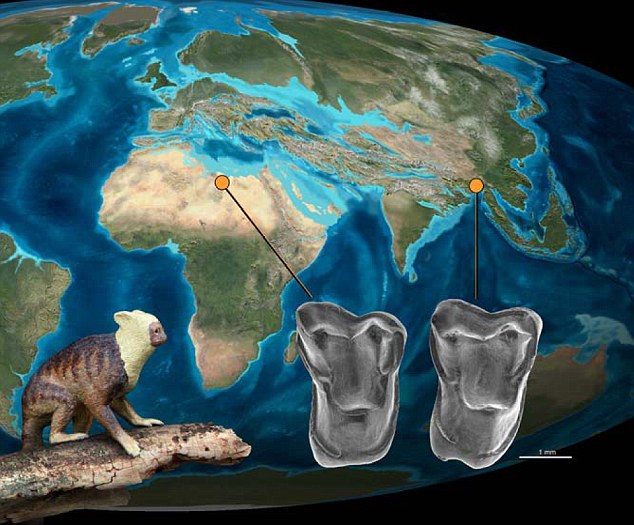
A team of palaeontologists in Myanmar has found the tooth of a pre-human ancestor - afrasia djijidae, so-called because it forms a missing link between Africa and Asia - that is very similar another early ancestor found in Libya

The 37-million-year-old tooth proves that early human ancestors lived in Asia, and only moved to Africa fairly late in the process of evolution - the latest in a series of discoveries that have 'sealed' Asia as the starting point for our species

The human family tree: A team of palaeontologists in Myanmar has found the tooth of a pre-human ancestor - afrasia djijidae, so-called because it forms a missing link between Africa and Asia. It is very similar another early ancestor found in Libya
‘Not only does Afrasia help seal the case that anthropoids first evolved in Asia, it also tells us when our anthropoid ancestors first made their way to Africa, where they continued to evolve into apes and humans,’ says Chris Beard, Carnegie Museum of Natural History palaontologist.
He worked with an international team that
included scientists from the University of Poitiers.
‘Afrasia is a game-changer because for the first time it signals when our distant ancestors initially colonized Africa. If this ancient migration had never taken place, we wouldn’t be here talking about it.’
Paleontologists have been divided over exactly
how and when early Asian anthropoids made their way from Asia to Africa.
The trip could not have been easy, because a more extensive version of the modern Mediterranean Sea called the Tethys Sea separated Africa from Eurasia at that time. While the discovery of Afrasia does not solve the exact route early anthropoids followed in reaching Africa, it does suggest that the colonization event occurred relatively recently, only shortly before the first anthropoid fossils are found in the African fossil record.

¿Not only does Afrasia help seal the case that anthropoids first evolved in Asia, it also tells us when our anthropoid ancestors first made their way to Africa, where they continued to evolve into apes and humans,¿ says Chris Beard, Carnegie Museum of Natural History palaontologist
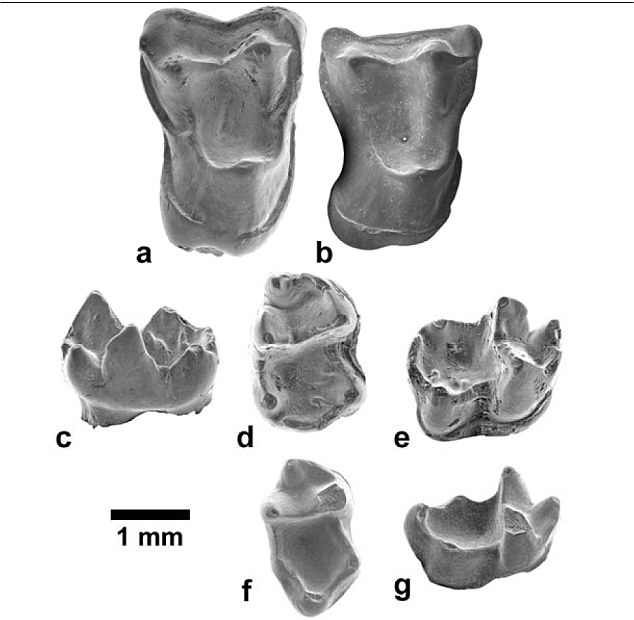
¿Not only does Afrasia help seal the case that anthropoids first evolved in Asia, it also tells us when our anthropoid ancestors first made their way to Africa, where they continued to evolve into apes and humans,¿ says Chris Beard, Carnegie Museum of Natural History palaontologist
Myanmar’s 37-million-year-old Afrasia is remarkable in that its teeth closely resemble those of Afrotarsius libycus, a North African primate dating to about the same time.
The four known teeth of Afrasia were recovered
after six years of sifting through tons of sediment near Nyaungpinle in central
Myanmar.
Details of tooth shape in the Asian Afrasia
and the North African Afrotarsius fossils indicate that these animals probably
ate insects.
The size of their teeth suggests that in life
these animals weighed around 3.5 ounces, roughly the size of a modern
tarsier.
‘For years we thought the African fossil
record was simply bad,’ says Professor Jean-Jacques Jaeger of the University of
Poitiers in France, the team leader and a Carnegie Museum research associate.
‘The fact that such similar anthropoids lived at the same time in Myanmar and
Libya suggests that the gap in early African anthropoid evolution is actually
real. Anthropoids didn’t arrive in Africa until right before we find their
fossils in Libya.’
The search for the origin of early
anthropoids—and, by extension, early human ancestors—is a focal point of modern
paleoanthropology.
The discovery of Afrasia shows that one
lineage of early anthropoids colonized Africa around 37–38 million years ago,
but the diversity of early anthropoids known from the Libyan site that produced
Afrotarsius libycus hints that the true picture was more complicated.
These other Libyan fossil anthropoids may be
the descendants of one or more additional Asian colonists, because they don’t
appear to be specially related to Afrasia and Afrotarsius. Fossil evidence of
evolutionary divergence—when a species divides to create new lineages—is
critical data for researchers in evolution.
The groundbreaking discovery of the
relationship between Asia’s Afrasia and North Africa’s Afrotarsius is an
important benchmark for pinpointing the date at which Asian anthropoids
colonized Africa.
 Amazing Grace made Cheryl sound like a squawking budgie: The...
 Why were the Queen and Prince Philip left to shiver in the...
 Prince Philip is 'getting better' and has watched every...
 'Thanks for making us all so proud to be British': Prince...
 An example to us all: Archbishop of Canterbury pays tribute...
 Man responsible for BBC coverage of Queen's Thames Pageant...
 Teen 'shot himself in head while internet chat room users...
 'Think of the children': Devastated Ben Goldsmith blasts...
 Lenny Henry accused of wrecking Rolf Harris's big moment...
 Finally! BBC replace disastrous presenting team with Huw...
 The BBC got the pageant so wrong because it holds those who...
 BBC blames the rain: Thames Pageant Producer behind 'inane'...





































.jpg)
.jpg)


























To Nigelsquare, 05/06/ - 13:16 -- Your post is just a re-statement of your old arguments. You say yet again -- "Scientific research has discovered no mechanism to turn non-living organic substances into self-reproducing life" - In my answer on 29th March I wrote -- [1] Regarding the origin of DNA and life itself--"British scientists recreate the molecules that gave birth to life itself" (DM 27/01). In this scientists from the University of York (UK) describe how they have created self-replication sugar molecules. This work was published in Organic & Biomolecular Chemistry. [2] On cell membranes see another Paper (published in the J. American Chem. Soc., Jan 2012) entitled "Chemists Synthesize Artificial Cell Membrane". [3] On early life-forms see--"Microfossils of sulphur-metabolizing cells in 3.4-billion-year-old rocks of Western Australia" by David Wacey et al (published in the J. Nature Geoscience on 21/08/2011).
- EB, Milton Keynes, 05/6/2012 17:02
Report abuse