 Burmese Medicinal Plants (in Burmese-Myanmar)
- by
 {lèý-ya seik-pyo:ré: kau-po-ré:rhing:} (LSR)
(Agricultural Corporation), 1978, 1980
indx-LSR
Burmese Medicinal Plants (in Burmese-Myanmar)
- by
{lèý-ya seik-pyo:ré: kau-po-ré:rhing:} (LSR)
(Agricultural Corporation), 1978, 1980
Set in HTML and by U Kyaw Tun (UKT), and staff of TIL
for staff and students of TIL. Not for sale.
Edited by UKT, to bring the presentation in line with TIL style. Some additions
have been made from other sources.
Translation of Burmese-Myanmar text to English by daughter of UKT:
Daw Nini Tun (DNT) (B.Sc. (Honours in Zoology, Rangoon Arts & Sc. Univ.), M.Sc.
(Biology, Brock Univ., Ontario, Canada)
UKT: Two versions of the same reference were available to me:
• Published in 1978, pp. 503
• Published in 1980, with coloured illustrations, pp. 503
You will find minor discrepancies in spellings of the plants: I have given spellings found in 1978 version.
index.htm |
Top
MP-Para-indx.htm
|
Caution -- Names
given by Myanmar authors, should be taken with caution. There are cases, where various Myanmar authors
gave different names primarily due to the lack of standardisation of
the Burmese-Myanmar spellings. Moreover, all Myanmar authors
are not very careful about their Myanmar spellings. Similarly the English common names given by them
should be taken only as guides because of the lack coordination amongst them.
To overcome this drawback in part, I should have given the Burmese-Myanmar spellings and their
transliterations based on official Myanmar dictionaries (issued by Myanmarsar Commission
or MLC) using Romabama. However, in these pages, I have used the
orthography as was given in the original ink-on-paper book published
by LSR in 1978 version. This version had a table of errata at the end,
probably, to toe the MLC line. My rationale for giving the older
spellings is because I will be including in MMPDB, Burmese-Myanmar
sources published long before the MLC policy change came into effect. |
Basic aksharas
Medials or conjuncts: The same descriptive format is used for each plant. Altogether 152 plants were listed. Flowering and Fruiting periods are given in Burmese-Myanmar Lunar Months |
References used by UKT
•
Though Botanical Names of Myanmar Plants
of Importance (Names of Plants in Burmese-Myanmar akshara)
was published in the year 2000, some 20 years later, I have made
references to it in these pages, primarily to show the variation in
Burmese-Myanmar names. I have referred to it as: Agri2000
• Myanmar-English Dictionary (MEDict) by MLC (Myanmar Language
Commission), which gives the MLC transcriptions (i.e. pronunciations).
For some plants, unless you write the transcription instead of the
transliteration, you end up with the wrong meaning. Though the
transcription gives you the wrong spelling, it is probably better to end
up with the right meaning. e.g. see entries that begin with {hsi:} which
are sometimes preferably written as {zi:}.
• A Checklist of the Trees,
Shrubs, Herbs, and Climbers of Myanmar (Chklist) --
by W. J. Kress, R. A. DeFillipps, Ellen Farr, and Daw Yin Yin Kyi, (Revised from
the original works by J.H. Lace, R. Rodgers, H.G. Hundley, and U Chit Ko Ko, on
the "List of Trees, Shrubs, Herbs and Principal Climbers, etc. Recorded from
Burma"), Department of Systematic Biology - Botany, National Museum of
Natural History, Washington, DC, 2003, pp 590.
Online:
http://persoon.si.edu/myanmar/index.cfm
UKT notes
Burmese-Myanmar | Medials or conjuncts |
Burmese-Myanmar terms |
Romabama -- the (almost) one-to-one transliteration of Burmese-Myanmar into Burmese-Latin:
In the following pages, you will see (for each entry) Burmese-Myanmar terms in
Romabama. Please learn a few words written in Romabama. Please remember that it
has been the life-long intention of U Kyaw Tun (UKT) to bring the literature in
Burmese-Myanmar to the world's attention. It is one of the reasons why he has
set out to invent Romabama: an intention he has always maintain since he was in
his early teens until now, at this late stage in life -- he is now 73. Please
learn these Romabama terms.
The following is from 1978 version:
In English:
01. The Standard Cyclopaedia of "Horticulture", Vol. 1-3, by L. H. Bailey
02. Flora of British India, Vol. 1-6, by Hooker, J. D.
03. Medicinal Plants of the Philippines, by Eduardo quisundings
04. Potter's new Cyclopaedia Botanical Drugs and Preparations, by R. C. Wren, F.L.S.
05. Glossary of Indian Medicinal Plants, by R. N. Chopra
06. Indian Materia Medica, K. M. Nadkarni, Vol. 1-2
07. Useful Plants of India and Pakistan, by J. F. Dastur
08. Medicinal Plants of India and Pakistan, by J. F. Dastur
09. The Wild Flowers of Kuwait and Bahrain, by Violet Dickson
10. Systematic Botany for Degree Students, by Jagjit Singh
11. The Science of Botany, by Paul B. Weisz and Meloins Fuller
12. The Eucalyptus: Botany, Chemistry, Cultivations and Utilization, by A. R. Penfold and J. L. Willis
13. EXOTICA 3. Pictorial Cyclopedia of exotic plant, by Alfred Byrd Graf
14. Flora of Malaysiana, Vol. 4, Part 1
15. Botanical Latin, by William T. Strearn
16. The Grasses of Burma, by D. Rhind
17. Tropical Planting and Gardening, H. F. Mamillan
18. A Hand Book of Forest Products of Burma, by Rogers
19. Lists of Trees, Shrubs, Herbs and Principal Climbers of Burma, by H. G.
Hundley and U Chit Ko Ko
In Burmese-Myanmar
01. 
02. 
03.
Burmese speech in Myanmar script
• Burmese is a non-rhotic language, and the "r" is rarely pronounced. When it occurs
as the first consonant in a Rombama syllable, pronounce it as an English "y".
• Similar to the French, the end consonant in a Romabama syllable is not pronounced.
• Romabama consonant-akshara r6c1
 {ya.} stands for regular akshara with the inherent vowel. The killed-consonant
 {ya.thut} is written as ý (Alt+0253).
• Romabama uses extended Latin alphabet, e.g.:
- à (Alt0224) for denoting
 {re:hkya. a·thut}
 ending in a killed non-nasal, as in {àt}

- • æ (Alt0230) in combination with Ñ (Alt0209) to denote {Ña.kri:thut}
Medials or conjuncts
There are 4 medial-classes, and their derivatives:
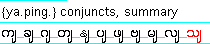
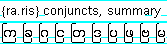

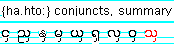
Burmese-Myanmar terms
Each plant is described in terms of the following sections:
01. {myo:ring:}
 - Family
02. {roak~hka. bé-da. a.mæÑ}
 - Botanical name
03. {a.hkau-a.wau}
 - Common names
04. {poan-thaN~Htàn}
 - Description (physical appearance)
{a.ping}
 -
Plant
-
Plant
{a.rwak}
 -
Leaf
-
Leaf
{a.pwing.}
 - Flower
{a.thi:}
 - Fruit
05. {pauk-rauk-thi. dé-tha}
 - Habitat: locality
06. {pauk-rauk-poän}
 - Habitat: natural or grown
07. {seik-pro:næÑ: sa.nis} - Method of cultivation
{myo:sé.} - Propagation from seed
{seik-pyo:hkring:} - Preparation of soil and time of planting
{pru.su.ga.ru.seik-hkring:} - Care
{rait-thaim:hkring:} - Harvesting
08. {a.thoän:pru.thæÑ. a.sait-a.peing:} - Part of plant used
09. {a-ni.thing} - Effect
10. {a.thoän:pru.poän} - Method used
{a.mris} - Root
{a.Ñwan.} - Shoot (young leaves)
Go back rbm-terms-b
Burmese-Myanmar Lunar months {la.}:
01. {tan-hku:} 29 days -- Mar-Apr (Burmese-Myanmar Solar New Year falls about
the middle of Apr)
02. {ka.hsoan} 30 days -- Apr-May
03. {na.yoan} 29 days -- May-Jun
04. {wa-hso} 30 days -- Jun-Jul (rainy season begins: beginning of Buddhist
Lent)
05. {wa-hkaung} 29 days -- Jul-Aug
06. {tau-tha.ling:} 30 days -- Aug-Sep
07. {thi-ting:kwat} 29 days -- Sep-Oct (rainy season ends: end of Buddhist Lent)
08. {tan-hsaung-moan:} 30 days -- Oct-Nov
09. {nut-tau} 29 days -- Nov-Dec (the month dedicated to Nat worship, the
equivalent of Halloween)
10. {pra-tho} 30 days -- Dec-Jan
11. {ta.po.twè:} 29 days -- Jan-Feb
12. {ta.paung:} 30 days -- Feb-Mar (Burmese-Myanmar do not celebrate the Lunar
New Year)
Because, the Lunar year is short, every three years or so, an extra
month is added, as the second {wa-hso}, to bring the calendar in line with the
Solar year.
It is the duty of the government (which can be traced back to eras
before the birth of Gottama Buddha) to appoint a body of astronomers (who also
dabble in astrology) to calculate the beginning of the Solar New Year (when the
Sun passes from the constellation of Pisces to the constellation of Aries, to
exact hour, minute, and second). These astronomers also check their calculations
with actual observations. Myanmar being an agricultural country with a huge
delta (Irrawaddy River delta), the lunar months are very important. All those
who live in the delta must know about the high tides and the low tides.
Go back Bur-Myan-Lunar-b
Descriptive format
UKT: It is felt that, the Burmese-Myanmar text originally given by LSR was in need of
more punctuation and more white spaces to separate the words. I have according
edited the text without changing the words, and you will still see the over-use
(by LSR) of the sentence ending fossilized-akshara
 {iÉ}. See Fossilized killed consonants in Romabama rules:
•
{é.} --> {i.}. (U Tun Tint, Myanmar Language Commission)
UKT: Fossil sentence-ending akshara{I.} and
{I}. It is to be noted that
{thæÑ} in modern writings.
1. {myo:ring:}
 --
--
2. {roak~hka.bé-da. a.mæÑ}
 --
--
3. {a.hkau-a.wau}

{mran-ma a.mæÑ} Myanmar --
{ïn~ga.laip a.mæÑ} English --
{ka.hkying a.mæÑ} Kachin --
{ka.ring a.mæÑ} Karan --
{hkying: a.mæÑ} Chin --
{mwan a.mæÑ} Mon --
{rham: a.mæÑ} Shan --
Agri2000
4. {poän-thaN~Htàn}

{a.ping}
{a.rwak}
{a.pwing.}
{a.thi:}
{a.sé.}
{a.mris}
5. {pauk-rauk-thæÑ. dé-tha.}
6. {pauk-rauk poän}
7. {a.thoan:pru.thæÑ. a.sait-a.peing:}
8. {a-ni.thing}
Go back des-format-b
End of TIL file