 • Sesamum indicum
• Padaliaceae
• Sesamum indicum
• Padaliaceae • {nwèý-hkyo}
 •
Glycyrrhiza glabra
• Fabaceae
•
Glycyrrhiza glabra
• Fabaceae • {nwèý-tha-ki}
 • Nerium indicum /
N. odorum • Apocynaceae
• Nerium indicum /
N. odorum • Apocynaceae compiled by U Kyaw Tun, U Pe Than, and staff of TIL. Not for sale.
Contents of this page:
Romabama entries in English-Latin alphabetical order.
• {nham:}
• Sesamum indicum
• Padaliaceae
• {nwèý-hkyo}
•
Glycyrrhiza glabra
• Fabaceae
• {nwèý-tha-ki}
• Nerium indicum /
N. odorum • Apocynaceae
Main Index of DB |
Top
Contents of this page

UKT: Popularly known and sometimes spelled as
{hsa.nwing:}
Burmese-Myanmar transcript names:
• Agri.Dept.2000 32-0840:
 {na.nwing:}
• FAO : NL
• Lè-seik-shin 227:
{na.nwing:}
• KS-TMN: NL
• Nagathein 2-101:
{na.nwing:} or
{hsa.nwing:}
• UHM 19: Hsa-nwin
Myanmar-Script Spelling
•
Official Myanmar Dictionaries :
{hsa.nwing:} -- see
{na.nwing:} --TravPo-M-Dict
099
{na.nwing:}
-
 --TravPo-M-Dict
159
--TravPo-M-Dict
159
{na.nwing:}
- n. tumeric. Curcuma longa - Myan-Engl-Dict 220
For more information, go to Curcuma longa
UKT: I gave the Burmese-Myanmar name {na.ling-kyau} in MMPDB-2005, in accordance with UHM, From the evidence I have at present, UHM seemed to be very mistaken in identifying {na.ling-kyau} as Cinnamomum zeylanicum .
syn. Cinnamomum bejolghota

UKT: There are not many Internet websites on C. obtusifolium. The following is scanty information from:
• Cinnamomum obtusifolium A Chev (Cinnamomum bejolghota (Buch-Hamex Neas) Sweet) -- www.apafri.org/fsiv/_private/main_el_files/Use%20Indigenoustree/025-Used-IT.htm
• Cinnamomum bejolghota (Buch.-Ham.) Sweet, Lauraceae. Engl.: wild cassia. Bot. syn.: Cinnamomum obtusifolium (Roxb.) Nees. -- http://www.henriettesherbal.com/php/get.php?id=14584
Ref. Burmese-Myanmar transcript names:
• Agri.Dept.2000 32-0851:
 {na.ling-kyau} • Agri.dept.2000 32-851
• FAO : NL
• Lè-seik-shin 231:
{na.ling-kyau}
• KS-TMN : NL
• Nagathein 3-462: NL as {na.ling-kyau}.
• UHM : NL
Myanmar-Script Spelling :
•
Official Myanmar Dictionaries
{na.ling-kyau}/
 {lu.ling-kyau}
-
 --
TravPo-M-Dict 160
--
TravPo-M-Dict 160
-
 --
TravPo-M-Dict 284
--
TravPo-M-Dict 284
-
{na.ling-kyau} - n. See {lu.ling-kyau} -- Myan-Engl-Dict 221
-
{lu.ling-kyau} - n. tree, the roots of which are ground into a paste and
used for relieving aches and pains, Cinnamonum obtusifolium -- Myan-Engl-Dict 426
For more information, go to Cinnamonum obtusifolium

Burmese-Myanmar transcript names:
• Agri.Dept.2000 33-0863:
 {nan°nan°
(mran-ma)}
{nan°nan°
(mran-ma)}
• FAO : NL
• Lè-seik-shin 243:
 {nan°nan°ping}
• KS-TMN :
• Nagathein 2-158:
 {nan°-nan°}
• UHM 17: Nan-nan
Myanmar-Script Spelling :
•
Official Myanmar Dictionaries :
{nan°nan°}
-
 --TravPo-M-Dict
165
--TravPo-M-Dict
165
{nan°nan°}
- n. coriander. Coriandrum sativum . -- Myan-Engl-Dict 230
The foliage is "cilantro" (a parsley-like garnish with a distinctive, fresh fragrance that is used in Mexican and Southeast Asian salads, soups, and meat dishes) and the dried seeds are "coriander". -- www.floridata.com/ref/C/cori_sat.cfm
For more information, go to Coriandrum sativum

Burmese-Myanmar transcript names:
• Agri.Dept.2000 33-0861:
 {né-lhèÑ.}
• FAO : NL
• Lè-seik-shin : NL
• KS-TMN 149: Ne-hle
• Nagathein 2-145:
{né-lhèÑ.}
• UHM 39: Ne-hle
Myanmar-Script Spelling
•
Official Myanmar Dictionaries :
{né-lhèÑ.}
{né-lhèÑ.} --
 -- TravPo-M-Dict
164
-- TravPo-M-Dict
164
{né-lhèÑ.} -- n. herbaceous plant related to the prairie trunip, Psoralea
corylifolia. -- Myan-Engl-Dict 227
UKT: Though the Burmese-Myanmar pronunciation of the second syllable is
{lhè.}, it is spelled with a killed
{Ña.}, and the correct spelling is
{lhèÑ.} meaning "to turn". The killed consonant
For more information, go to Psoralea corylifolia

Burmese-Myanmar transcript names:
• Agri.Dept.2000 34-0892:
{nham:}
• FAO : NL
• Lè-seik-shin : NL
• KS-TMN 182 : Hnan
• Nagathein 2-179:
{nham:}
• UHM : NL
Myanmar-Script Spelling
•
Official Myanmar Dictionaries:
{nham:}
{nham:}
-
 -- TravPo-M-Dict 177
{nham:}
- sesame, Sesamum indicum -- Myan-Engl-Dict 247
For more information, go to Sesamum indicum

Burmese-Myanmar transcript names:
• Agri.Dept.2000 33-0878:
{nwèý-hkyo}
• FAO : NL
• Lè-seik-shin : NL
• KS-TMN: NL
• Nagathein 2-166:
{nwèý-hkyo}
• UHM 27: Nwe-cho
Myanmar-Script Spelling
•
Official Myanmar Dictionaries :
{nwèý-hkyo}
--
 -- TravPo-M-Dict
173
-- TravPo-M-Dict
173
{nwèý-hkyo}
-- n. liquorice -- TravPo-M-Dict 241
UKT: Though the Burmese-Myanmar pronunciation of the first syllable is
{nwè}, it is spelled with a killed
{ya.}, and the correct spelling is
{nwèý} meaning a "creeper". However, we must note that, unlike the English-Latin semivowel <y>, the Burmese-Myanmar semivowel {ya.} acts more like a consonant than a vowel, and the killed {ya.} is not pronounced.
For more information, go to Glycyrrhiza glabra
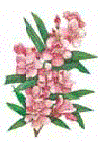
UKT: Since, Nerium indicum and N. odorum are synomyms
data on the two are presented in the same entry. See Chklist data given below.
Burmese-Myanmar transcript names:
• Agri.Dept.2000 34-0884:
Nerium oleander
{nwèý-tha-ki} or {nwèý-tha-ki}
• Chklist: Nwe-tha-gee, Tayok-hnin-si
• LSR 251:
{nwèý-tha-ki}
• FAO : NL
• KS-TMN 49: Nwe-tha-gee, Tayoke-hnin-si
• Nagathein 2-171:
{nwèý-tha-ki}
• UHM 34: Nwe-tha-gi
UKT: literary meaning of "Tayoke-hnin-si" is "Chinese rose."
Myanmar-Script Spelling
•
{nwèý-tha-ki} -
 --
MMDict173
--
MMDict173
•
{nwèý-tha-ki} /|nwe tha gi|/ - n. oleander, Nerium odorum -- MEDict 241
UKT: Though the Bur-Myan pronunciation of the first syllable is /
{nwè}/, it is spelled with a killed
{ya.} -- the correct spelling is
{nwèý} meaning a "creeper". We must note that, unlike the English-Latin semivowel <y>, the Bur-Myan semivowel
For more information, go to Nerium indicum
Entry format:
Burmese-Myanmar name / Botanical name / Family /
Ref. Burmese-Myanmar transcripts / Official Myanmar Dictionary /
Hindi / Sanskrit / English common name used in Myanmar / Picture / Plant
identification characters / Distribution in Myanmar / Part used and uses
/ Constituents /
End of TIL file