Update:
2006-08-09 01:01 PM -0700
TIL
Myanmar Medicinal Plant Database
Family: Rubiaceae
compiled by U Kyaw Tun, U Pe Than, and staff of TIL. Not for sale.
Contents of this page
Family: Rubiacea 7 entries
• Rubiaceae family - general characters
• Cinchona ledgeriana
• {kwi-neing}

• Gardenia coronaria
• {ring-hkat-ping}

• Ixora coccinea
• {poaN~Ða.raik}

• Mitragyna parvifolia
• {htaim-ping}

• Morinda angustifolia
• {rè:yo (tau:)}
 /
{ni-pa: hsé: ping}
/
{ni-pa: hsé: ping}

• Morinda citrifolia
• {rè:yo}

•
Randia dumetorum
• {hsé:than°-pu.ra}

• Morinda spp.
• Randia spp.
Main Index of DB |
Top
Contents of this page
From: Families yielding important phytopharmaceuticals in
Fundamentals of Pharmacognosy and Phytotherapy, by Michael Heinrich, J.
Barnes, S. Gibbons, and E. Williamson, October 2003, ISBN:0443071322, pp.320 --
www.fleshandbones.com/readingroom/pdf/747.pdf
The family yields one of the most important stimulants, coffee (Coffea
arabica L. and C. canephora Pierre ex Froehner) and one of the first
and most important medicinal plants brought over from the ‘New World’, cinchona
bark (see below).
Important medicinal plants from the family
• Cinchona succirubra Weddell, C. calisaya Weddell and
Cinchona spp. (cinchona, Peruvian bark), used as a bitter tonic, febrifuge
and against malaria.
Morphological characteristics of the family
This family consists mostly of trees or shrubs, with some lianas (climbing
plants) and herbs. It has simple, entire and generally decussate leaves, which
are nearly always opposed and which usually have connate stipules (sometimes as
large as the leaves themselves, e.g. Gallium).
The usually bisexual and epigynous, insect-pollinated flowers have
four to five petals and four to five sepals, and five (or four) stamens and two
gynaecia. The type of fruit varies (berry, drupe capsule).
Distribution
This is a large cosmopolitan family with more than 10,000 species,
particularly prominent in the tropical and warmer regions of the world.
Chemical characteristics of the family
The family is known for a large diversity of classes of natural products,
including iridoids (a group of monoterpenoids), alkaloids (including indole
alkaloids such as quinine from Cinchona spp.), methylxanthines such as
caffeine, theobromine and theophylline, and anthranoids in some taxa (e.g. the
now obsolete medicinal plant Rubia tinctorum, which was withdrawn because
of its genotoxic effect).
Contents of this page
Family: Rubiacea
Ref. Burmese-Myanmar
transcripts:
• Agri.Dept.2000 10-0238:
{kwi-neing}
• Chklist:
• LSR : NL
• FAO : NL
• KS-TMN : NL
• Nagathein 1-201:
{kwi-neing}
• UHM 14: Kwi-nine
Myanmar-Script Spelling
•
Official Myanmar Dictionaries :
{kwi-neing} -
 --
TravPo-M-Dict 035
--
TravPo-M-Dict 035
{kwi-neing} - n. quinine. -- Myan-Engl-Dict 046
Hindi:
Sanskrit:
Chklist data:
English common name used in Myanmar :
• Agri.Dept.2000 10-0238: Quinine
• FAO : NL
• Lè-seik-shin : NL
• KS-TMN : NL
• Nagathein 1-202: Quinine
• UHM 14: Cinchona Bark, Peruvian Bark, Red Cinchona
Picture:
• Leader from Nagathein 1-201
Plant identification characters :
• An evergreen tree attaining a height of 24 m and having a trunk
diameter of up to 0.6 m. at the base, leaves elliptical, elliptic-lanceolate,
petiolate and show lateral interpetiolar stipules, flowers pentamerous, tubular
and cymose, fruits septicidally dehiscent capsules -- UHM
Distribution in Myanmar :
• Old plantation area in Leikpok 12 miles from Tenasserim -- UHM
Part used and uses:
• Dried bark of the stem or of the root. Used as
bitter, tonic, anti-malarial and anti-pyretic, usually in the form of its
preparations of alkaloids. -- UHM
Constituents:
• 1. A number of alkaloids (about 6-7 %) -
Quinine, Quinidine, Cinchonine, Cinchonidine
2. Cinchotannic acid, quinic acid, cinchona red etc. (7)
The alkaloids occur in combination with organic acids. -- UHM
Contents of this page
Family : Rubiaceae
Ref. Burmese-Myanmar
transcripts :
• Agri.Dept.2000 51-1340:
 {ring-hkat-kri:}
• Chklist:
• LSR : NL
• FAO : NL
• KS-TMN 190: Yingat-gyi
• Nagathein 3-155:
{ring-hkat-kri:}
• UHM : NL
Myanmar-Script Spelling :
•
Official Myanmar Dictionaries :
{ring-hkat-kri:} --
 --
TravPo-M-Dict 273
--
TravPo-M-Dict 273
{ring-hkat-kri:}
-- NL in -- Myan-Engl-Dict
{ring-hkat ping} -- Myan-Ortho 226
Chklist data:
Hindi :
Sanskrit :


English common name used in Myanmar
• Agri.Dept.2000 51-1340: NG
• Chklist:
• LSR : NL
• FAO : NL
• KS-TMN 190: NG
• Nagathein 3-155: NG
• UHM : NL
Picture :
• Leader -- Nagathein
• Photos: left - habit with flowers; right -- habit with fruits.
Click on the pictures to enlarge. -- KS-TMN
Plant identification characters:
• A deciduous unarmed tree; branches stout, woody, younger stems notched at the
nodes, pubescent, buds resinous. Leaves opposite and decussate, simple; stipules
interpetiolar; subsessile; laminae abovate, sometimes elliptic-obovate, the
bases cuneate, the margins entire, the tips abruptly and shortly acuminate,
unicostate, reticulate, the surfaces glabrescent, glaucous. Inflorescences
usually axillary cymes, sometimes terminal, solitary or 2-to3-flowered,
frequently leaf-opposed or supra-axillary; bracts foliaceous. Flowers ebracteolate,
subsessile, bisexual, actinomorphic, pentamerous, epigynous, large
and showy, fragrant. Hypanthium tubiform, 5-or rarely 4-or 6-angled. Calyx
synsepalous, tubular, obscurely and irregularly 5-toothed, acutely 5-angled,
spathaceous, caducous. Corolla synpetalous, 5-lobed, rarely 4-or 6- lobed,
salverform, twisted in bud, the tubes long, cylindrical, the lobes obliquely
ovate, obtuse, about half the length of tube, pale to yellowish green.
Androecium polyandrous, stamens 5, rarely 4 or 6, alternate the corolla lobes,
epipetalous, attached at the mouth of corolla tube, subsessile, completely
inserted, the anthers dithecous, linear-oblongoid, dorsifixed,dehiscence
longitudinal. Pistil 1, ovary ellipsoid, 2-carpelled, syncarpous, 1-loculed
above, 2-loculed below, the ovules numerous on the parietal placentae, the style
long, thick, persistent, the stigma 2-lobed, clavate fusiform. Fruit a hard
drupe, ellipsoid, 5-ribbed, the style persistent forming a beak, orange to
reddish brown when ripe; seeds many, reniform, compressed, testa thin, endosperm horny.
Flowering period: January - April.
Fruiting period: February - August. -- KS-TMN
Distribution:
• Grows wild throughout Myanmar up to 4000ft. or cultivated. -- KS-TMN
Parts used and uses:
• Flower -- Pyrexia due to either biliary or chest infections or blood dyscrasia .
Fruit -- Cough; Mucolytic -- KS-TMN
Contents of this page
Family: Rubiaceae
Ref. Burmese-Myanmar transcripts:
• Agri.Dept.2000 38-0995:
 {poaN~Na.rait}
• Chklist:
• LSR : NL
• FAO : NL
• KS-TMN 193: Pone-na-yeik
• Nagathein : NL
• UHM : NL
Myanmar-Script Spelling :
•
Official Myanmar Dictionaries :
{poaN~Ða.raik} -
 -- TravPo-M-Dict- 192
{poaN~Ða.raik} - n. ixora, Ixora arborea. -- Myan-Engl-Dict 273
Chklist data:
Hindi :


Sanskrit :
English common name used in Myanmar :
• Agri.Dept.2000 38-995: Ixona; Hedge plant
• Chklist:
• LSR : NL
• FAO : NL
• KS-TMN 193: Jungle Geranium
• Nagathein : NL
• UHM : NL
Picture:
• Leader :
www.plantoftheweek.org/image/ixora.jpg
• Photos:
left - habit with flowers;
right - close up of fruits.
Click on the pictures to enlarge. -- KS-TMN
Plant identification characters :
• Shrubs, unarmed; younger stems cylindrical, glabrate. Leaves opposite and
decussate, simple; stipules interpetiolar, ovate-caudate, deciduous; petioles
obsolete; laminae obovate or elliptic-obovate, the bases cuneate, frequently
cordate, the margins entire, the tips acute, mucronate, unicostate, reticulate,
the surfaces glabrous. Inflorescences terminal, rarely axillary, cymes dichasial,
paniculate, the cymules 3-flowered, occasionally the ultimate cymules 2-or
5-flowered; bracts minute, triangular. Flowers bracteolate, sessile or with
short pedicels, bisexual; actinomorphic, tetramerous, epigynous. Hypanthium
cupuliform, glabrous. Calyx aposepalous, the sepals 4, ovate, reddish, glabrous.
Corolla synpetalous, 4-lobed, tubular-rotate, the lobes 4, ovate, glabrous.
Androecium polyandrous, stamens 4, exserted, the anthers dithecous, acicular,
apiculate, dorsifixed, introrse, dehiscence longitudinal. Pistil 1, ovary
2-carpelled, syncarpous, 2-loculed, the placentation axile, the ovule 1 in each
locule, the style filiform, the stigma 2-lobed, ellipsoid, exserted. Fruit a
berry, globose, with persistent calyx, dark or blackish red; seeds oblongoid,
plano-convex, endospermic. Flowering and
fruiting period: Throughout the year -- KS-TMN
Distribution:
• Grows wild or cultivated especially in Lower Myanmar -- KS-TMN
Parts used and uses:
• Leaf -- Dismenorrhoea;
Intestinal obstruction; Ascities; Laxative; Tooth-ache; Inflammation of gums;
Analgesics for painful gums due to oropharyngeal ulcers. -- KS-TMN
Constituents:
Contents of this page
Family: Rubiaceae
Ref. Burmese-Myanmar transcripts:
• Agri.Dept.2000 31-0802:
 {htaim}
• Chklist:
• LSR : NL
• FAO : NL
• KS-TMN 194: Htein, Hnaw-htein
• Nagathein 2-065:
 {htain-thé:}
• UHM : NL
Myanmar-Script Spelling :
•
Official Myanmar Dictionaries :
{htaim} -
 -
TravPo-M-Dict- 148
-
TravPo-M-Dict- 148
{htaim} -
n. large hardwood tree bearing winged fruit pods. Nauclea parviflora -
Myan-Engl-Dict 205
{htaim-ping} - Myan-ortho 119
Chklist data:
Hindi :


Sanskrit :
English common name used in Myanmar :
• Agri.Dept.2000 31-0802: NG
• Chklist:
• LSR : NL
• FAO : NL
• KS-TMN 194: NG
• Nagathein 2-065: NG
• UHM : NL
Picture :
• Leader - Nagathein
• Photos:
left - flowers and fruits;
right - tree.
Click on the pictures to enlarge. -- KS-TMN
Plant identification characters :
•A deciduous tree, shedding leaves in the hot season; stems quadrangular, the
younger ones puberulent, the older glabrous with lenticels. Leaves opposite,
decussate, simple, stipules interpetiolar, obovate, caducous; petioles short;
laminae oblong-obovate or suborbicular, variable in size and shape, the bases
rounded to obscurely truncate, the margins entire, the tips acute to acuminate,
unicostate, reticulate, the surfaces glabrous. Inflorescences terminal,
sometimes axillary, in globose heads, solitary or in cymes of usually 3 heads,
tomentose; bracts foliaceous, oblanceolate, deciduous. Flowers bracteolate,
sessile, bisexual, actinomorphic, pentamerous, epigynous. Calyx synsepalous,
tubular-truncate, glabrous, persistent. Corolla synpetalous, tubular, 5-lobed,
the lobes lorate, the outer surfaces glabrous, the inner pubescent, greenish
yellow. Androecium polyandrous, stamens 5, epipetalous to the throat of corolla
tube, the non-adherent filaments short, the anthers dithecous, narrowly ovoid,
basifixed, introrse, dehiscence longitudinal. Pistil 1, ovary ovoid,
2-carpelled, syncarpous, 2-loculed, the ovules numerous in each locule,
pendulous, attached to the semi-cylindrical placentas, the style filiform,
exserted, the stigma mitriform, disc absent. Fruits a capsule, with persistent
calyx, ovoid, sulcate, glabrous; seeds numerous linear-obovoid, minute, winged
all round, endosperm fleshy. Flowering period: October - November.
Fruiting period: December - January -- KS-TMN
Distribution in Myanmar :
• Grow wild throughout Myanmar. -- KS-TMN
Part used and uses :
• Bark and root --
Pyrexia; Gastro-intestinal colic; Muscular pain. -- KS-TMN
Constituents :
Contents of this page
Family: Rubiaceae
{rè:yo (tau:)} /
{ni-pa: hsé: ping}
UKT: Notice the small fruits and relatively large flowers in the
photo given
as M. angustifolia by
http://home.hiroshima-u.ac.jp/shoyaku/photo/Thai/020307Morinda.jpg .
The leaves in the photo do not resemble those of
{rè-yo}. The
{rè-yo} leaves can be cooked with fish -- one of my favorite Myanmar dishes.
The bitterness of the leaves brings out the flavour of the fish.
Since I know the plant so well I do not believe that M. angustifolia
as shown in the photo is the vegetable {rè-yo}, and Agri.Dept.2000, LSR,
and Nagathein are all wrong in identifying {rè-yo} as M. angustifolia .
See M. citrifolia .
Furthermore, according to the Internet sources such as
http://cmuj.chiangmai.ac.th/abs/2002/jan2002-5a.htm, which I have
downloaded and given below, a red dye is obtained from M. angustifolia.
See the downloaded Production of Red Pigment.
Therefore, I am referring to M. angustifolia as
{rè:yo (tau:)} /
{ni-pa: hsé: ping}. Though I have given the drawing (on the right) from
Nagathein as M. angustifolia (out my deep respect for Shin Nagathein), it
should actually accompany
M. citrifolia.
Ref. Burmese-Myanmar transcripts:
• Agri.Dept.2000 50-1338:
{rè-yo}
• Chklist: Nibase-gyi, Yeyo
• LSR 375:
{rè-yo}
• FAO : NL
• KS-TMN : NL
• Nagathein 3-096:
 {rè-yo-thi:}
• UHM : NL
UKT: Nagathein (3-096) mentions another species under a separate heading
{rè-yo (tau:)}.

He mentions
 {tau: rè:yo} (literal meaning: "jungle {rè:yo}") as the one known in traditional medicine as
 {ni-pa.hsé:}.
and
are the same: the word {tau:} meaning 'jungle' can be used either as an adjective,
in parentheses, or as a prefix.
Myanmar-Script Spelling :
•
Official Myanmar Dictionaries :
 {ni-pa:} -
 -
TravPo-M-Dict 163
-
TravPo-M-Dict 163
{ni-pa: hsé:} -
 -
TravPo-M-Dict 163
-
TravPo-M-Dict 163
 {ni-pa: thaim}-
 - TravPo-M-Dict 163
None of above listed in Myan-Engl-Dict .
{rè-yo} --
 -
TravPo-M-Dict 270
-
TravPo-M-Dict 270
{rè-yo} -- n. species of morinda, Morinda angustifolia.
- Myan-Engl-Dict 400
Chklist data:
• Morinda angustifolia Roxb. Habit: Small tree. Distribution:
Wide. Common Names: Latloot, Nibase-gyi, Nlung, Yeyo
Hindi :
Sanskrit :

English common name used in Myanmar :
• Agri.Dept.2000 50-1338: Morinda
• Chklist: NG
• LSR 375: Morinda
• FAO : NL
• KS-TMN : NL
• Nagathein 3-096: NG
• UHM : NL
Picture :
• Leader: Nagathein
• Photo:
http://home.hiroshima-u.ac.jp/shoyaku/photo/Thai/020307Morinda.jpg -- M. angustifolia
Plant identification characters :
Distribution in Myanmar :
Part used and uses :
Constituents :
Production of Red Pigment
from the Root of Morinda angustifolia Roxb. var.
scabridula Craib. by Root Cell Culture
-- Paitoon Aobchey1, Supawadee Sriyam1, Worawit
Praharnripoorab1, Sorasak Lhieochaiphant 2 and Suree
Phutrakul1*,
1Department of Chemistry, Faculty of Science,
Chiangmai University, 50200, Thailand
2
Department of Pharmacognosy, Faculty of Pharmacy, Chiangmai
University, 50200, Thailand
*Corresponding author. E-mail:
scchi007@chiangmai.ac.th
http://cmuj.chiangmai.ac.th/abs/2002/jan2002-5a.htm
-- downloaded by UKT:
ABSTRACT
Antraquinone is a group of natural red dye found in the root of Morinda
sp. which is available in the upper north of Thailand and has been widely used
on cotton dyeing. Recently, interest in natural dyes has increased and there
is a need to find suitable alternative sources of natural dyes. We have
studied one alternative to increase the production of anthraquinone dye by
root cell culture of Morinda angustifolia Roxb. var. scabridula
Craib. The major components of the red pigment extracted from the root of this
plant was purified and analyzed for the chemical structure and was found to be
an anthraquinone pigment morindone. Uncontaminated root cells were obtained by
growing the Morinda seed on Murashige and Skoog agar medium (MS).The
roots were cut into 2.5 mm. pieces and grown in fresh MS medium to get callus.
The callus fully proliferation on a modified Gamborg’s B5 medium
supplemented with 40 g/l succinic acid, 0.1 mg/l kinetin, 0.2 mg/l auxin and
20 g/l sucrose cultured in shake flask 100 rpm at 25°
C for 3 months gave root cells only 0.14 g dry weight whereas the callus
cultured on B5 agar at the same condition gave 1.22 g dry cells
within one month. The cultivated callus contained red and yellow pigments.
Extraction of the pigment from the cultured cells and separated by Thin Layer
Chromatography with the same solvent system as what had been used to separate
pigment in the plant’s root extract and gave two major components with Rf
values comparable to the red pigment extracted from Morinda plant’s
root. The production of anthraquinone dye from root cells cultured for 5
months was 1.4 times of the cells cultured for 3 months and could produce 0.6
times of the dye from the root of 2-3 years old plant.
Key words: Red pigment, Morinda sp. Extraction, Root cell
culture
CMU. Journal (2002) Vol. 1(1) : 66-78
Contents of this page
Family: Rubiaceae
Ref. Burmese-Myanmar transcripts:
• Agri.Dept.2000 : NL
• Chklist: Nibase, Nyagyi
- UKT re-transliteration:
 /
/
 (note1)
• LSR : NL
• FAO : NL
• KS-TMN 197: Nipa-se; Yeyo
- UKT re-transliteration:
/

• Nagathein : NL
• UHM : NL
Myanmar-Script Spelling :
•
Official Myanmar Dictionaries :
{ni-pa:} -
-
TravPo-M-Dict 163
{ni-pa: hsé:} -
-
TravPo-M-Dict 163
{ni-pa: thaim}-
-
TravPo-M-Dict 163
None of above listed in Myan-Engl-Dict .
{rè-yo} --
-
TravPo-M-Dict 270
{rè-yo} -- n. species of morinda, Morinda angustifolia.-
Myan-Engl-Dict 400
Chklist data:
• Morinda citrifolia L. Habit: Small tree. Distribution:
Cultivated. Common Names: Nibase, Nyagyi
Hindi:

Sanskrit :
English common name used in Myanmar:
• Agri.Dept.2000 : NL
• Chklist: NG
• FAO : NL
• LSR : NL
• KS-TMN 197: Indian Mulberry
• Nagathein : NL
• UHM : NL
UKT: Nagathein listed two species of Morinda :
1. M. angustifolia as
{rè:yo}-- Nagathein 3-097
2. M. tinctoria as
{ni-pa.hsé:} or
{tau:rè:yo} -- Nagathein 2-141
Picture:
• Leaders --
http://www5a.biglobe.ne.jp/~jansen/morinda%20citrifolia.jpg
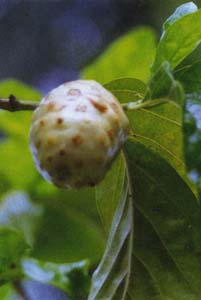
• Photos: left -- habit with flowers; right -- habit with fruits. Click on
the pictures to enlarge. -- KS-TMN
• Photos: Fruit and section --
http://www5a.biglobe.ne.jp/~jansen/morinda%20citrifolia.jpg


Plant identification characters:
•A small tree; trunk straight, the barks smooth, the younger stems obtusely
4-angled, glabrous. Leaves opposite, simples stipules large, obovate or oblong,
the tips rounded or acute; petioles short; lamiae broadly elliptic to obovate,
the bases acute to cuneate, the margins entire, undulate, the tips acute,
unicostate, reticulate, glabrous, green, the upper darker, glaucous.
Inflorescences in dichisal cymes, condensed and aggregated into heads, borne on
peduncles, the head ellipsoid, solitary, leaf opposed, at alternate node; bracts
foliaceous. Flowers ebracteolate, pedicellate, bisexual, actinomorphic,
pentamerous, epifynous. Calyx synsepalous, the tube or hypanthium urceolate,
adnate to the ovary, basaly adnate to the other tubes. Corolla synpetalous,
5-lobed, infundibuligorm, the lobes lanceolate, acute, glabrous, the throat
pubescent, white. Androecium polyandrous, stamens 5, epipetalous, the filaments
short, hairy, the anthers dithecous, oblongoid, introrse, dehiscence
longitudinal. Pistil 1, 2-carpelled, syncarpous, 2-loculed, the placentation
axile-basal, the ovule solitary in each locule, the style 1, slender with 2
linear stigmatic branches. Fruit of many berries aggregated into a fleshy head,
irregularly shaped, glaucous, pale green, whitish when ripe; seeds ovoid, testa
membranous, endosperm fleshy. Flowering and fruiting periods: Throughout the year.
-- KS-TMN
Distribution:
• Commonly grows wild especially on banks of streams and rivers or planted. -- KS-TMN
Parts used and uses:
• Diarrhoea; Amoebic dysentery; Regulates menstrual cycle: Antipyretic; Gains weight.
Root-- Purgative.
Leaf -- Arthritis; Infantile amoebic dysentery; Heals carbuncles; Neuritis; Pyrexia.
Fruit young -- For the integrity of teeth and gums.
Fruit Dried -- Analgesic for gum inflammation.
Fruit -- Bleeding in sores. -- KS-TMN
Constituents:
Contents of this page
alternate spelling: Randia dumentorum
Family: Rubiaceae
Burmese-Myanmar transcript names:
• Agri.Dept.2000 21-0535:
{hsé:than°pu.ra}
• FAO : NL
• Lè-seik-shin : NL
• KS-TMN: NL
• Nagathein 1-474:
{hsé:than°pu.ra},
also known as
 {tha.min-sa-hpru-thi:} -- Nagathein 3-380
• UHM 41: Se-than-baya
Myanmar-Script Spelling :
•
Official Myanmar Dictionaries :
{hsé:than°pu.ra}, and
{tha.min-sa-hpru-thi:} are not listed in TravPo-M-Dict
Hindi :
• {mingn hpèl} -- Nagathein 1-474:
{hsé:than°pu.ra}
(UKT: Compare {mingn hpèl} with Bengali and Hindi names- Mainphal,
Karhar
in Medicinal herbs of Chhattisgarth,
India )
Sanskrit :

English common name used in Myanmar :
• Agri.Dept.2000 21-0535: Bushy garderia
• FAO : NL
• Lè-seik-shin : NL
• KS-TMN: NL
• Nagathein 1-474: NG
• UHM 41: NG
Picture:
• Leader:
{tha.min-sa-hpru-thi:} -- Nagathein 3-380
• Photo: Catunaregam spinosa --
www.shop.sunshine-seeds.de
Plant identification characters :
• A small tree or rigid shrub, spines often long and strong, horizontal,
leaves 1-2 in., glabrous or harshly or softly pubescent on one or both surfaces,
obtuse or subacute, narrowed into the short petiole, flowers 2-3 on a peduncle,
subsessile, greenish yellow or white, berry olobose or ovoid 3/4 - 1 1/4 in. long,
glabrous or pubescent, smooth or obscurely ribbed, yellow pericarp thick. -- UHM
• The small tree Randia dumetorum now known as Catunaregam spinosa,
flowers after the first rains like many other plants do. The plant is covered
with white flowers turning yellow over a few days and it possibly attracts the
maximum number of butterflies and daytime moth like the Clearwing hawk moth.
The whole plant looks colourful with butterflies of different hues feeding
on the flowers. When the pods develop, they are green turning to brown.
The seeds have some medicinal properties and have also been used as fish poison. --
www.blackbuck.org/blackbuck/vol_12/article2.htm
Distribution of Myanmar:
• Pegu, Martaban, Myitkyina. -- UHM
Part used and uses:
• Fruits - Used as Emetic, fish poison, dysentery, anthelmintic, abortifacient, fevers. -- UHM
Uses elsewhere:
• Randia dumetorum, Lam. India: fruit
eaten. Vernacular name: Bombay Presidency, Surat district: Gengua. Ref.
GAMMIE. -- Famine Foods
Constituents :
• 1. Neutral and acid saponin (active constituent). 2. Acid resin. (36) -- UHM
• Oleanolic acid 3-/3-Glucoside (RDG-1) was isolated from the
seeds of the plant Randia dumetornm (Rubiaceae). The
compound showed significant anti-inflammatory activity in the exudative and
proliferative phases of inflammation in the doses of 25 and 100 mg/kg orally.
Significant analgesia was observed only on thermal stimulus. It did not show any
antipyretic activity against Brewer’s yeast induced pyrexia in rats. The
approximate oral LD,o were found to be 3600 mg/kg and 1500 mg/kg in mice and
rats respectively. --
www.chiroonline.net/_fileCabinet/oleanolic.pdf
Medicinal herbs of Chhattisgarh, India, having less known traditional uses. XVIII.
Mainphal (Randia dumetorum, family Rubiaceae)
--
www.botanical.com/site/column_poudhia/173_mainphal.html
-- by Research Note - Pankaj Oudhia © 2001,2002,2003 Pankaj Oudhia - All Rights Reserved
Maniphal is a shrub or small tree found in monsoon and dry
forests, in general. Its English name is Emetic nut. The leading
pharmaceutical companies sell Mainphal based combination in name of
Pancha Kashaya, used for causing emesis. In Chhattisgarh, very few
traditional healers are aware of its medicinal properties and uses. In
tribal belt of Chhattisgarh, it is used as fish poison. Through my
ethnobotanical surveys conducted in different parts of Chhattisgarh, I
got information that the traditional medicinal knowledge about this herb
is limited to very few healers. As these information are not available
in documentation form, in present article, I am describing these uses.
At first, I am giving information on its botany and reported medicinal
uses. According to reference literatures, Mainphal (Randia dumetorum
syn. Gardenia spinosa, syn. Xeromphis spinosa syn. Randia spinosa syn.
Gardenia dumetorum) is armed shrub or small tree, spines axillary.
Leaves mostly fascicled on branchlets, obovate or oblanceolate, sub
coriaceous, glabrescent or pubescent, stipules ovate. Flowers solitary
or 2-3 fascicles, creamy white, fragrant. Calyx campanulate, Corolla
covered with appressed silky hairs. Fruits globose, fleshy. Flowering
time May-June and fruiting October-January. As medicine, bark and fruit
are used commonly. According to Ayurveda, Mainphal is bitter, sweet,
heating, aphrodisiac, emetic, antipyretic, carminative, alexiteric and
cures abscesses, ulcers, inflammations, tumours, skin-diseases, piles
etc. According to Unani system of medicine, Mainphal is bitter in taste,
emetic, purgative, carminative and useful in chronic bronchitis,
muscular pains, paralysis, inflammations, leprosy, boils, eruptions etc.
Common names of Mainphal in India:
(Languages - Region Names)
1. Assamese - Gurol, Behmona, Mona. 2. Bengali and Hindi -
Mainphal, Karhar
3. Gujarati - Mindhal, Mindhola, Midhola. 4. Kanarese - Kare, Banegora, Mangari, Minkare
5. Khasia - Diengmakasing-Khlaw. 6. Kashmir - Kirkla, Kokoa
7. Malyalam - Kara. 8. Marathi - Ghela, Peralu, Mindhal, Wagatta, Gelphal
9. Oriya - Palova. 10. Sanskrit - Madana, Pinditak, Dharaphal
11. Tamil - Marukkalankay, Madkarai. 12. Telugu - Manga
13. English - Emetic nut
To induce vomiting, in order to clean the stomach, the traditional healers of
Chhattisgarh use the fruit rind of Mainphal. The rind is collected and
dipped in water overnight. Next morning, the leachate is given
internally to induce vomiting. After few seconds of intake, the vomiting
starts. The natives are also aware of this use but they use it under
supervision of the traditional healers. To flush out the intestinal
worms, Mainphal is powered and given with Shahad (honey). The
traditional healers of Chhattisgarh, use the fruit juice externally in
hair care. According to them, its regular use makes the hair free from
dandruff and lice. The traditional healers of Kondagaon region recommend
it in treatment of breast related diseases. It is used externally. The
fruits of Mainphal are edible. The natives of Chhattisgarh use this
fruit with sugar, before sunrise, internally in treatment of Adhasisi
(Migraine). In case of stomach ache as first aid remedy, the aqueous
paste of bark is applied around the umbilicus. The traditional healer of
Mudpar village use the dry fruit powder in treatment of liver related
diseases. He prefers fresh fruit and in case of non-availability dry
fruits are used. To treat gastric troubles, the healers of Rajnandgaon
region, recommend dry fruit powder with fresh milk internally. The most
of the above mentioned uses are of academic importance as other
promising and effective alternatives are available, the traditional
healers use above mentioned formulation less frequently. Mainphal is
present in Chhattisgarh in abundance. This is really surprising that the
natives and traditional healers are having very less traditional
knowledge about this herb. Mainphal is not in the list of non-wood
forest produces having regular demand. I am trying my best to gather
more information of its medicinal uses through the ethnobotanical
surveys.
Contents of this page
Family: Rubiaceae
Results of search for 'Morinda' in the Checklist of Plants of
Myanmar, U.S. National Herbarium, 7 Jun 2006.
• Morinda angustifolia Roxb. Habit: Small tree. Distribution:
Wide. Common Names: Latloot, Nibase-gyi, Nlung, Yeyo
• Morinda citrifolia L. Habit: Small tree. Distribution:
Cultivated. Common Names: Nibase, Nyagyi
• Morinda elliptica Ridl. Habit: Small tree. Distribution: Shan,
Taninthayi. Common Names: Mai-yaw
• Morinda exserta Roxb. Habit: Small tree. Distribution: Mandalay.
Common Names: Nyaw
• Morinda persicaefolia Buch.-Ham. Habit: Shrub. Distribution: Wide.
Common Names: Nibase-gale
• Morinda tetrandra Roxb. Habit: Shrub. Distribution: Mon, Taninthayi
• Morinda tinctoria Roxb. Habit: Small tree. Distribution: Mandalay, Mon.
Common Names: Nibase, Niyo
• Morinda umbellata L. Habit: Shrub. Distribution: Mon, Taninthayi
• Morinda wallichii Kurz. Habit: Shrub. Distribution: Reported from Myanmar
UKT:
Note 1: Transcription of Burmese into English-Latin
sometimes makes a Burmese word unintelligible to even to an English speaking
ethnic Burmese. That is the main reason why I am using transliteration of
Burmese-Myanmar to English-Latin. Moreover the ordinary ethnic Burmese often
"mispronounce" their words, and though Myanmar script is a phonetic script, the
locals pay very little attention to it. Their adage being {hpat-tau. a.than/
ré:tau. a.mhan } -- translated: "what is written is correct, how it is
pronounced is just sound"). IPA might be an improvement on Myanmar script, but
in face of the usual "mispronunciations", transcription in IPA might even
compound the problem.
Keeping the above in mind, I can say that
{ni-ba.hsé:}/
{ni-pa.hsé:}/
 {ni-pa:hsé:} are the same.
However, it is to be noted that my transliterations given above are
based on the Burmese pronunciation of
{ni-pa:}. According to
Official Myanmar Dictionaries, the syllable
{ni-pa:} is pronounced
 {ni-ba:} in
{ni-pa:} and {ni-pæ} in
{ni-pa: hsé:} and in
{ni-pa: thaim}. (If you want to know about the use of {a.} and {æ} to
represent the inherent vowel of the akshara, please go to
Neutral vowels in
Myanmar Script.)
{ni-ba:} in
{ni-pa:} and {ni-pæ} in
{ni-pa: hsé:} and in
{ni-pa: thaim}. (If you want to know about the use of {a.} and {æ} to
represent the inherent vowel of the akshara, please go to
Neutral vowels in
Myanmar Script.)
It is also to be noted that the Burmese suffix referring to
<child>, <small>, <junior>, <stunted> etc. is
 {ka.lé:} or
 {thaim}, and therefore
{ni-pa: thaim} and
{thaim}, and therefore
{ni-pa: thaim} and
 {ni-pa.hsé: ka.lé:} are the same.
•
Official Myanmar Dictionaries :
{ni-pa:} -
- TravPo-M-Dict 163
{ni-pa: hsé:} -
- TravPo-M-Dict 163
{ni-pa: thaim}-
- TravPo-M-Dict 163
None of above listed in Myan-Engl-Dict .
USDA-NRCS
"MORIN","Morinda L.","morinda","Rubiaceae"
"MOCI3","Morinda citrifolia L.","Indian mulberry","Rubiaceae"
"MOTR","Morinda trimera Hbd.","noni kuahiwi","Rubiaceae"
"MOSA2","Morinda sandwicensis O. Deg.",">>Morinda trimera","Rubiaceae"
"MOUM","Morinda umbellata L.","redgal","Rubiaceae"
"MORO2","Morinda royoc hort.",">>Morinda umbellata","Rubiaceae"
Contents of this page
Family: Rubiaceae
Results of search for 'Randia' in the Checklist of Plants of
Myanmar, U.S. National Herbarium, 7 Jun 2006.
• Aidia parvifolia (King & Gamble) Wong. Cited as:
Randia densiflora var. parvifolia King & Gamble. Habit: Small
tree. Distribution: Reported from Myanmar
• Oxyceros longiflora (Lam.) T. Yamaz. Cited as: Randia longiflora
Lam. Habit: Shrub. Distribution: Yangon. Common Names: Kywe-gyo
• Randia angustissima Wall. Habit: Small tree Distribution: Chin.
• Randia densiflora Benth. Habit: Tree. Distribution: Yangon
• Randia dumetorum Lam. Habit: Shrub. Distribution: Kachin,
Mandalay, Yangon. Common Names: Kaw, Magyi-bauk, Nam-nu, Nbalawi, Se-kyetsu,
Se-thanbaya, Sutayet, Thamin-sa
• Randia exaltata Griff. Habit: Tree. Distribution: Taninthayi
• Randia fasciculata DC. Habit: Shrub. Distribution: Taninthayi
• Randia griffithii Hook. f. Habit: Small tree. Distribution: Sagaing
• Randia hygrophyla Hook. f. Habit: Shrub. Distribution: Bago
• Randia klossii Ridl. Habit: Small tree. Distribution: Taninthayi
• Randia schoemannii (Teijsm. & Binn.) Bakh. f. Habit: Shrub.
Distribution: Reported from Myanmar
• Randia siamensis Craib. Habit: Shrub. Distribution: Taninthayi
• Randia tomentosa Blume. Habit: Shrub. Distribution: Bago, Kayin, Mon,
Shan. Common Names: Magyi-bauk
• Randia uliginosa DC. Habit: Small tree. Distribution: Ayeyarwady,
Bago, Yangon. Common Names: Hman-phyu
• Randia uranthera Fischer. Habit: Tree. Distribution: Shan, Taninthayi
• Randia urathera Fischer. Habit: Small tree. Distribution: Shan, Taninthayi
• Tarennoidea wallichii (Hook. f.) D. Tirvengadum & Sastre. Cited as:
Randia wallichii Hook. f. Habit: Small tree. Distribution: Chin,
Taninthayi. Common Names: Katmya
USDA-NRCS
"RACL","Randia clusiifolia (Jacq.) Chapman",">>Casasia
clusiifolia","Rubiaceae"
"RANDI","Randia L.","indigoberry","Rubiaceae"
"RAAC","Randia aculeata L.","white indigoberry","Rubiaceae"
"RAACM2","Randia aculeata L. var. mitis (L.) Griseb.",">>Randia
aculeata","Rubiaceae"
"RAMI4","Randia mitis L.",">>Randia aculeata","Rubiaceae"
"RAFO2","Randia formosa (Jacq.) K. Schum.","jasmin de rosa","Rubiaceae"
"MUFO2","Mussaenda formosa Jacq.",">>Randia formosa","Rubiaceae"
"RAPA4","Randia parvifolia Lam.","smallflower indigoberry","Rubiaceae"
"RAPO2","Randia portoricensis (Urban) Britt. & Standl.","Puerto Rico
indigoberry","Rubiaceae"
"RARH2","Randia rhagocarpa Standl.","crucillo","Rubiaceae"
Contents of this page
Entry format: Botanical name / Family / Ref. Burmese-Myanmar
transcripts (• Agri.Dept.2000 :
• Chklist: • LSR : • FAO : • KS-TMN:
• Nagathein :
• UHM :/ Myanmar-Script Spelling (•
Official Myanmar Dictionaries : - TravPo-M-Dict - Myan-Engl-Dict - Myan-Ortho
/ Chklist data / Hindi /
Sanskrit / English common name used in Myanmar / Picture /
Plant identification characters / Distribution in Myanmar / Part
used and uses / Constituents /
End of TIL file


