• Piperaceae family - general characters
• Piper betle • {kwam:rwak ping}

• Piper nigrum • {nga.roat-kaung:}

• Piper spp.
compiled by U Kyaw Tun, U Pe Than, and staff of TIL. Not for sale.
Family: Piperaceae 2
entries
• Piperaceae family - general characters
•
Piper betle
• {kwam:rwak ping}
•
Piper nigrum
• {nga.roat-kaung:}
• Piper spp.
Main Index of DB | Top
Contents of this page
From: Families yielding important phytopharmaceuticals in Fundamentals of Pharmacognosy and Phytotherapy, by Michael Heinrich, J. Barnes, S. Gibbons, and E. Williamson, October 2003, ISBN:0443071322, pp.320 -- www.fleshandbones.com/readingroom/pdf/747.pdf
Important medicinal plants from the family
• Piper methysticum Forster f. (kava-kava), traditionally used as
a mild stimulant in Oceania and now used for conditions of nervous anxiety;
recent reports of liver toxicity has resulted in withdrawal in many countries.
 • Piper nigrum L. (black and white pepper), occasionally used in
rubefacient preparations and as a spice.
• Piper nigrum L. (black and white pepper), occasionally used in
rubefacient preparations and as a spice.
Morphological characteristics of the family
(Fig. 4.13)
This family of shrubs and herbs or small trees generally has simple, spirally
arranged, leaves. The flowers are drastically reduced and sit in dense fleshy
spikes.
Distribution
The family, with about 2000 species, is restricted to the tropics. The most
important genera are Piper (including black pepper and kava-kava) and
Peperomia. Some species are epiphytic (grow on other plants).
Chemical characteristics of the family
Pungent acidic amides, such as piperine, are known from several members of
this family, and sometimes essential oil is present. The α-pyrone derivatives
(e.g. kavain) from Piper methysticum are another group of commonly found
compounds known from species of Piper.

Burmese-Myanmar transcript names:
• Agri.Dept.2000 10-0240:
 {kwam:}
• Chklist: Kun, Kun-ywet-pin
• LSR 101 :
{kwam:}
• FAO : NL
• KS-TMN : NL
• Nagathein 1-211:
 {kwam: ping}
• UHM 37: Kun
Myanmar-Script Spelling
Official Myanmar Dictionaries :
{kwam:} -
 -- TravPo-M-Dict 037
{kwam:} - n. 1 betel vine. Piper betle . 2 betel
leaf. Also
 - Myan-Engl-Dict
048
- Myan-Engl-Dict
048
-
Myan-Ortho
UKT: There are two entirely different plants with the Burmese common name
•
•{kwan: thi: pin} -- Betel nut palm,
Areca catechu L.
If we were to use just the word
Chklist data :
• Piper betle L. Habit: Climber/Creeper. Distribution:
Cultivated. Common Names: Betel vine, Kun, Kun-ywet-pin
Hindi : Pan. (UKT: Devanagari script not available)
Sanskrit:
English common name used in Myanmar :
• Agri.Dept.2000 10-0240: Betel vine
• Chklist: Betel vine
• LSR 101 : Betle vine (spelling mistake by LSR)
• FAO : NL
• KS-TMN : NL
• Nagathein 1-211: Betel vine
• UHM 37: Betel vine
Picture:
• Leader from
http://basementshaman.com/pipbetbet.html
Plant identification characters :
• A stout glabrous climber, stem terete, sparingly rooting, much thickened at the nodes, leaves coriaceous, 10-18 by 5-12.5 cm., broadly ovate, acuminate, glabrous, 5-9 nerved base rounded, male spikes 3-6 in. female long peduncled, fruiting stout 1-5 in. pendulous. -- UHM
• A slender, aromatic creeper, rooting at the nodes; branches swollen at the nodes. Leaves alternate, entire, cordate, smooth, shining, long stalked; apex prominently pointed; ribs 5 - 7, arising opposite the leaves; male spike 3 - 6 in. long, very thin; female spikes 5 in. long, 1/2 in. thick; flowers minute, dioecious. Berries small, globose, 1-seeded. -- Dastur
Distribution in Myanmar:
• Twanté, Shansu, Nyaungthaga, Konwetchaung. -- UHM
Distribution elsewhere
• Indigenous in moist evergreen forests of North-Eastern and Southern India -- Dastur
Part used and uses:
• Fresh and dried leaves. The essential oil present gives rise to a sensation of warmth and well-being in the mouth and stomach. It also produces a primary stimulation of the central nervous system followed by a part in starch digestion. -- UHM
• The leaves are aromatic, carminative, anti-septic, astringent, aphrodisiac, mildly stimulant, expectorant, exhilarant and sialogogue; their juice with honey is given to children in colic, indigestion, diarrhoea, fever and laryngitis in one drachm doses twice a day; in hysteria the juice is given with milk; as a pectoral the juice is given with the juice of fresh ginger; a liquid extract of the leaves, in doses of 10 to 30 minims, is administered to children in catarrhal inflammation of the throat, larynx and bronchi, cough, difficult respiration and indigestion; the leaves are chewed to sweeten the breath, to remove foul odor from the mouth and to improve the voice. The leaves are chewed at frequent intervals by patients suffering from hookworms; immature worms are thrown out with the frequent expectoration leaf juice is used as eye drops in ophthalmia, and other painful eye diseases and night blindness. Oil coated hot leaves are applied in layers as a rubefacient over the chest, especially of a child, in labored breathing, cough, pulmonary affections and bronchitis; over the liver when it is congested; over the abdomen in colic and flatulence; and over mammary glands to resolve glandular swellings and to suppress the secretion of milk in case of mammary abscesses; they are also locally used in orchitis and ovaritis; they are a useful dressing for blistered surfaces and ulcers; they are an excellent substitute for oiled skin and gutta-percha tissue; they are used as a pessary in constipation or tympanites of children. Betel oil, the essential oil extracted from the leaves, is given in catarrhal and pulmonary diseaes; one drop of the oil is given in 100 grams of water; this mixture is an antiseptic gargle in diphtheria; the oil, in dose of 30 to 90 minims, is a weak anthelmintic for hookworms. -- Dastur
• One such medicinal plant studied was Piper betle L. Results showed that among the 300 plant species screened, P. betle maintained a broad spectrum antibacterial activity against all the test pathogens, such as Ralstonia, Xanthomonas, and Erwinia. It was also revealed that the P. betle solvent extract had more superior action than streptomycin. Through this study, a protocol for the fractionation of the plant material was established. The study also revealed that the active compound in P. betle is hydroxychavicol. Its mode of action is similar to phenols, which are also anti-microbial agents. -- Philippine Council for Agriculture, Forestry and Natural Resources, Research and Development http://www.fftc.agnet.org/library/article/rh2003004a.html#0
• Piper betle L. (Piperaceae) leaves which are traditionally used in India and China in the prevention of oral malodor was examined by bioassay-guided fractionation to yield allylpyrocatechol (APC) as the major active principle which showed promising activity against obligate oral anaerobes responsible for halitosis. The biological studies with APC indicated that the potential to reduce methylmercaptan and hydrogen sulfide was mainly due to the anti-microbial activity as established using dynamic in vitro models. -- http://bad-breath.hairmillion.com/bad-breath-halitosis-abs/bad-breath-halitosis-research-abs.25.html
Constituents:
• 1. Essential oil up to 4.2 percent, has a strong aromatic odour and sharp burning taste. ;2. Starch, sugars, tannin and diastases (4) -- UHM
• 1. 0.2-1% volatile oil; 2. chavibetol; 3. chavicol; 4. cadinene; 5. allylpyrocatechol -- Merck Index, 13th ed., 2001, p.201

Burmese-Myanmar transcript names:
• Agri.Dept.2000 15-0381:
{nga.roat-kaung:}
• Chklist: Nga-yok-kaung, Sayo-me
• FAO : NL
• LSR 133:
{nga.roat-kaung:}
• KS-TMN: NL
• Nagathein 1-347:
{nga.roat-kaung:}
• UHM 37: Nga-yok-kaung
Myanmar-Script Spelling
Official Myanmar Dictionaries :
{nga.roat-kaung:} -
 -- TravPo-M-Dict 069
{nga.roat-kaung:}
-n. pepper (black or white), Piper nigrum -- Myan-Engl-Dict 091
Chklist data:
• Piper nigrum L. Habit: Climber/Creeper. Distribution:
Cultivated. Common Names: Black pepper, Bumawng-ru, Nga-yok-kaung, Sayo-me,
U-pinlong
Hindi:

Sanskrit:
English common name used in Myanmar:
• Agri.Dept.2000 15-0381: Black pepper
• Chklist: Black pepper
• FAO : NL
• LSR 133: Black pepper
• KS-TMN: NL
• Nagathein 1-347: Black pepper
• UHM 37: Black Pepper, Pepper corn
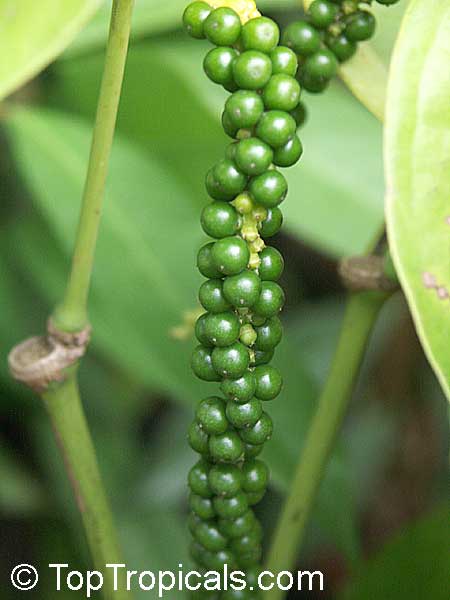
Picture:
• Leader from Nagathein 1-348:
• Unripe fruit:
http://toptropicals.com/pics/garden/05/7/7495.jpg
Plant identification characters :
• A perennial climbing or trailing woody vine . Leaves coriaceous, grayish green, petiolate, broadly ovate to suborbicular with 3 prominent middle nerves, flowers whitish perfect, elongated spikes, fruit a globular red drupe (when ripe). -- UHM
• A stout, glabrous creeper, much swollen at the nodes. Leaves broadly ovate, 4 - 9 in. long, 4 1/2 in. broad, leathery, 5 - 9 ribed, paler beneath. Flowers unisexual and bisexual, in slender, drooping spikes; berries in racemes, rather fleshy, one-sided. -- Dastur
Distribution in Myanmar:
• Hot damp parts of Burma. -- UHM
Distribution elsewhere
• Western Ghats and evergreen forests of Kerala. -- Dastur
Part used and uses :
• Dried unripe fruit. Used as Aromatic, stomachic, carminative. -- UHM
• The unripe dried berries are the black pepper or kali mirich of
commerce; and the ripe fruit with the outer covering removed is the white pepper
of commerce. The berries contain the alkaloid piperine.
Black pepper is aromatic, stimulant, carminative, digestive, stomachic, nervine
tonic, deobstruent, resolvent, cholagogal, diuretic, emmenagogue and
antiperiodic; it is given in dyspepsia, flatulence, debility, prolapse of the
anus, diarrhoea, cholera, piles, disorders of the urinary system, cough,
vertigo, coma, gonorrhoea and malarial fever; as an alterative it is useful in
paralytic and arthritic diseases and vertigo; it is given with quinine when the
system will not respond to quinine alone; it is a substiute for cubebs in
gonorrhoea; black pepper is given either as an infusion or powder or confection;
as an antidote to arsenic poisoning a hot infusion of the seeds is given; its
powder is used in doses of five to 20 grains; in overdoses it is a poison. A
paste of black pepper is, like mustard, a rubefacient and stimulant; it is
locally used for boils, relaxed sore throat, piles, paralytic affections,
theumatic pains, headache, prolapsed rectum, skin diseases, toothache, alopacia
and urticaria. White pepper is more aromatic and less pungent than black
pepper; it is particularly recommended to dyspeptics for relief of constipation.
-- Dastur
Constituents:
• 1. A crystalline feebly basic principle-piperine - hydrolysis-colourless liquid alkaloid alkaloid piperidine and piperic acid. 2. Yellowish aromatic volatile oil. 3. A very pungent isomeride of piperine termed chavicine. 4. Starch, resin. and proteins. (7) -- UHM
Results of search for 'Piper' in the Checklist of Plants of
Myanmar, U.S. National Herbarium, 5 Aug 2006.
• Piper acutistigmum C. DC. Habit: Shrub. Distribution: Unknown
• Piper attenuatum Buch.-Ham. Habit: Climber/Creeper.
Distribution: Kachin, Mandalay, Sagaing, Yangon. Common Names: Sayo
• Piper aurantiacum Wall. Habit: Climber/Creeper. Distribution: Kachin.
Common Names: Ye-nu-pin
• Piper avanum Wall. Habit: Shrub. Distribution: Reported from Myanmar
• Piper betle L. Habit: Climber/Creeper. Distribution:
Cultivated.Common Names: Betel vine, Kun, Kun-ywet-pin
• Piper boehmeriaefolium Wall. Habit: Shrub. Distribution: Bago,
Taninthayi
• Piper caninum Blume. Habit: Climber/Creeper. Distribution: Taninthayi
• Piper cubebe L. f. Habit: Climber/Creeper. Distribution:
Kachin, Mandalay, Sagaing. Common Names: Cubeb, Nga-yok-kaung-gyi, Peik-chin
• Piper diffusa Vahl. Habit: Shrub. Distribution: Mandalay
• Piper kurzii A. DC. Habit: Shrub. Distribution: Bago, Kachin
• Piper leptostachyum Wall. Habit: Climber/Creeper. Distribution: Mon
• Piper longum L. Habit: Climber/Creeper. Distribution:
Cultivated. Common Names: Long pepper, Nga-yok-kaung, Peik-chin
• Piper nigrum L. Habit: Climber/Creeper. Distribution:
Cultivated. Common Names: Black pepper, Bumawng-ru, Nga-yok-kaung, Sayo-me,
U-pinlong
• Piper peepuloides Roxb. Habit: Climber/Creeper. Distribution: Chin
• Piper porrectum C. DC. Habit: Shrub. Distribution: Reported from
Myanmar
• Piper pothiforme Wall. Habit: Climber/Creeper. Distribution: Reported
from Myanmar
• Piper pothoides Wall. Habit: Shrub. Distribution: Reported from
Myanmar
• Piper ribesioides Wall. Habit: Climber/Creeper. Distribution:
Taninthayi. Common Names: Taw-kun
• Piper sumatranum Cas. Habit: Climber/Creeper. Distribution:
Taninthayi. Common Names: Taw-kun
• Piper sylvaticum Roxb. Habit: Climber/Creeper. Distribution:
Taninthayi. Common Names: Taw-kun
• Piper umbellatum L. Habit: Climber/Creeper. Distribution: Taninthayi
• Piper wallichii (Miq.) Hand.-Mazz. Habit: Shrub. Distribution: Kachin
USDA-NRCS
"PIPER","Piper L.","pepper","Piperaceae"
"PIAD","Piper aduncum L.","higuillo de hoja menuda","Piperaceae"
"PIAE3","Piper aequale Vahl [excluded]","","Piperaceae"
"PIAM2","Piper amalago L.","higuillo de limon","Piperaceae"
"PIAN6","Piper angustifolium Lam.","pepper","Piperaceae"
"PIAS3","Piper asperifolium Pavón [excluded]","","Piperaceae"
"PIAU","Piper auritum Kunth","Vera cruz pepper","Piperaceae"
"PIBE3","Piper betel L.","betel pepper","Piperaceae"
"PIBE4","Piper betle L.","","Piperaceae"
"PIBL","Piper blattarum Spreng.","moth pepper","Piperaceae"
"PICU","Piper cubeba L. f.","cubeb","Piperaceae"
"PIDI","Piper dilatatum L.C. Rich.","higuillo","Piperaceae"
"PIGL3","Piper glabrescens (Miq.) C. DC.","Guyanese pepper","Piperaceae"
"PITR7","Piper treleaseanum Britt. & P. Wilson",">>Piper
glabrescens","Piperaceae"
"PIGU4","Piper guahamense C. DC.","","Piperaceae"
"PIGU3","Piper guineense Schumacher & Thonn.","pepper","Piperaceae"
"PIHI2","Piper hispidum Sw.","Jamaican pepper","Piperaceae"
"PISC","Piper scabrum Sw., non Lam.",">>Piper hispidum","Piperaceae"
"PIJA","Piper jacquemontianum Kunth","Caracas pepper","Piperaceae"
"PICI2","Piper citrifolium Lam.",">>Piper jacquemontianum","Piperaceae"
"PIWY","Piper wydlerianum (Miq.) C. DC.",">>Piper
jacquemontianum","Piperaceae"
"PILO3","Piper longifolium Ruiz & Pavón","pepper","Piperaceae"
"PILO4","Piper longum L.","Indian long pepper","Piperaceae"
"PIMA4","Piper marginatum Jacq.","marigold pepper","Piperaceae"
"PIME","Piper methysticum G. Forst.","kava","Piperaceae"
"PINI3","Piper nigrum L.","black pepper","Piperaceae"
"PIOR","Piper ornatum N. E. Br.","Celebes pepper","Piperaceae"
"PIPO3","Piper ponapense C. DC.","pepper","Piperaceae"
"PIRE10","Piper reticulatum L. [excluded]","","Piperaceae"
"PIRE9","Piper retrofractum Vahl","Javanese long pepper","Piperaceae"
"PIOF2","Piper officinarum (Miq.) C. DC.",">>Piper
retrofractum","Piperaceae"
"PISW","Piper swartzianum (Miq.) C. DC.","spanish elder","Piperaceae"
"PITU","Piper tuberculatum auct. non Jacq. [misapplied]",">>Piper
swartzianum","Piperaceae"
Agri.Dept.2000
Piper betle -- Piperaceae -- {kwam:} 10-0240
Piper longum -- Piperaceae -- {pait-ching:} 38-0997
Piper longum -- Piperaceae -- {sa.ro} 17-0424
Piper nigrum -- Piperaceae -- {nga.roat-kaung:} 15-0381
Entry format: Botanical name / Family / Ref. Burmese-Myanmar
transcripts • Agri.Dept.2000 :
• Chklist: • LSR : • FAO : • KS-TMN:
• Nagathein :
• UHM :/ Myanmar-Script Spelling (
• Official Myanmar Dictionaries : - TravPo-M-Dict - Myan-Engl-Dict -
Myan-Ortho / Chklist data / Hindi /
Sanskrit / English common name used in Myanmar /
Picture / Plant identification characters /
Distribution in Myanmar / Part used and uses /
Constituents /
End of TIL file