Update:
2006-08-10 07:43 AM -0700
TIL
Medicinal Plants of Myanmar
Euphorbiaceae
compiled by U Kyaw Tun, U Pe Than, and staff of TIL. Not for sale.
Contents of this page:
Family: Euphorbiaceae
10 entries
• Baccaurea sapida
• {ka.na.so:}

• Croton oblongifolius
• {thak-ring:-kri:}

• Croton tiglium
• {ka.na.hko}

• Emblica officinalis • {hsi:hpru}
 ; {thhya:hpru}

• Euphorbia hirta • {kywè:kyaung:ming-sé:}

•
Jatropha curcas
•
{krak-hsu (siÑ:ro:)}

• Jatropha multifida • {sé:ma.hkam:}

• Mallotus philippinensis
• {tau:thi-ting:}

• Phyllanthus emblica • {hsi:hpru}
; {sha:hpru}
• Ricinus communis
• {krak-hsu}

• Croton spp.
• Emblica spp.
• Phyllanthus spp.
Main Index of DB |
Top
TIL-DB Indices:
Akshara |
Alphabet-Botanical |
Alphabet-Family
Index of Collected papers
Contents of this page
syn. B. ramiflor ; B. cauliflora ; B. wrayi
Family: Euphorbiaceae
Burmese-Myanmar transcript names:
• Agri.Dept.2000 02-0033:
{ka.na.so:}
• FAO 77: kanazo
• Lè-seik-shin : NL
• KS-TMN : NL
• Nagathein: NL in vol. 1. Listed as
 {Boan°za-thi:} in 2-385
• UHM : NL
Myanmar-Script Spelling
• Official Myanmar Dictionaries:
{ka.na.so:}
-
 --
TravPo-M-Dict 003
--
TravPo-M-Dict 003
{ka.na.so:}
- kind of tree bearing edible fruits in bunches,
Baccaurea sapida
-- Myan-Engl-Dict 003
UKT: TravPo-M-Dict did not list
{Boan°za-thi:} or its modern equivalent
 {boan°za-thi:}.
Internet links:
--
www.fao.org/documents/show_cdr.asp?url_file=/docrep/004/ab777e/ab777e04.htm
www.absoluteastronomy.com/encyclopedia/b/bu/burmese_grape.htm
Hindi:
Sanskrit:

English common name used in Myanmar :
• Agri.Dept.2000 : Burmese grape
• FAO 77: kanazo
• Lè-seik-shin : NL
• KS-TMN : NL
• Nagathein 2-385: Burmese grape
• UHM : NL
Picture :
• Leader from:
http://coombs.anu.edu.au/~vern/fletcher/tree.html
This tree is Baccaurea ramiflora showing a good example of cauliflory
(fruit growing directly off the main trunk). from Kon Kai Kinh Reserve, Gia Lai
Province. © Fletcher and Baylis, 1995
• Photo: rruits
-- www.skn.ac.th/skl/project/gar76/o11.gif
Plant identification characters :
• The tree can grow up to 25 m tall. The leaf is simple, alternately arranged,
with petiole. It is ovate to ovate-lanceolate in shape and 10-20 × 4-9 cm in
size. The petiole is 1-8 cm long with lanceolated and fimbriated stipules.
Tomentose inflorescences appear on branches and on the trunk. The male racemes
are 3-8 cm long; flowers are fascicled on very short rachises with 4-5 sepals,
and 4-8 stamens. The female racemes are 14 cm long and are borne lower on the
trunk. Female flowers are solitary, with 4-5 sepals, 3-locular ovary and 2-lobed
stigmas. The fruits are glabrous and 2.5-3.0 cm in diameter. The fruits can be
of various colours from yellowish, pinkish to bright red (Figure 1). In Thailand
the fruits are harvested in June-July. --
www.fao.org/documents/show_cdr.asp?url_file=/docrep/004/ab777e/ab777e04.htm
• Found all over Asia, most commonly cultivated in India and Malaysia. Slow
growing. Grows in humid evergreen forest, and disturbed margins, near streams,
on wide range of soils, such as sandstone and limestone bedrock.
Rami/cauliflorous evergreen tree to 25 m, with spreading crown, DBH
to 50 cm, with thin bark. Leaves, alternate, ovate-lanceolate, 10-20 cm by 4-9
cm, young leaves reddish, brown pubescent. The petiole is 1-8 cm long with
lanceolated and fimbriated stipules. Inflorescence on old branches or on trunk,
red-pink tomentose; male racemes 3-8 cm long, pale yellow; female racemes 14 cm
long and born lower on the trunk, yellow, fragrant. Fruit, ovoid, yellowish,
pinkish to bright red or purple, 2.5-3.5 cm in diameter, glabrous, with 2-4
large purple-red seed, with white aril. --
www.absoluteastronomy.com/encyclopedia/b/bu/burmese_grape.htm
Distribution in Myanmar :
• This fruit tree belongs to the Euphorbiaceae family, the same as rambai and
lang-khae. It is native to the Southeast Asian region and found growing wild as
well as under cultivation in Nepal, India, Myanmar, South China, Indo-China,
Thailand, the Andaman Islands, and Peninsular Malaysia. --
www.fao.org/documents/show_cdr.asp?url_file=/docrep/004/ab777e/ab777e04.htm
Part used and uses :
• B. rammiflora Lour. (Mafai in Thai) fruits are used as a refreshing
nibble or as table fruit. As with other related fruits in this genus, to consume
the fruit one is advised to break the fruit open with the fingers and/or peel
the skin. The pulp is then eaten directly and usually the seeds are also
swallowed. Mafai is regarded as a minor fruit in Thailand. It has little chance
of being developed to the commercial level. At present, it is cultivated in the
home garden and intercropped with other tropical fruits like durian, rambutan,
and mango. Unless there is more market demand for this fruit, little attention
on research and development in production technology of mafai will be seen. --
www.fao.org/documents/show_cdr.asp?url_file=/docrep/004/ab777e/ab777e04.htm
• Fruits are sweet to sour, also used in stews or to make wine. Eating to many
fruit gives an upset stomach. Fruits also medicinally used for skin diseases.
Bark, root and wood is also medicinal.
www.absoluteastronomy.com/encyclopedia/b/bu/burmese_grape.htm
Ethnobotany (Worldwide use) :
Constituents :
Contents of this page
Family : Euphorbiaceae
Ref. Burmese-Myanmar transcripts
• Agri.Dept.2000 59-1579 :
{thak-ring:-kri:}
• Chklist: Thetyin-gyi
• LSR : NL
• FAO : NL
• KS-TMN 093 : Thetyin-gyi
• Nagathein 3-436:
{thak-ring:-kri:}
• UHM 18: Thet-yin-gyi
Myanmar-Script Spelling
• Official Myanmar Dictionaries:
{thak-ring:kri:} --
 -- TravPo-M-Dict 331
{thak-ring:kri:} - n. small tree the root, bark, leaves and seeds of which are used
medicinally, Croton oblongifolius.-- Myan-Engl-Dict 509
Chklist data:
• Croton oblongifolius Roxb. Habit: Shrub. Distribution: Wide.
Common Names: Thetyin-gyi
Hindi :
Sanskrit


English common name used in Myanmar
• Agri.Dept.2000 59-1579 : NG}
• Chklist: NG
• LSR : NL
• FAO : NL
• KS-TMN 093 : not given
• Nagathein 3-436: not given
• UHM : not given
Picture :
• Leader from Nagathein 3-436
• Photos: left - habit with flowers, right -- fruits.
Click on the pictures to enlarge. -- KS-TMN
Plant identification characters :
• A middle sized tree, deciduous; bark brownish, branches lepidote while young.
Leaves alternate, crowded towards the ends of the branchlets, simple; stipules
deciduous; petioles cylindrical, lepidote; laminae elliptic-oblong or oblong-lanceolate,
the bases acute or obtuse, the margins serrate, the tips acute to acuminate,
unicostate, reticulate, the surfaces glabrescent, the upper dark green.
Inflorescences in terminal paniculate cymes, the cymules fascicled at the axils
of minute bracts, monoecious, the staminate flowers at the upper portion, more
numerous than the pistillates, the pistillates at the lower; peduncles erect,
lepidote; bracts lanceolate to ovat. Flowers ebracteolate, pedicellate,
unisexual, actinomorphic, pentamerous, hypogynous. Staminate flowers: Calyx
synsepalous, 5-partite, lepidote, persistent. Corolla apopetalous, the petals 5,
ovate, villous within, glabrous without, pale yellowish green. Androecium
polyandrous, stamens 12, inserted on a villous receptacle, the filaments long,
slender, inflexed in bud, more hairy at the bases, the anthers dithecous,
oblongoid, adnate, introrse, dehiscence longitudinal. Pistillode absent.
Pistillate flowers: Calyx synsepalous, 5-partite, the lobes broadly ellitptic,
lepidote, persistent. Corolla obsolete. Androecium nil. Pistil 1, ovary
oblongoid, glabrous, 3-carpelled, syncarpous, 3-loculed, the placentation axile,
the ovule one in each locule, the styles 3, the stigmas 2-fid for more than half
the length. Fruit a regma of three, 2-valved 1-seeded cocci, globose, 3-lobed,
depressed at the top, with persistent calyx, pale greenm lepidote; seeds 3,
oblongoid, pale green, smooth, caruncle small, endosperm copious, fleshy.
Flowering period: December--February.
Fruiting period: June--April -- KS-TMN
• A small deciduous tree, branches rather stout, leaves oblong, elliptic-oblong
or ovate or lanceolate acute more or less repand, toothed or serrate
penninerved, very pale green when dry, nerves 12-26 pairs, racemes often
fascicled, erect, pedicels long or short -- UHM
Distribution in Myanmar:
• Grows wild, more common in lower Myanmar. -- KS-TMN
• Tenasserim -- UHM
Part used and uses:
• Root bark, leaves and seeds.
Root bark -- Pneumonitis; Hepatitis;
Hepatomegaly; Arthritis.
Bark --Oedema; Hepatitis; Hepatomegaly; Best antidote for snake bite; Pyexia.
Seeds -- Diarrhoea; Oedema; Very useful for inflammations either taken
orally or as an external application -- KS-TMN
• Roots, bark and seeds. Purgative, liver diseases, high blood pressure. -- UHM
Constituents :
• 1. Seeds contain a fatty oil similar to Cronton tiglium (19) -- UHM
Contents of this page
Family: Euphorbiaceae
Burmese-Myanmar transcript names:
• Agri.Dept.2000 02-0030:
{ka.na.hko}
• Chklist: Kanakho
• LSR 007 :
{ka.na.hko}
• FAO : NL
• KS-TMN 094: Kana-kho
• Nagathein 1-045:
{ka.na.hko}
• UHM 18: Kanako, Wet-tha-wa-raw (Mon)
Myanmar-Script Spelling
• Official Myanmar Dictionaries:
{ka.na.hko}
-
 -- TravPo-M-Dict 003
{ka.na.hko}
- purgative croton, Croton tiglium -- Myan-Engl-Dict 003
Chklist data:
• Croton tiglium L. Habit: Small tree. Distribution: Cultivated.
Common Names: Kanakho, Mai-hkang
Hindi: {ka.na.ka}
Sanskrit:

English common name used in Myanmar:
• Agri.Dept.2000 : Purgative Croton
• Chklist: NG
• LSR : Purging Croton
• FAO : NL
• KS-TMN : Purging Croton
• Nagathein : Purging Croton
• UHM : Purging Croton
Picture:
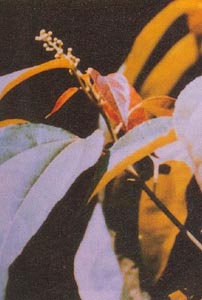
• Leader from Nagathein 1-045
• Photos: left -- habit, right -- habit with flowers & fruits.
Click on the pictures to enlarge. -- KS-TMN
Plant identification characters:
• A small tree, evergreen; bark smooth, the younger stems stellate puberulent.
Leaves alternate, simple; stipulate; petioles long; laminae ovate or
elliptic-lanceolate, the bases obtuse to rounded, the margins serrate,
the tips acute to acuminate, 3-costate, reticulate, the surfaces glabrous.
Inflorescences in terminal racemes, bearing unisexual flowers; monoecious;
bracts subulate. Flowers ebracteolate, pedicellate, unisexual, actinomorphic,
pentamerous, hypogynous. Staminate flower: Calyx synsepalous, 5-partite,
the tips bearded, glabrescent, persistent. Corolla apopetalous, the petals 5,
linear, as long as the calyx., the margins pubescent, white. Androecium polyandrous,
stamens 15, inserted on a villous receptacle, disc glands 5, small, opposite
the calyx lobes, the anthers dithecous, adnate, introrse, dehiscence longitudinal.
Pistillode absent. Pistillate flower: Calyx synsepalous, 5-partite, the tips bearded,
stellate puberulent, villous at the base within, persistent. Corolla absent; disc
obscure, annular. Pistil 1, ovary ellipsoid, stellately hispid, 3-lobed,
3-carpelled, syncarpous, 3-loculed, the placentation axile, the ovule one in
each locule, the styles 3, the stigmas 2-fid. Fruit a schizocarp capsule of
three 1 - seeded cocci, elliptic-oblongoid, 3-lobed, hispid; seeds oblongoid,
3-lobed, hispid; seeds oblongoid, obtusely trigonous, carunculate ,endosperm
copious, fleshy. Flowering period: July - September. Fruiting period:
August - November -- KS-TMN
• An small evergreen tree about 15-20 feet producing capsules similar
to those of castor, but devoid of spines, leaves 2-4 in. yellowish
when dry, rarely elliptic or oblong, sometimes glandular beneath,
nerves 2-3 pairs above the basal long-petioled flowers in racemes,
small, stamens 15-20 ovary stellately hispid -- UHM
Distribution in Myanmar:
• Grows wild in Myanmar. Planted. -- KS-TMN
• Shan States, Pyinmana, wild sources in Upper Burma,
moderately abundant in Tenasserim -- UHM
Part used and uses:
• Seed: Ascites; Febrifuge; Leprosy;
As an antidote for scorpion stings -- KS-TMN
• Seeds as drastic purgative -- UHM
Constituents:
• 1. The kernel contains about 50 % of fixed oil.
2. Very albuminous substance Croton, a mixture of croton
albumin and croton globulin and comparable to Ricin.
3. Croton oil is composed of the glycerides of the following acids: stearic,
palmatic, myristic, lauric, oleic, tiglic, acetic, butyric, formic and valeric. -- UHM
Contents of this page
Family: Euphorbiaceae
Ref. Burmese-Myanmar
transcripts :
• Agri.Dept.2000 20-0502:
{hsi:hpru} Emblica officinalis
• Chklist: Shabyu, Zibyu
• LSR 165:
{hsi:hpru} Emblica officinalis , Phyllanthus emblica
• FAO : NL
• KS-TMN 098: Zibyu; Shabyu Phyllanthus emblica
• Nagathein 1-425:
{hsi:hpru} Emblica myrobalan ,
• UHM : NL
Myanmar-Script Spelling:
• Official Myanmar Dictionaries :
{hsi:hpru} -
 -- TravPo-M-Dict 100
{hsi:hpru} - n. Eastern gooseberry; emblic myrobalan, Emblica
officinalis.-- Myan-Engl-Dict 132
{thhya:hpru} -
 - TravPo-M-Dict 342
{thhya:hpru} - n. same as
{hsi:hpru} -- Myan-Engl-Dict 527
Chklist data:
• Emblica officinalis Gaertn. Habit: Tree.
Distribution: Wide. Common Names: Chay-ahkya, Htakyu, Ku-hlu, Mai-hkam, Set-kalwe,
Set-thalwe, Shabyu, Tasha, Taya, Zibyu
Hindi :
Sanskrit
Indian Name : Indian Gooseberry (Amla)
Botanical Name :Emblica officinalis, Euphorbiaceae
Other Names : Indian Gooseberry, Emblic myrobalan, Amla, Amalaki
--
http://emblica-officinalis.101herbs.com/

 English common name used in Myanmar:
• Agri.Dept.2000 20-0502: Emblic Myrobala
• Chklist: NK
• LSR 165: Emblic Myrobalan; Indian Gooseberry
• FAO : NL
• KS-TMN 098: Emblic Myrobalan tree; Easten Goose-berry
• Nagathein 1-425: NL
• UHM : NL
Picture:
• Leader from
http://toptropicals.com/pics/garden/05/10/0742.jpg
• Photos:
left -- habit with flowers;
right -- habit with fruits.
Click on the pictures to enlarge. -- KS-TMN
Plant identification characters:
•
A middle sized tree, deciduous; trunks crooked, branches
slender, spreading, bark greenish gray, younger stems pubescent.
Leaves alternate distichous, closely and symmetrically set along the
branch lets, appear like the leaflets of a pinnate leaf, simple;
stipules ovate, scarious; subsessile; laminae linear-oblong or
narrowly linear, the bases obtuse, the margins entire, the tips acute,
unicostate, reticulate, the surfaces glabrous. Inflorescences axillary cymes,
densely fasicled along the leaf bearing branchlets, often on the naked portion
below the leaves; bracts fimbriate. Flowers ebracteolate, the staminates pedicellate,
the pistillates subsessile, unisexual, monoecious, actinomorphic, trimerous,
hypogynous. Staminate flowers numerous; calyx aposepalous, the sepals 6, oblong,
obtuse, 2-seriate, greenish yellow. Androecium monadelphous, stamens 3,
the staminal column short, central, the anthers dithecous, oblongoid, extrorse,
dehiscence longitudinal; intrastaminal disc obsolete; pistillode absent.
Pistillate flowers few: calyx as in the staminates. Petals absent; intrastaminal
disc a lacerate cup. Pistil 1, ovary globose, 3-carpelled, syncarpous,
3-locuted the placentation axile, the ovules 2 in each locule, pendulous,
micropyle carunculate, the styles 3, basally connate, each 2-fid, the arms recurved,
the stigmas 6, very large filiform branches. Fruit fleshy with 3-bony 2-valved cocci,
indehiscent, depressed globose, obscurely 6-lobed; seeds 3-gonous, endosperm fleshy. Flowering period: November - December.
Fruiting period: January - July. -- KS-TMN
Distribution in Myanmar :
• Common in mixed deciduous forests up to 4,000ft. Also cultivated.
Parts used and uses:
• Fruit--
Dysuria;
Polyuria; Constipation; Dysentery; Hiccough. Seed:
Blennorrhoea -- KS-TMN
•
Emblica officinalis is effective in the treatment of amlapitta [peptic ulcer]and
in dyspepsia. The fruits exhibit hypolipiadaemic and antiatherosclerotic effects
in rabbits & rats. The fruit extract has antimutagenic activity on certain
directly acting mutagens in some strains of Salmonella typhimurium. The extract
of amla also has antimicrobial properties. Amlaki is an antioxidant with free
radical scavenging properties which may be due to the presence of high levels of
super oxide dismutase.
Indian Gooseberry or Amla is used for all Pitta diseases, all obstinate
urinary conditions, anemia, biliousness, bleeding, colitis, constipation,
convalescence from fever, cough, diabetes, gastritis, gout, hepatitis,
hemorrhoids, liver weakness, to relieve stress ,osteoporosis, palpitation,
spleen weakness, tissue deficiency, vertigo rebuilds blood, bones, cells, and
tissues. It increases red blood cell count and regulates blood sugar; heart
tonic, cleanses mouth, stops gum bleeding, stops stomach and colon inflammation;
cleanses intestines, strengthens teeth, aids eyesight, worms, acidity, eye and
lung inflammations, ulcerations, G.I. disorders, painful urination, and internal
bleeding. --
http://emblica-officinalis.101herbs.com/
UKT: The following is a bit of interesting information
www.lagosforum.com/interv.php?NR=326
on an African plant belonging to the same genus as {zi:phru-thi:}
"Phytochemical analysis of Phyllanthus amarus
by pharmacognosists at the Pharmacognosy Laboratory College of Medicine
University of Lagos (CMUL), Idi-Araba, shows that the whole plant is
very bitter due to the presence of a group of substances such as alkaloid,
sesquiterpene, essential oils, phyllanthine. These substances, according
to the Senior Laboratory Attendant, Mr. Isaac Adeleke, are generally
referred to as having bitter principle.
"Ihesie told The Guardian that local clinical trials of
Phyllanthus amarus in ElizKaf Herbal Home shows that it possesses a very
active blood cleansing property, increases the elimination of waste from
the blood and the body through the kidneys, lungs, skin and liver.
The blood purifying effects of Phyllanthus amarus, he said is enhanced by
mixing equal quantity of it with chickweed (Stellaria media). This mixture
according to Ihesie, when used as an infusion could help those suffering
from weight related arthritis or rheumatism.
"Ihesie continued: "Phyllanthus is one bitter tonic herb,
which helps in promoting the function of the liver. It is one of the herbs recommended
in most liver disorder especially, in acute phases of viral hepatitis jaundice.
Even after recovery from the disease, it is often taken orally for a long period
in order to help prevent the degenerative changes that might later occur in the
liver due to the viral infection. Such changes include the cirrhosis of the
liver or the cancer of the liver. "
Constituents :
• Amla is one of the most celebrated herbs in the Indian traditional medicine
system, Ayurveda. Amla's traditional uses include as a laxative, eye wash,
appetite stimulant, restorative tonic, and to treat anorexia, indigestion,
diarrhea, anemia, and jaundice. Amla is becoming increasingly well known for its
unusually high levels of Vitamin C, which is resistant to storage and heat
damage due to cooking.
Amla is highly nutritious and is an important dietary source of Vitamin C,
minerals and amino acids. The edible fruit tissue contains protein concentration
3-fold and ascorbic acid concentration 160-fold compared to that of the apple.
The fruit also contains considerably higher concentration of most minerals and
amino acids than apples. Glutamic acid, proline, aspartic acid, alanine, and
lysine are 29.6%, 14.6%, 8.1%, 5.4% and 5.3% respectively of the total amino
acids. The pulpy portion of fruit, dried and freed from the nuts contains:
gallic acid 1.32%, tannin, sugar 36.10%; gum 13.75%; albumin 13.08%; crude
cellulose 17.08%; mineral matter 4.12% and moisture 3.83%. Amla fruit ash
contains chromium, 2.5 ppm; zinc 4 ppm; and copper, 3 ppm.
Key Active Constituents: Emblicanin A&B, Puniglucanin, Pedunculagin, 2-keto-gluconolactone (Vitamin-C
equivalents). Ellagic acid, Hexahydroxy-diphenic acid and conjugates.
--
http://emblica-officinalis.101herbs.com/
The following references are given by --
http://emblica-officinalis.101herbs.com/ in support of the material given
above:
CAS, IP, Ayurveda book etc.
1. Chem Abstr, 1992 [116- 19982, 127273]; 1993 [119-103470]; 1989[110-73906];
Vohora, Indian Drugs, [1989-26(10), 526]; Janjua, Hamdard,
1991 [34(2)-104];
Yaqeenudin et. al., Pakist J Sci Ind Res, 1990 [33-268].
2. Roy, A.K. et. al., Int. J.of Pharmacog., 1991, v. 29(2), 117-126.
3. Mand, J.K. et. al., J. Res. Edu. in Ind.Med., 1991, v., 10(2), 1-7.
4. Ghosh, A. et. al., Int. J. of Pharmacog., 1993, v. 31(2), 116-120.
5. Mathur, R. et. al., J. of Ethnopharmacol., 1996, v., 50(2), 61-68.
6. Singh, B.N. and Sharma, P.V., J.Res. Ind. Med., 1971, 5, 223.
7. Ramaswamy, Minor Forest Products, Mysore, 1945,55;
Damodaran & Nair,Biochem. J. 1936,30,1014;
Giri,Indian J. med. Res., 1939, 27, 429; Mitra & Ghosh,Ann.
biochem.1941, 1, 307;
Srinivasan, loc. cit.
8. Chawla et. al., 1982, Indian J. Med. Res. 76 (Suppl.), 95-98.
syn. E. pilulifera
Family: Euphorbiaceae
Burmese-Myanmar transcript names:
• Agri.Dept.2000 10-0249:
{kywè:kyaung:ming-sé:}
• FAO : NL
• Lè-seik-shin 093 :
 {kywè:kyaung:ming-hsé:}
• KS-TMN : NL
• Nagathein 1-214:
{kywè:kyaung:ming-hsé:}
• UHM 24: Kywe-chaung-myin-si,
Kya-bahon
Myanmar-Script Spelling
•
Official Myanmar Dictionaries : Not listed as such.
{kywè:} - meaning "water buffaloe"
--
TravPo-M-Dict 038
{this-sé:} - meaning "exudate from a plant" --
--
TravPo-M-Dict 334
UKT: since this plant exudes a "milky sap" (English name in Myanmar: "milk
weed"), the appropriate spelling is
{kywè:kyaung:ming-sé:}.
- not listed under {kywè:kyaung:} -- Myan-Engl-Dict 049
Hindi:
Sanskrit:
English common name used in Myanmar :
• Agri.Dept.2000 10-0249: Milk weed; Australian Asthma weed
• FAO : NL
• Lè-seik-shin 093 : Milk weed; Australian Asthma weed
• KS-TMN : NL
• Nagathein 1-214: not given
• UHM 24: not given
Picture:
• Leader from Nagathein 1-215. The
large variety is on the left, and the small variety is on the right.
Plant identification characters :
• Nagathein, free translation by UKT:
A small annual usually found in rainy season in Myanmar. Hair on the
 plant.Height about 1 foot. Branches and shoots reddish in colour. Opposing leaves
about 1 inch in length and pointed at tip. Fruits in the middle and resembles
"corn" seeds. Exudes sap on breaking a branch.
plant.Height about 1 foot. Branches and shoots reddish in colour. Opposing leaves
about 1 inch in length and pointed at tip. Fruits in the middle and resembles
"corn" seeds. Exudes sap on breaking a branch.
1. Two kinds of (large) plants: pointed leaves reddish in colour and
round leaves greenish in color. In some parts of Myanmar known as {kra.ba.hoan°:}
2. A small kind of plant: leaves reddish in colour, grows close to
ground. Though known as
{kywè:kyaung:ming-sé:}
• An erect or ascending hispid annual herb, 1-2', leaves opposite,
elliptic-oblong, obovate or oblong-lanceolate obliquely cordate, acute, serrate
or serulate. -- UHM
Distribution in Myanmar:
• Widely distributed. A common weed occurring frequently on or
beside roads and paths -- UHM
Part used and uses :
• Dried stems and leaves.
Used as respiratory troubles, dysentery, colic and worms in children.-- UHM
Constituents :
•1. Gallic acid. 2. Querecetin. 3. Traces of an alkaloid. 4.
An essential oil.(9) 5. l-Iinosital and an alkaloid xanthorhamnin isolated. (21)
-- UHM
Contents of this page
Family: Euphorbiaceae.
Burmese-Myanmar transcript names:
• Agri.Dept.2000 08-0193:
 {krak-hsu-kri:} /
 {siÑ:ro: krak-hsu}
• FAO : NL
• Lè-seik-shin : NL
• KS-TMN : NL
• Nagathein 1-167:
( )
{krak-hsu (siÑ:ro: krak-hsu kri:)}
)
{krak-hsu (siÑ:ro: krak-hsu kri:)}
• UHM 30: Si-yo-kyet-su
UKT: Nagathein on {krak-hsu}
Jatropha curcas is
{siÑ:ro: krak-hsu} or
{krak-hsu (siÑ:ro:)} (which literally means "the {krak-hsu} that grows along
hedges". It is to be differentiated from the "castor oil plant" which is
Ricinus communis of the same family Euphorbiaceae.
Nagathein listed two kinds of
{siÑ:ro: krak-hsu}: the large and the small. He identified the large kind as
J. curcus, and the small kind as J. glandulifera . He also
differentiated them by their Hindi names.
Nagathein further listed two more kinds of
{krak-hsu}:
the large
 {krak-hsu (a.kri:)} and the small
 {krak-hsu (a.ngèý)}. He identified both of them as R. communis but
differentiated them by their Hindi names. He noted further that the large kind
is the imported species, whereas the small kind is the native species.
{krak-hsu (a.ngèý)}. He identified both of them as R. communis but
differentiated them by their Hindi names. He noted further that the large kind
is the imported species, whereas the small kind is the native species.
Myanmar-Script Spelling
• Official Myanmar Dictionaries
:
{krak-hsu}
-
 TravPo-M-Dict 031
{krak-hsu}
- n. castor oil plant, Ricinus communis -- Myan-Engl-Dict 041
Hindi:
Sanskrit:

English common name used in Myanmar :
• Agri.Dept.2000 08-0193: not given
• FAO : NL
• Lè-seik-shin : NL
• KS-TMN : NL
• Nagathein not given
• UHM 30: Si-yo-kyet-su
Picture:
• Leader from
Nagathein: left (small kind), right (large kind)
• See J. curcus
 from:
http://home.hiroshima-u.ac.jp/shoyaku/photo/Phil/84Jat.jpg
from:
http://home.hiroshima-u.ac.jp/shoyaku/photo/Phil/84Jat.jpg
Plant identification characters :
• Nagathein and UKT's free translation:

The small variety of this kind grows wild anywhere, however, the preferred
location is dry rocky ground. The approximate height is 4 to 12 feet. The leaves
are red and are similar in shape {krak-hsu} leaves. The leaves produces a milky
sap. The fruit has a 3-pointed cross-section, and is similar in shape to
{ka.na.hko} (Croton tiglium , family: Euphorbiaceae).
This variety is also known as {siñ:ro: krak-hsu-ka.lé:}, {ka.na.hko a.rein:},
{tau:ka.na.hko}, {Bau-za-keing:}, {na-ga.hsauk}.
 The
large variety of this kind is a small tree 10-15 feet high. The branches and the
leaves are very green in colour. Leaves: 3-lobed. Fruit: round, about the size
of large {kwam:thi:} (UKT: areca nut -- about 1 inch), in clusters of 4, 5, 6.
Leaves and leafstalk on breaking off gives out a white thick sap. The seed
within the fruit is similar in shape to the seed of
The
large variety of this kind is a small tree 10-15 feet high. The branches and the
leaves are very green in colour. Leaves: 3-lobed. Fruit: round, about the size
of large {kwam:thi:} (UKT: areca nut -- about 1 inch), in clusters of 4, 5, 6.
Leaves and leafstalk on breaking off gives out a white thick sap. The seed
within the fruit is similar in shape to the seed of
 {krar} (UKT: water-lily), and has a sweetish creamy taste, and is as strong a
purgative as {ka.na.hko}. The root, the milky sap, and the seed are medicinally
useful.
{krar} (UKT: water-lily), and has a sweetish creamy taste, and is as strong a
purgative as {ka.na.hko}. The root, the milky sap, and the seed are medicinally
useful.
• A large or small evergreen tree, leaves 4-6" diam, lobes obtuse or
acute, quite entire, petiole as long as the blade, flowers yellow,
capsule 1-1 1/2 in., Poison. -- UHM
Distribution in Myanmar:
• Yawnghwe, Shwe Nyaung, Hsi-Seng, Mongnai (Southern Shan State). -- UHM
Part used and uses:
• All parts are considered toxic but in particular the seeds. Contains a
purgative oil and a phytotoxin or toxalbumin (curcin) similar to
ricin in Ricinis. Curcin is found mainly in the seeds and also in the fruit and
sap. Purgative oil - the seed yields 40% oil, known as hell oil, pinheon
oil, oleum infernale or oleum, ricini majoris, which contains small
amounts of an irritant curcanoleic acid, which is related to ricinoleic
acid and crotonoleic acid, the principle active ingredients of castor oil and
croton oil respectively (Joubert et al., 1984). Jatropha is an ornamental
plant naturalised in many tropical areas. The roots, stems, leaves
seeds and fruits of the plant have been widely used in traditional folk medicine
in many parts of West Africa. The seeds of J. curcas have been used as a
purgative, anthelmintic and abortifacient
as well as for treating ascites, gout, paralysis and skin diseases. The seed
oil of the plant has been used as an ingredient in the treatment of rheumatic
conditions, itch and parasitic skin diseases, and in the treatment of fever, jaundice
and gonorrhoea, as a diuretic agent, and a mouth-wash. The leaf has been
used as a haemostatic agent and the bark as a fish poison. In certain
African countries people are accustomed to chewing these seeds when in need
of a laxative. J. curcas seeds have been found to be highly effective
against Strongyloides papillosus infection in goats (Adam & Magzoub, in press).
It has also been suggested that J. curcas seeds could be a useful
chemotherapeutic agent provided that it is active at a non-lethal dose
(Adam, 1974). This may be because of it's reported antihelminthic activity. --
edited extract from:
http://www.inchem.org/documents/pims/plant/jcurc.htm.
Used as powerful purgatives.
Constituents:
• 1. About 20 percent of a fixed oil.
2. Curcin, a substance comparable to ricin.- UHM
Contents of this page
Family : Euphorbiaceae
Burmese-Myanmar transcripts :
• Agri.Dept.2000 17-0440:
{sé:ma.hkan:}
• FAO : NL
• Lè-seik-shin : NL
• KS-TMN 097: Hsay-makhan; Bein-hpo
• Nagathein 1-393:
{sé:ma.hkan:}
• UHM : NL
Myanmar-Script Spelling
• Official Myanmar Dictionaries :
{sé:ma.hkan:}
-
 -- TravPo-M-Dict 087
{sé:ma.hkan:} - n. coral plant, Jatropha multifida -- Myan-Engl-Dict 003
Hindi :
Sanskrit :


English common name used in Myanmar :
• Agri.Dept.2000 17-0440: coral bush
• FAO : NL
• Lè-seik-shin : not given
• KS-TMN 097: Coral Plant; Coral-bush; French Physic Nut; Small Physic Nut
• Nagathein 1-393: not given
• UHM : NL
Picture :
• Leader from Nagathein
• Photos:
left - habit with flowers;
right - habit.
Click on the pictures to enlarge. -- KS-TMN
Plant identification characters :
• A large shrub or a small tree; younger stems glabrous, sap milky.
Leaves
alternate, simple; stipules multifid stalks; petioles long, canaliculated;
laminae orbicular, palmatisect, 3- to 5-lobed, incised into many narrow entire
or lobulate segments, the bases rounded or cordate, the margins entire or
glandular semulated, the tips caudate-acuminate, 5- to 10-costate, reticulate,
glabrous, the upper surfaces green, the lower reddish green glaucous.
Inflorescences in terminal and axillary corymbose scorpioid cymes; peduncles
long; bracts subulate, minute, green. Flowers ebracteolate, pedicellate,
unisexual, monoecious, actinomorphic, pentamerous, hypogynous. Staminate flowers
8-12: Calyx synsepalous, 5-partite, companulate, the lobes ovate, petaloid,
orange-red. Corolla synpetalous, connate only at the bases, the petals 5,
obovate, cuneate, each base with a glandular disc, red or orange-red. Androecium
monadelphous, stamens 10, the anthers dithecous, ovoid, erect, dorsifixed,
extrorse, dehiscence longitudinal; intrastaminal disc entire; pistillode absent.
Pistillate flowers 2-3: solitary, axillary, calyx and corolla as in the
staminate flowers; intrastaminal disc urceolate. Pistil 1, ovary oblongoid,
3-carpelled, syncarpous, 3-loculed, the placentation axile, the ovule 1in each
locule, pendulous, micropyle carunculate, the style short, the stigmas 3, each
2-fid. Fruit a septifragal capsule, globose, 3-lobed, splitting into three
2-valved, 1 -seeded crustaceous cocci, dehiscing ventrally, green when
young, yellow or pale black when mature; seeds 3, carunculate, pale black,
endosperm fleshy. Flowering period: Throughout the year.
Fruiting period: Throughout the year -- KS-TMN
Distribution in Myanmar :
• Planted. -- KS-TMN
Part
used and uses :
Leaf, fruit, seed, latex --
Haemorrhoids; Common cold; Ascites. Leaf -- Scabies. Seed --
Aphrodisiac; Abortifacient. Latex -- Common cold; Heals boils and pustules.
-- KS-TMN
Constituents :
Contents of this page
Family: Euphorbiaceae.

Burmese-Myanmar transcript names:
• Agri.Dept.2000 27-0710:
{tau:thi-ting:}
• FAO :
• Lè-seik-shin :
• KS-TMN:
• Nagathein 3-404:
 {thi-ting: (tau:)}
• UHM 31: Taw-thi-din, Po-thi-din
Myanmar-Script Spelling :
•
Official Myanmar Dictionaries : (UKT: Listed a species named
 {thi-ting:} which bears red fruits. The seeds provide a red dye. However,
this species may or nay not be M. philippensis .)
{thi-ting:} which bears red fruits. The seeds provide a red dye. However,
this species may or nay not be M. philippensis .)
{thi-ting:}
-
 -- TravPo-M-Dict
324
-- TravPo-M-Dict
324
{thi-ting:}
- n. annato; lipstick tree, Bixa orellana -- Myan-Engl-Dict 496
Hindi:
Sanskrit:

 English common name used in Myanmar :
• Agri.Dept.2000 27-0710: Kamala tree
• FAO :
• Lè-seik-shin :
• KS-TMN: NL
• Nagathein 3-404: not given
• UHM 31: Rottlera, Kameela, Glandulae, Rottlerae
Picture:
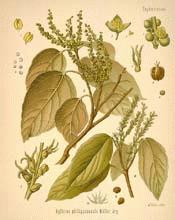
• Leader from: Kamala, drawing 175X220,
http://www.botanical.com/botanical/mgmh/k/kamala01-s.jpg
• Photo: left Mallotus philippinensis http://www.brisrain.webcentral.com.au/database/Mall_philippinensis.htm mp,
right Mallotus philippinensis
http://fm2.fieldmuseum.org/plantatlas/images.asp?plantID=1994#
Plant identification characters :
• A tree with alternate, ovate or oblong-ovate coriaceous evergreen
leaves, racemes of staminate and pistillate flowers, and glandular-hairy 3
celled septifragally dehiscent capsules. -- UHM
• Kamala. U. S. 1890. Kamala. Glandulae Rottlerae.—The U.
S. Pharmacopoeia, under the name of Rottlera, U. S., 1870, Kameela,
formerly recognized the glands and hairs from the capsules of Mallotus
philippinensis (Lamarck) Muell.-Arg. (Fam. Euphorbiaceae.) This tree
grows in Abyssinia, Southern Arabia, Hindostan, the East India Islands, China,
and Australia, reaching a height of from fifteen to twenty feet, and yielding a
roundish, three-valved, three-locular capsule about the size of a small cherry,
thickly covered with a red powder, which is collected in Hindostan by rolling
the berries about in large baskets until the freed powder sifts through the open
wicker-work. -- US Dispensatory, 1918: Kamala. Mallotus philippinensis. Rottlera.
The
Dispensatory of the United States of America.
Distribution of Myanmar:
• Central Range, Hsi-Seng (Southern Shan States.) -- UHM
Part used and used as:
• The hairs obtained from the capsules.
Used as taenifuge, anthelmintic to remove ascaris and thread worms,
as a dye stuff. -- UHM
Constituents:
• 1. An active taenifuge principle called rottlerin.
2. A red resin.
3. A yellow resin.
4. Wax, tannin, colouring matter. (7) -- UHM
Contents of this page
Family: Euphorbiaceae
Ref. Burmese-Myanmar
transcripts :
• Agri.Dept.2000 20-0502:
{hsi:hpru} Emblica officinalis
• FAO : NL
• Lè-seik-shin 165:
{hsi:hpru} Emblica officinalis , Phyllanthus emblica
• KS-TMN 098: Zibyu; Shabyu Phyllanthus emblica
• Nagathein 1-425:
{hsi:hpru} Emblica myrobalan ,
• UHM : NL
Myanmar-Script Spelling:
• Official Myanmar Dictionaries :
-
-
-- TravPo-M-Dict 100
--
-- TravPo-M-Dict 342
n. Eastern gooseberry; emblic myrobalan, Emblica
officinalis.-- Myan-Engl-Dict 132
For more information, go to Emblica officinalis
Contents of this page
Family Euphorbiaceae
Listed as
 {krak-hsu-ro:ni} in Myanmar Medicinal Plant
Database 2005.
{krak-hsu-ro:ni} in Myanmar Medicinal Plant
Database 2005.
Ref. Burmese-Myanmar
transcripts
• Agri.Dept.2000 08-0194:
{krak-hsu-ro:ni}
• FAO :
• Lè-seik-shin 059:
{krak-hsu kri:}
• KS-TMN 101: Kyet-su
• Nagathein 1-165:
{krak-hsu (a.kri:} /
{krak-hsu (a.ngèý)}
• UHM : NL
UKT: See Nagathein on {krak-hsu}
Myanmar-Script Spelling :
• Official Myanmar Dictionaries
:
{krak-hsu}-
TravPo-M-Dict 031
{krak-hsu} - castor oil plant, Ricinus communis -- Myan-Engl-Dict 041
Hindi :


Sanskrit
English common name used in Myanmar
:
• Agri.Dept.2000 08-0194: Castor oil plant
• Nagathein 1-165: Castor oil plant
Nagathein 1-165: Castor oil plant
• FAO : NL
• Lè-seik-shin 059: Castor oil plant
• KS-TMN 101: Castor-oil Plant; Palma Christi.
• UHM : NL
Picture:
• Leader from Nagathein: large kind
• Photos: left - habit with flowers and fruits,
right - flowers and fruits.
Click on the pictures to enlarge. -- KS-TMN
Plant identification characters:
• Evergreen small trees or annual herbs; stems cylindrical, hollow, glabrous,
the younger ones and the infloreseence axes red or green. Leaves alternate,
simple; stipules intrapetiolor, linear; petioles long, red or green; laminae
palmatipartite, 5-to 11-lobed, the lobes oblong to linear, the bases peltate,
the margins dentate or serrate, the tips acauminate, 5-to 11-costate,
reticulate, the surfaces glabrous, membranous, green or reddish-green.
Inflorescences thyrsiform, terminal, the cymules 3- to 6-flowered; bracts ovate,
persistent. Flowers ebracteolate, pedicellate, unisexual, monoecious, the
staminates borne on the lower part of the peduncle, the pistillates on the upper
part, apetalous, actinomorphic, hypogynous. Staminate flowers: Pedicels short.
Calyx aposepalous, the sepals 5, ovate, glabrous, Androecium polyadelphous, the
bundles 1-6, stamens numerous, the filaments much branched, the anthers
dithecous, cells distinct, globose, divergent, basifixed, introrse, dehiscence
longitudinal. Pistillode absent. Pistillate flowers: Pedicels long. Calyx
aposepalous, the sepals 5, ovate, deciduous. Pistil 1, ovary ellipsoid, usually
3-carpelled, cyncarpous, 3-loculed, 4-carpelled and 4-loculed rare, the
placentation apical, the ovule one in each locule, pendulous, the styles 3,
terminal, the stigmas bifid, plumose. Fruit a dehiscent regma, spiny, globosely
oblongoid, green, red or reddish-green, dehiscing into 3, 2-valued coccae when
ripe, the cocci 1-seeded; seeds ovoid, oblongoid or cuboid, testa crustaceous,
variously coloured, grey, brown, black, reddish brown or deep chocolate brown,
the markings or mottlings various, white or brown or wholly black and non
mottled, endosperm oily and fleshy. Flowering and fruiting periods:
October-May -- KS-TMN
• Nagathein and UKT's free translation:
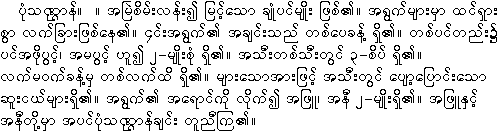
A large, evergreen shrub. Leaves: palmate about a foot wide. Both male and
female flowers on the same plant. Fruits: 3-lobed, 1/2 to 1 inch. Covered with
soft spines.
 The
plants are termed "white" (green) or "red" depending on the colour of leaves.
Depending on the size of the plants, the plants can also be divided into the
"large" and the "small" kind.
The
plants are termed "white" (green) or "red" depending on the colour of leaves.
Depending on the size of the plants, the plants can also be divided into the
"large" and the "small" kind.
Distribution in Myanmar :
• Commonly grows wild, naturalized or cultivated in Myanmar. -- KS-TMN
Part
used and uses :
• Seed -- Promotes
spermatogenesis;
Cathartic; Dysentery;
Ascites; Colic;
Hyperlipaemia; Hepatitis;
Carminative; Cough; As an expectorant; Asthma;
Backache; Head-ache; Orchitis;
Haemorrhoids; Gouty arthritis; Leprosy; Pyrexia -- KS-TMN
• Nagathein and UKT's free translation:

Highly indigestible. Promotes production of semen. Promotes internal heat.
Purgative. Useful for "wind" and "phlegm" diseases. Used in
colic, fever, cough, dysentery, backache, headache, leprosy, hyperlipemia,
orchitis, etc.
 The large and small variety are equally effective in medicine. However, the
practitioners of the past preferred to use the small variety. Note: The large
variety is the imported species, whereas the small variey is native.
The large and small variety are equally effective in medicine. However, the
practitioners of the past preferred to use the small variety. Note: The large
variety is the imported species, whereas the small variey is native.
• Considered
anodyne, antidote,
aperient, bactericide,
cathartic,
cyanogenetic,
discutient, emetic,
emollient,
expectorant, insecticide, lactagogue, larvicidal, laxative, POISON, purgative,
tonic, and vermifuge, castor or castor oil is a dangerous ingredient in folk
remedies for abscess, anasarca, arthritis, asthma, boils, burns, cancer, carbuncles,
catarrh, chancre, cholera, cold, colic, convulsions, corns, craw-craw, deafness,
delirium, dermatitis, dogbite, dropsy, epilepsy, erysipelas, fever, flu, gout,
guineaworm, headache, inflammation, moles, myalgia, nerves, osteomyelitis, palsy,
parturition, prolapse, puerperium, rash, rheumatism, scald, scrofula, seborrhea,
skin, sores, stomachache, strabismus, swellings, toothaches, tuberculosis, tumors,
urethritis, uteritis, venereal disease, warts, whitlows, and wounds. The oil and
seed have been used as folk remedies for: warts, cold tumors, indurations of the
abdominal organs, whitlows, lacteal tumors, indurations of the mammary gland, corns,
and moles, etc. Castor-oil is a cathartic and has labor-inducing properties. Ricinoleic
acid has served in contraceptive jellies. Ricin, a toxic protein in the seeds,
acts as a blood coagulant. Oil used externally for dermatitis and eye ailments.
Seeds, which yield 45–50% of a fixed oil, also contain the alkaloids ricinine
and toxalbumin ricin, and considered purgative, counter-irritant in
scorpion-sting and fish poison. Leaves applied to the head to relieve headache
and as a poultice for boils. (Duke and Wain, 1981). --
http://www.hort.purdue.edu/newcrop/duke_energy/Ricinus_communis.html#Uses
Constituents :
• Per 100 g, the leaves are reported to contain on a zero-moisture basis, 24.8 g
protein, 5.4 g fat, 57.4 g total carbohydrate, 10.3 g fiber, 12.4 g ash, 2,670
mg Ca, and 460 mg P. The seed contains 5.1–5.6% moisture, 12.0–16.0% protein,
45.0–50.6% oil, 3.1–7.0 NFE, 23.1–27.2% CF, and 2.0–2.2% ash.
Seeds are high in phosphorus, 90% in the phytic form. The castor oil consists principally of
ricinoleic acid with only small amounts of dihydroxystearic, linoleic, oleic,
and stearic acids. The unsaponifiable matter contains b-sitosterol. The
oil-cake from crushing whole seeds contain 9.0% moisture, 6.5% oil, 20.5%
protein, 49.0% total carbohydrate and 15.0% ash. The manural value is 6.6% N,
2.6% P2O5, and 1.2% K2O (C.S.I.R., 1948–1976).
There are 60 mg/kg uric acid
and 7 ppm HCN in the seed. The seeds contain a powerful lipase, employed for
commercial hydrolysis of fats, also amylase, invertase, maltase, endotrypsin,
glycolic acid, oxidase, ribonuclease, and a fat-soluble zymogen. Sprouting
seeds contain catalase, peroxidase and reductase. --
http://www.hort.purdue.edu/newcrop/duke_energy/Ricinus_communis.html#Chemistry
Contents of this page
Family: Euphorbiaceae
Results of search for 'Croton' in the Checklist of Plants of
Myanmar, U.S. National Herbarium, 9 Aug 2006.
• Croton argyratus Blume. Habit: Tree. Distribution: Mon, Taninthayi
• Croton birmanicus Muell. Arg. Habit: Shrub. Distribution: Bago,
Taninthayi, Yangon.
• Croton calderi T. Chakrabarty & N.P. Balakr. Habit: Shrub.
Distribution: Reported from Myanmar
• Croton calococcus Kurz. Habit: Shrub. Distribution: Wide. Common
Names: Kanakho-gale
• Croton caudatus Geisel. Habit: Shrub. Distribution: Wide. Common
Names: Awle, Taung-salat
• Croton chlorocalyx Wall. Habit: Shrub. Distribution: Sagaing
• Croton erythrostachys Hook. f. Habit: Shrub. Distribution: Reported
from Myanmar
• Croton flocculosus Kurz. Habit: Tree. Distribution: Wide. Common
Names: Thala
• Croton joufra Roxb. Habit: Shrub. Distribution: Bago, Kachin,
Mandalay, Mon, Sagaing, Taninthayi. Common Names: Thetyin-gale, Thetyin-kado
• Croton meeboldianus T. Chakrabarty & N. P. Balakr. Habit: Shrub.
Distribution: Reported from Myanmar
• Croton oblongifolius Roxb. Habit: Shrub. Distribution: Wide.
Common Names: Thetyin-gyi
• Croton rhodostachyus Muell. Arg. Habit: Shrub. Distribution: Chin,
Kachin, Mandalay, Sagaing
• Croton robustus Kurz. Habit: Small tree. Distribution: Bago, Mon,
Taninthayi, Yangon. Common Names: Thetyin
• Croton roxburghianus N.P. Balakr. Habit: Small tree. Distribution:
Wide. Common Names: Ha-yang, Maisat-lan, Thetyin-gyi, Umawng
• Croton sublyratus Kurz. Habit: Shrub. Distribution: Mon, Rakhine,
Taninthayi
• Croton tiglium L. Habit: Small tree. Distribution: Cultivated.
Common Names: Kanakho, Mai-hkang
• Croton tomentosus Muell. Arg. Habit: Shrub. Distribution: Ayeyarwady,
Bago, Mon, Taninthayi
• Croton wallichii Muell. Arg. Habit: Tree. Distribution: Ayeyarwady,
Bago, Mandalay, Mon, Taninthayi, Yangon. Common Names: Thetyin-kado
Contents of this page
Family: Euphorbiaceae
Results of search for 'Emblica' in the Checklist of Plants of
Myanmar, U.S. National Herbarium, 7 May 2006.
• Emblica officinalis Gaertn. Habit: Tree.
Distribution: Wide. Common Names: Chay-ahkya, Htakyu, Ku-hlu, Mai-hkam, Set-kalwe,
Set-thalwe, Shabyu, Tasha, Taya, Zibyu
USDA-NRCS-data:
"EMOF","Emblica officinalis Gaertner",">>Phyllanthus
emblica","Euphorbiaceae"
Contents of this page
Family: Euphorbiaceae
Results of search for 'Phyllanthus' in the Checklist of Plants
of Myanmar, U.S. National Herbarium, 6 May 2006.
• Glochidion helferi Hook. f. Cited as:
Phyllanthus helferi Muell. Arg. Habit: Small tree. Distribution: Taninthayi
• Glochidion laevigatum (Muell. Arg.) Hook. f. Cited as:
Phyllanthus laevigatus Muell. Arg. Habit: Shrub. Distribution: Taninthayi
• Phyllanthus acidus (L.) Skeels. Cited as: Cicca acida (L.)
Merr. Habit: Small tree. Distribution: Reported from Myanmar. Common Names: Mak-hkam-sang-paw,
Star gooseberry, Thinbaw-zibyu
• Phyllanthus albizzioides (Kurz) Hook. f. Cited as: Cicca
albizzioides Kurz. Habit: Tree. Distribution: Wide. Common Names: Sha-ma, Shit-sha
• Phyllanthus baeobotryoides Wall. Habit: Shrub. Distribution:
Taninthayi
• Phyllanthus birmanicus Muell. Arg. Habit: Shrub. Distribution:
Reported from Myanmar
• Phyllanthus clarkei Hook. f. Habit: Shrub. Distribution: Shan
• Phyllanthus columnaris Muell. Arg. Habit: Small tree. Distribution:
Wide. Common Names: Kalon-letthe, Mak-sup-ka-lawn, Ye-tasha
• Phyllanthus distichus Muell. Arg. Habit: Tree. Distribution:
Mandalay, Yangon. Common Names: Thin-baw-ziphyu
• Phyllanthus elegans Wall. Habit: Shrub. Distribution: Bago, Mandalay,
Mon, Taninthayi
• Phyllanthus gomphocarpus Hook. f. Habit: Shrub. Distribution:
Taninthayi
• Phyllanthus hamiltonianus Muell. Arg. Habit: Shrub. Distribution:
Sagaing
• Phyllanthus lanceolarius (Roxb.) Muell. Arg. Cited as: Glochidion
lanceolarium (Roxb.) Voigt. Habit: Small tree. Distribution: Bago, Chin, Kachin, Mandalay, Sagaing,
Shan, Shan, Taninthayi. Common Names: Hta-min-sok, Tamasok
• Phyllanthus macrocarpus (Blume) Muell. Arg. Cited as: Cicca macrocarpa (Blume) Kurz. Habit: Shrub. Distribution: Reported from Myanmar
• Phyllanthus maderaspatensis L. Habit: Shrub. Distribution: Mandalay. Common Names: Taw-ziphyu
• Phyllanthus nanus Hook. f. Habit: Shrub. Distribution: Wide. Common Names: Mye-shit-sha-gale
• Phyllanthus niruri L. Habit: Shrub. Distribution: Wide. Common Names: Flor-de-joja, Kyet-tha-hin,
Yaung-ma-ywet
• Phyllanthus parvifolius Buch.-Ham. Habit: Shrub. Distribution: Chin, Kachin, Kachin
• Phyllanthus pomiferus Hook. f. Habit: Small tree. Distribution: Wide. Common Names: Chyahkya, Mai-mak-hkam, Sha-byu,
Zibyu
• Phyllanthus prainianus Collett & Hemsl. Habit: Small tree. Distribution: Chin, Kachin, Mandalay, Yangon
• Phyllanthus pulcher Wall. Habit: Shrub. Distribution: Yangon
• Phyllanthus reticulatus Poir. Cited as: Cicca reticulata (Poir.) Kurz. Habit: Shrub. Distribution: Mandalay, Yangon. Common Names: Ye-chin-yar
• Phyllanthus rheedii Wight. Habit: Herb. Distribution: Mandalay, Yangon. Common Names: Ma-shaw, Ma-shaw-se
• Phyllanthus roeperianus Wall. Habit: Shrub. Distribution: Kachin, Shan.
• Phyllanthus simplex Retz. Habit: Shrub. Distribution: Kachin, Sagaing. Common Names: Shit-sha
• Phyllanthus urinaria L. Habit: Herb. Distribution: Wide. Common Names: Mye-shit-sha, Mye-ziphyu
USDA-NRCS-data
"PHYLL","Phyllanthus L.","leafflower","Euphorbiaceae"
"PHAB","Phyllanthus abnormis Baill.","Drummond's leaf-flower","Euphorbiaceae"
"PHABA","Phyllanthus abnormis Baill. var. abnormis","Drummond's leaf-flower","Euphorbiaceae"
"PHDR2","Phyllanthus drummondii Small",">>Phyllanthus abnormis var.
abnormis","Euphorbiaceae"
"PHGA2","Phyllanthus garberi Small",">>Phyllanthus abnormis var.
abnormis","Euphorbiaceae"
"PHABR","Phyllanthus abnormis Baill. var. riograndensis G.L. Webster","Rio
Grande leaf-flower","Euphorbiaceae"
"PHAC3","Phyllanthus acidus (L.) Skeels","Tahitian gooseberry
tree","Euphorbiaceae"
"CIAC2","Cicca acidua (L.) Merr.",">>Phyllanthus acidus","Euphorbiaceae"
"CIDI3","Cicca disticha L.",">>Phyllanthus acidus","Euphorbiaceae"
"PHDI10","Phyllanthus distichus (L.) Muell.-Arg.",">>Phyllanthus
acidus","Euphorbiaceae"
"PHAC7","Phyllanthus acuminatus Vahl","Jamaican gooseberry tree","Euphorbiaceae"
"PHAM5","Phyllanthus amarus Schumacher & Thonn.","carry me
seed","Euphorbiaceae"
"PHAN9","Phyllanthus angustifolius (Sw.) Sw.","foliage flower","Euphorbiaceae"
"PHCA9","Phyllanthus caroliniensis Walt.","Carolina leaf-flower","Euphorbiaceae"
"PHCAC","Phyllanthus caroliniensis Walt. ssp. caroliniensis","Carolina leaf-flower","Euphorbiaceae"
"PHCAS","Phyllanthus caroliniensis Walt. ssp. saxicola (Small) G.L.
Webster","Carolina leaf-flower","Euphorbiaceae"
"PHPR6","Phyllanthus pruinosus auct. non Poepp. ex L.C. Rich. [misapplied]",">>Phyllanthus
caroliniensis ssp. saxicola","Euphorbiaceae"
"PHSA5","Phyllanthus saxicola Small",">>Phyllanthus caroliniensis ssp.
saxicola","Euphorbiaceae"
"PHDE4","Phyllanthus debilis Klein ex Willd.","niruri","Euphorbiaceae"
"PHDI8","Phyllanthus distichus Hook. & Arn.","pamakani mahu","Euphorbiaceae"
"PHSA6","Phyllanthus sandwicensis Muell.-Arg.",">>Phyllanthus
distichus","Euphorbiaceae"
"PHSAD2","Phyllanthus sandwicensis Muell.-Arg. var. degeneri Sherff",">>Phyllanthus
distichus","Euphorbiaceae"
"PHSAE","Phyllanthus sandwicensis Muell.-Arg. var. ellipticus Muell.-Arg.",">>Phyllanthus
distichus","Euphorbiaceae"
"PHEM2","Phyllanthus emblica L.","emblic","Euphorbiaceae"
"EMOF","Emblica officinalis Gaertner",">>Phyllanthus emblica","Euphorbiaceae"
"PHEP","Phyllanthus epiphyllanthus L.","swordbush","Euphorbiaceae"
"XYEP","Xylophylla epiphyllantha (L.) Britt.",">>Phyllanthus
epiphyllanthus","Euphorbiaceae"
"PHER2","Phyllanthus ericoides Torr.","heather leaf-flower","Euphorbiaceae"
"PHFR5","Phyllanthus fraternus G.L. Webster","gulf leaf-flower","Euphorbiaceae"
"PHJU2","Phyllanthus juglandifolius Willd.","gamo de costa","Euphorbiaceae"
"ASGR13","Asterandra grandifolia (L.) Britt.",">>Phyllanthus
juglandifolius","Euphorbiaceae"
"PHLI13","Phyllanthus liebmannianus Muell.-Arg.","Florida leaf-flower","Euphorbiaceae"
"PHLIP2","Phyllanthus liebmannianus Muell.-Arg. ssp. platylepis (Small) G.L.
Webster","Florida leaf-flower","Euphorbiaceae"
"PHPL2","Phyllanthus platylepis Small",">>Phyllanthus liebmannianus ssp.
platylepis","Euphorbiaceae"
"PHMA31","Phyllanthus marianus Müll. Arg.","","Euphorbiaceae"
"PHNI2","Phyllanthus niruri L.","gale of the wind","Euphorbiaceae"
"PHNIL","Phyllanthus niruri L. ssp. lathyroides (Kunth) G.L. Webster","gale of
the wind","Euphorbiaceae"
"PHLA11","Phyllanthus lathyroides Kunth",">>Phyllanthus niruri ssp.
lathyroides","Euphorbiaceae"
"PHNIN2","Phyllanthus niruri L. ssp. niruri","gale of the wind","Euphorbiaceae"
"PHOR10","Phyllanthus orbicularis Kunth","wedge leaf-flower","Euphorbiaceae"
"ANCU","Andrachne cuneifolia Britt.",">>Phyllanthus
orbicularis","Euphorbiaceae"
"PHCU4","Phyllanthus cuneifolius (Britt.) Croizat",">>Phyllanthus
orbicularis","Euphorbiaceae"
"PHPE7","Phyllanthus pentaphyllus C. Wright ex Griseb.","fivepetal leaf-flower","Euphorbiaceae"
"PHPEP2","Phyllanthus pentaphyllus C. Wright ex Griseb. ssp.
pentaphyllus","fivepetal leaf-flower","Euphorbiaceae"
"PHPEF2","Phyllanthus pentaphyllus C. Wright ex Griseb. ssp. pentaphyllus var.
floridanus G.L. Webster","fivepetal leaf-flower","Euphorbiaceae"
"PHPEP","Phyllanthus pentaphyllus C. Wright ex Griseb. ssp. polycladus (Urban)
G.L. Webster","fivepetal leaf-flower","Euphorbiaceae"
"PHPO6","Phyllanthus polycladus Urban",">>Phyllanthus pentaphyllus ssp.
polycladus","Euphorbiaceae"
"PHPO3","Phyllanthus polygonoides Nutt. ex Spreng.","smartweed leaf-flower","Euphorbiaceae"
"PHPU6","Phyllanthus pudens L.C. Wheeler","birdseed leaf-flower","Euphorbiaceae"
"PHPU11","Phyllanthus pulcher Wallich ex Muell.-Arg.","tropical leaf-flower","Euphorbiaceae"
"PHSA15","Phyllanthus saffordii Merr.","","Euphorbiaceae"
"PHST5","Phyllanthus stipulatus (Raf.) G.L. Webster","stipulate leaf-flower","Euphorbiaceae"
"PHDI11","Phyllanthus diffusus Klotzsch",">>Phyllanthus
stipulatus","Euphorbiaceae"
"PHTE5","Phyllanthus tenellus Roxb.","Mascarene Island leaf-flower","Euphorbiaceae"
"PHUR","Phyllanthus urinaria L.","chamber bitter", "Euphorbiaceae"
Contents of this page
Entry format: Botanical name / Family / Ref. Burmese-Myanmar
transcripts (• Agri.Dept.2000 :
• Chklist: • LSR : • FAO : • KS-TMN:
• Nagathein :
• UHM :/ Myanmar-Script Spelling (•
Official Myanmar Dictionaries : - TravPo-M-Dict - Myan-Engl-Dict - Myan-Ortho
/ Chklist data / Hindi /
Sanskrit / English common name used in Myanmar / Picture /
Plant identification characters / Distribution in Myanmar / Part
used and uses / Constituents /
End of TIL file