• Heliotropium indicum • {hsing-nha-maung:kri:}

compiled by U Kyaw Tun, U Pe Than, and staff of TIL. Not for sale.
Family: Boraginaceae 1 entry
• Heliotropium indicum • {hsing-nha-maung:kri:}
Main Index of DB | Top
Contents of this page
Ref. Burmese-Myanmar transcript names:
• Agri.Dept.2000 21-0546:
{hsing-nha-maung:kri:}
• FAO : NL
• Lè-seik-shin : NL
• KS-TMN 74: Sinlet-maung-gyi; Sinnha-maung-gyi
• Nagathein 1-487:
{hsing-nha-maung:kri:}
• UHM : NL
Myanmar-Script Spelling
•
Official Myanmar Dictionaries
 {hsing-nha-maung:} -
 --
TravPo-M-Dict 105
--
TravPo-M-Dict 105
{hsing-nha-maung:} - n. elephant's trunk -- Myan-Engl-Dict 138
Hindi
Sanskrit
English common name used in Myanmar :
• Agri.Dept.2000 -- Heliotrope
• FAO -- NL
• Lè-seik-shin -- NL
• KS-TMN -- Not given
• Nagathein -- Not given
• UHM -- NL


• Leader from
http://plants.usda.gov/cgi_bin/topics.cgi?earl=plant_profile.cgi&symbol=HEIN
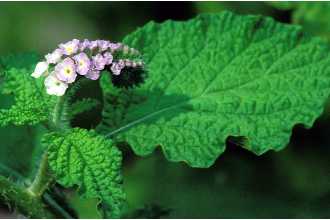
• Colour photo showing flowers and leaves, © Thomas G. Barnes. Barnes, T.G. &
S.W. Francis. 2004. Wildflowers and ferns of Kentucky.
University Press of Kentucky from
http://plants.usda.gov/cgi_bin/topics.cgi?earl=plant_profile.cgi&symbol=HEIN
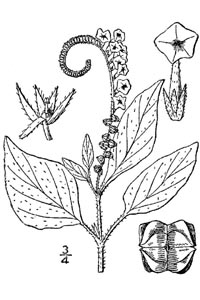
• Photos: left -- habit with flowers and fruits,
right -- wild growing plants
-- KS-TMN
• An annual herb, coarse, succulent; stems stout, cylindrical, with longitudinal grooves, branches ascending, densely hirsute. Leaves alternate or subopposite, simple; exstipulate; petioles obscurely winged; laminae ovate or ovate-oblong, the bases rounded, then narrowed and decurrent into the petiole, the margins crenulate, the tips subacute, unicostate, reticulate, the veins more conspicuous on the lower side, the upper surfaces puberulent, the lower villous. Inflorescences scorpioid cymes, spicate, terminal and unilateral on the peduncle, leaf apposed; bracts lanceolate, persistent. Flowers ebracteolate, sessile, bisexual, actinomorphic, pentamerous, hypogynous. Calyx synsepalous, 5-partite, the lobes linear-lanceolate. Corolla synpetalous, 5-lobed, infundibuliform, the tubes tubular, the lobes orbicular, spreading, imbricate or contorted in bud, naked at the throat, light mauve. Androecium polyandrous, stamens 5, epipetalous, inserted, the filaments very short, alternate with the corolla lobes, the anthers dithecous, ovoid, basifixed, introrse, dehiscence longitudinal. Pistil 1, ovary ovoid, 2-carpelled, syncarpous, 2-loculed, becoming 4-loculed at maturity due to false septation, the ovule 1 in each locule, the placentation axile, at times seemingly basal, the style 1, terminal, the stigma conoid-linear. Fruit a durpe, ovoid, 2-lobed, 4-ribbed, separating into two, 2-seeded, 2-pointed pyrenes; seeds 4, ovoid, endosperm abundant. Flowering period: April-June-October. Fruiting period: July-August-November -- KS-TMN
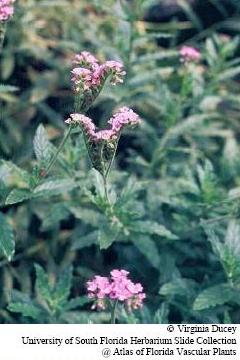 • Description: General: Borage Family (Boraginaceae).
Heliotropium indicum , one of the largest heliotropes found in Texas,
is introduced, and is one of the few annuals within this genus (in Texas).
India heliotrope grows upright (2-3 feet in height) and is very leafy, when compared
to other heliotropes. The leaves are dark green, alternate, entire,
and hispid (hairy). The stems are also hispid. Flowers are blue or violet
(rarely white), and like all heliotropes, the younger flowers are located
towards the tip of the inflorescence (flower cluster), while mature seed are
lower on the flower stalk.
• Description: General: Borage Family (Boraginaceae).
Heliotropium indicum , one of the largest heliotropes found in Texas,
is introduced, and is one of the few annuals within this genus (in Texas).
India heliotrope grows upright (2-3 feet in height) and is very leafy, when compared
to other heliotropes. The leaves are dark green, alternate, entire,
and hispid (hairy). The stems are also hispid. Flowers are blue or violet
(rarely white), and like all heliotropes, the younger flowers are located
towards the tip of the inflorescence (flower cluster), while mature seed are
lower on the flower stalk.
There are approximately 14 species of Heliotropium in Texas.
Most are upland species found in the western portions of the state. Six are
commonly found in wetlands. Most have white flowers, although blue or violet is
not uncommon. Vegetatively, most heliotropes have smallish and narrow leaves and
the growth habit is prostrate, or generally so. The seed head, and the way that
the flowers are restricted to the tips, is very characteristic of the entire genus.
Establishment: Adaptation: This species is found
throughout the eastern half of Texas and as far west as the Edwards Plateau. It
is often found as individual plants scattered within the plant community. It is
commonly found in wetlands, and like other annuals is opportunistic of bare
soils and disturbed sites. Although this species of Heliotropium is
considered a wetland plant, it is seldom found growing on ponded sites, but does
commonly invade bare soil once water recedes from an area. India heliotrope is
particularly fond of clayey bottomland sites. Commonly associated with
Heliotropium indicum are species from the Ludwigia (water primrose),
Polygonum (smartweed), Echinochloa
(millet) and Cyperus (flat sedge) genera.
References: University of South Florida 2001.
Atlas of Florida vascular plants.
Institute of Systematic Botany, Tampa, Florida. Accessed: 21May2001. --
http://plants.usda.gov/cgi_bin/topics.cgi?earl=plant_profile.cgi&symbol=HEIN
• A common weed on road-sides and stream-bed areas. -- KS-TMN
• Leaf -- Astringent; Antipyretic for high fevers; Analgesic; Remedy for sores. Leaf juice -- Excessive lacrimation -- KS-TMN
UKT: Medical terms from AHTD and other sources:
• lac·ri·ma·tion also lach·ry·ma·tion n. 1. Secretion of tears, especially in excess.
 Properties and Effectiveness: Ability to shrink. Cure for high fevers.
Remedy for muscular pains. Cleans wounds and sores, and promotes healing.
Inflammation can be cured by bandaging with fresh leaves.
-- excerpt from Nagathein, free translation by UKT.
Properties and Effectiveness: Ability to shrink. Cure for high fevers.
Remedy for muscular pains. Cleans wounds and sores, and promotes healing.
Inflammation can be cured by bandaging with fresh leaves.
-- excerpt from Nagathein, free translation by UKT.
• Wound healing activity has been reported by Reddy et al. [17].
They showed that topical application of 10% w/v of H. indicum
increased the percentage of wound contraction and completed wound healing
by 14th day indicating rapid epithelization and collagenization.
The control used healed a similar wound in 23 days. An increase of the
tensile strength indicated the increase in collagen facilitating wound healing.
Kugelman et al. [18] isolated the N-oxide of the alkaloid
indicine from H. indicum and observed significant antitumour activity
of the compound in W-256 carcinosarcoma, L-1210 leukemia, P-388 leukemia, P-1534
leukemia and melanoma B-16 tumour systems. On the basis of these results the
compound was selected for human clinical trials. Studies related to the uses
in Mali have not been performed.
17. Reddy JS, Rao PR, Reddy Mada S:
Wound healing effects of Heliotropium indicum,
Plumbago zeylanicum and Acalypha indica in rats.
Journal of ethnopharmacology 2002, 79:249-251.
18. Kugelman M, Lui W-C, Axelrod M, McBride TJ, Rao KV:
Indicine-Noxide: the antitumor principle of
Heliotropium indicum.
Lloydia 1976, 39:125-128.
--- From:Ethnopharmacological survey of different uses of seven
medicinal plants from Mali, (West Africa) in the regions Doila,
Kolokani and Siby by Adiaratou Togola et.al. , Journal of Ethnobiology
and Ethnomedicine 2005, 1:7 doi:10.1186/1746-4269-1-7, Published:
27 September 2005. Received: 23 June 2005. Accepted: 27 September 2005.
This article is available from: http://www.ethnobiomed.com/content/1/1/7
Entry format: Botanical name / Family / Ref. Burmese-Myanmar
transcripts (• Agri.Dept.2000 :
• Chklist: • LSR : • FAO : • KS-TMN:
• Nagathein :
• UHM :/ Myanmar-Script Spelling (•
Official Myanmar Dictionaries : - TravPo-M-Dict - Myan-Engl-Dict - Myan-Ortho
/ Hindi /
Sanskrit / English common name used in Myanmar / Picture /
Plant identification characters / Distribution in Myanmar / Part
used and uses / Constituents /
End of TIL file