 {læÑ-myo}
Adam's apple -
 {sa.loat}
Opening the glottis
Closing the glottis
Pharynx
What the Ancients could not have seen in a live person.
interior.htm
by U Kyaw Tun (UKT) (M.S., I.P.S.T., USA) and staff of Tun Institute of Learning (TIL) . Not for sale. No copyright. Free for everyone. Prepared for students and staff of TIL Research Station, Yangon, MYANMAR : http://www.tuninst.net , www.romabama.blogspot.com
Larynx or voice box -
{læÑ-myo}
Adam's apple -
{sa.loat}
Opening the glottis
Closing the glottis
Pharynx
UKT note
• adduct
• pharyngalisation
• phonation (sound files <)) attached)
• Sapir-Whorf hypothesis (SWH)
• sibilant
• spirant
• thibilant
• thorn
UKT 100413, 180709
Note that this present file is on the articulatory view of sound (vowel) production. To study sound we also have to study the acoustic aspect as well. These two views are not compatible with each other. Then comes the Quantal-Enhancement Theory as developed by K.N. Stevens and his colleagues in 1972.
UKT 180716: I read someone saying that "These two views are not compatible with each other". I'm now trying to find the meaning, and I've the sinking feeling that I'm getting into deeper waters. See what I am reading now: Articulatory modeling and the definition of acoustic-perceptual targets for reference vowels, by Jacqueline Vaissière, 2009, in TIL HD-PDF and SD-PDF libraries:
- JVaissiere-ArticulatAcousticVowels<Ô> / Bkp<Ô> (link chk 180716)
"This paper is a revisit of the notion of Cardinal Vowels, which were mainly described in articulatory terms."
UKT 180716: Instead of extending Cardinal Vowels from 8 to 11, and then to more, as the paper proposes, I just use two dictionaries, such as one for Skt-Dev (by A. A. Macdonell), and another for Pal-Myan (by U Hoke Sein) for understanding Sanskrit and Pali.
So far (100413), I have paid little attention to
it until I came across Quantal Phonetics and
Distinctive Features: a Review , by
George N Clements, and Rachid Ridouane,
Proceedings of ISCA Tutorial and Research Workshop
on Experimental Linguistics, 28-30 August 2006,
Athens, Greece. in TIL HD-PDF and SD-PDF libraries:
-
GNClementsRRidouane-QuantalPhonetics<Ô> /
Bkp<Ô> (link chk 180709)
"This paper reviews some of the basic premises
of Quantal-Enhancement Theory as developed by
K.N. Stevens and his colleagues. Quantal theory seeks
to explain why some articulatory and acoustic
dimensions are favoured over others in distinctive
feature contrasts across languages. " See my
observation below:
Sonority Scale, Noise Intensity and TIL
definitions of Syllable, Word, etc.
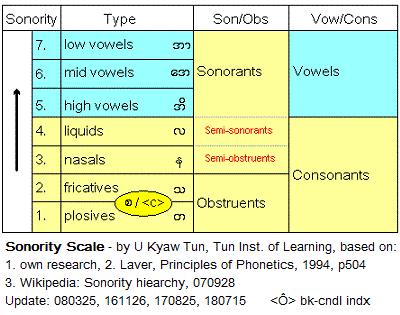


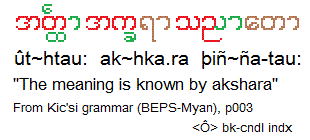 UKT 180715: Hissing and Hushing
fricatives with high Noise intensity are relatively rare in Bur-Myan.
Because of this, BEPS has to be adjusted when Skt-Dev
and Engl-Latin are incorporated into the tables of BEPS consonants and vowels.
Unfortunately, Grammatical terms are not clearly defined for Bur-Myan, and I've
to come up with my own definitions. I can no longer
rely on IPA, and just aim for understanding based on the motto of Shin Kicsi.
UKT 180715: Hissing and Hushing
fricatives with high Noise intensity are relatively rare in Bur-Myan.
Because of this, BEPS has to be adjusted when Skt-Dev
and Engl-Latin are incorporated into the tables of BEPS consonants and vowels.
Unfortunately, Grammatical terms are not clearly defined for Bur-Myan, and I've
to come up with my own definitions. I can no longer
rely on IPA, and just aim for understanding based on the motto of Shin Kicsi.
UKT 180709: For Clinical Anatomy of Vocal Cord, by
Ashutosh S. Mangalgiri, Raza Razvi, G. S. Longia, in
People’s Journal of Scientific Research,
vol. 1, Jul 2008:
-
ASMangalgiriEtAl-AnatomyVocalCord<Ô> /
Bkp<Ô> (link chk 180709)
"Larynx is a multifunctional organ. Laryngeal
cavity is divided into the supra-glottic, glottic
and sub-glottic cavity by vestibular fold (False vocal
cords) and vocal folds (True vocal cords)"
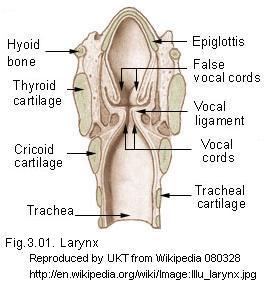 I have said that the vowels are produced in
the larynx. The larynx can thus be taken as
the "Place of Articulation" of the
vowels. In this chapter, we will take up the
larynx itself. We will come to see that what we
called vocal folds are not simple structures, and
the muscles involved in moving them during vowel
production are quite complex. I had been troubled
by my lack of understanding about the vowels,
until I came across the concept of voice
quality (or VQ for short) and then a valuable
source of information in The Phonetic Description
of Voice quality, by John Laver, Cambridge Univ.
Press, 1980. ISBN 0 521 231 760. The book is no
longer available on the market -- there was not even
a single reseller. Finally I got the book in 2007
through Canadian interlibrary loan from Carlton
University in Ottawa. It was available just for
three weeks, and I had to ask my son to scan the whole
book. I then retyped every page copying the
illustrations. It, the html version was in TIL library,
but now lost.
I have said that the vowels are produced in
the larynx. The larynx can thus be taken as
the "Place of Articulation" of the
vowels. In this chapter, we will take up the
larynx itself. We will come to see that what we
called vocal folds are not simple structures, and
the muscles involved in moving them during vowel
production are quite complex. I had been troubled
by my lack of understanding about the vowels,
until I came across the concept of voice
quality (or VQ for short) and then a valuable
source of information in The Phonetic Description
of Voice quality, by John Laver, Cambridge Univ.
Press, 1980. ISBN 0 521 231 760. The book is no
longer available on the market -- there was not even
a single reseller. Finally I got the book in 2007
through Canadian interlibrary loan from Carlton
University in Ottawa. It was available just for
three weeks, and I had to ask my son to scan the whole
book. I then retyped every page copying the
illustrations. It, the html version was in TIL library,
but now lost.
A companion to the above book is Voice Quality and
Indexical Information, by John D. M. Laver, M.A.,
in British J. of Disorders of Communication
(publication date not given), p43-54, in TIL HD-PDF and
SD-PDF libraries.
-
JDMLaver-VQIndxInfo<Ô> /
Bkp<Ô> (link chk 180710)
"As actors in a social world, we interact with
other people by virtue of a constant interchange of
information on many different levels. Perhaps the most
explicit sort of information exchanged in social
intercourse is language, and modem linguistic and
phonetic theory has developed some elegant and effective
concepts for the description of speech, the spoken medium
of language."
How the vowels are produced (or "Manner of Articulation") is also quite complex: described by Laver as articulatory settings. Laver writes, on p012:
The originator of the term 'articulatory setting' was Honikman (1964: 73). But while the term was new, the general concept was not (Laver 1978). Early writers on phonetics such as Wallis (1653), Wilkins (1668), Holder (1669), Cooper (1685) and Herries (1773) all made comments on the settings that characterized the pronunciation of particular languages or particular individuals. While the general concept of a setting was clearly established over three hundred years ago, the concept had to wait for a specific name until the second half of the nineteenth century, when phoneticians such as Sweet, Sievers, Storm, Jespersen and Viëtor became interested in the topic. Kelz (1971) gives an excellent account of the widespread adoption of Felix Franke's term 'Artikulationsbasis', coined earlier but published posthumously in an article in 1889 edited by Jespersen. Franke's term replaced slightly earlier terms such as Siever's 'Operationsbasis', Storm's 'Mundlage', and Sweet's 'Organic basis'. The term in most general use nowadays is the English translation of Franke's original term, 'basis of articulation'
Laver also writes in Introduction on p001:
In his Institutes of Oratory, Quintilian wrote that 'The voice of a person is as easily distinguished by the ear as the face by the eye' (c.III, Book XI). The importance of an individual speaker's voice in everyday social interaction, as an audible index of his identity, personality and mood, could hardly be overstated. Yet we know how only a little more about the factors that give rise to different qualities of the voice than Quintilian did. Abercrombie was recently still able to write, with justification, that 'voice quality is the least investigated' of the different strands in the production of speech (Abercrombie 1967: 91). This book is an attempt to apply the principles of phonetic analysis to the description of voice quality.
This chapter is based on:
• Wikipedia: http://en.wikipedia.org/wiki/Larynx 070920
• Discovering Language, http://www.palgrave.com/PDFs/1403912629.Pdf 070814
• The Phonetic Description of Voice Quality, by John Laver,
http://www.ling.mq.edu.au/ling/units/sph302/papers/laver_1980_nasal.pdf 071029
http://www.ling.mq.edu.au/ling/units/sph302/papers/laver_1980_phonation.pdf 071024
• The Analysis of Voice Quality in Speech Processing, by Eric Keller, eric.keller@unil.ch www.unil.ch/webdav/site/imm/users/ekeller/public/keller/Keller_04_VoiceQuality.pdf 071101
(I feel that what I have given below is quite extensive, and needs to be simplified. My apologies to the reader.)
- n. part of the neck above the Adam's apple -- MEDict453
- the larynx (Pali: {gau:thi.tra.} -- UHS-Dict740Skt-Devan: कण्ठ-कूप kaṇṭha-kūpa m. cavity of larynx - SpkSktDict
Skt-Devan: ध्वनि पेडिका dhvani peḍikā noun voice-box - SpkSktDict
Skt-Devan: ध्वनि नन्तुः dhvani nantuḥ noun vocal-cords - SpktSktDict
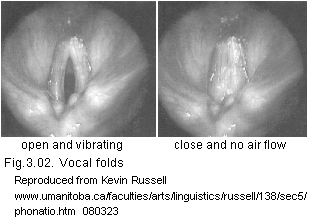
 So far, we have not been saying much about the vocal cords. Are they really
"cords" like the guitar strings? They are not, since the masses of tissue are
actually not cords. The term "vocal cords" originated with an early erroneous
anatomical study (UKT: from a footnote on p.59, Dicrete-Time Speech Signal
Processing: Principles and Practices, by T. F. Quatreri, Prentice-Hall
Signal Processing Series, paperback 2001.
http://vig.pearsoned.co.uk/samplechapter/013242942X.pdf 080323.) Because of
this, some people prefer to use the word "fold" instead of "cord".
They are two flaps of tissues attached to the cartilages of the larynx or (voice box in the
area of Adam's apple of your throat). Muscles can move the cartilages in order
to adjust the position and tension of the vocal folds.
So far, we have not been saying much about the vocal cords. Are they really
"cords" like the guitar strings? They are not, since the masses of tissue are
actually not cords. The term "vocal cords" originated with an early erroneous
anatomical study (UKT: from a footnote on p.59, Dicrete-Time Speech Signal
Processing: Principles and Practices, by T. F. Quatreri, Prentice-Hall
Signal Processing Series, paperback 2001.
http://vig.pearsoned.co.uk/samplechapter/013242942X.pdf 080323.) Because of
this, some people prefer to use the word "fold" instead of "cord".
They are two flaps of tissues attached to the cartilages of the larynx or (voice box in the
area of Adam's apple of your throat). Muscles can move the cartilages in order
to adjust the position and tension of the vocal folds.
Fig.3.03 from: Discovering Language, The Structure of Modern English, by Lesley Jeffries, Palgrave Macmillan, 2006. http://www.palgrave.com/PDFs/1403912629.Pdf download 070814
The vocal folds can be fully open or fully closed,
or somewhere in between. If they can vibrate,
we have the "voiced"
phonation as in the production of
 {ga., da. ba.}. We can feel the vocal folds vibrating by
placing our fingers lightly over the area of the Adam's apple.
They do not vibrate (or vibrate very slightly) in
"voiceless phonation" as in the case of saying c1-aksharas
{ga., da. ba.}. We can feel the vocal folds vibrating by
placing our fingers lightly over the area of the Adam's apple.
They do not vibrate (or vibrate very slightly) in
"voiceless phonation" as in the case of saying c1-aksharas
 {ka. ta. pa.} and c2-aksharas
 {hka. hta. hpa.}. In pronouncing c3-aksharas
{ga., da., ba.} we can feel the folds vibrate, and the consonants
are described as "voiced" (vd). Consonants
{hka., hta. hpa.} are described as "voiceless" (vl).
The corresponding allophones
{ka. ta. pa.} are also voiceless but because of their lack of "aspiration"
are described as "tenuis" /'ten.ju|.ɪs/.
{hka. hta. hpa.}. In pronouncing c3-aksharas
{ga., da., ba.} we can feel the folds vibrate, and the consonants
are described as "voiced" (vd). Consonants
{hka., hta. hpa.} are described as "voiceless" (vl).
The corresponding allophones
{ka. ta. pa.} are also voiceless but because of their lack of "aspiration"
are described as "tenuis" /'ten.ju|.ɪs/.
We must remember that there's more than one way the vocal folds can vibrate. And, there's more than one way they can fail to vibrate.
Except for some consonants, I haven't indicated where each consonant is produced. If you would like to see the POAs of all consonants, see the IPA table and table of English consonants in my notes in the BG4M2-indx. The most prominent part you can see in the interior of the mouth is the uvula which is one of the POAs. However, sounds (such as vowels and "h") are produced further back in the throat -- in the larynx , areas which are almost unknown until recently.
 The larynx (plural larynges), colloquially known as the
voice box, is an organ in the neck of mammals involved in protection
of the trachea and sound production. The larynx houses the vocal folds,
and is situated just below where the tract of the pharynx splits
into the trachea (windpipe) and the esophagus ("food"-pipe).
The larynx (plural larynges), colloquially known as the
voice box, is an organ in the neck of mammals involved in protection
of the trachea and sound production. The larynx houses the vocal folds,
and is situated just below where the tract of the pharynx splits
into the trachea (windpipe) and the esophagus ("food"-pipe).
Human voice sound is produced in the larynx, and that is where pitch (related to fundamental frequency) and volume (loudness) are manipulated. The strength of expiration (out-going breath) from the lungs also contributes to loudness, and is necessary for the vocal folds to produce speech.
Fine manipulation of the larynx is used in a great way to generate a source sound with a particular fundamental frequency, or pitch. This source sound is altered as it travels through the vocal tract, configured differently based on the position of the tongue, lips, mouth, and pharynx. The process of altering a source sound as it passes through the filter of the vocal tract creates the many different vowel and consonant sounds of the world's languages.
UKT: The word "filter" found in linguistics is not the kind familiar to a layman or a chemist. It simply means a place of obstruction.
filter n. 1. a. A porous material through which a liquid or gas is passed in order to separate the fluid from suspended particulate matter. b. A device containing such a substance. -- AHTD
Because I am a chemist, this word has stood in the way of my understanding of phonetics for a long time. This brings to mind one of my favorite hypothesis in linguistics: The Sapir-Wolfe hypothesis -- http://en.wikipedia.org/wiki/Sapir-Whorf_hypothesis 071221, I have summed this up: "You can see only what your preconceived ideas would allow you to see."
During swallowing, the larynx (at the epiglottis/glottis) is closed to prevent swallowed material from entering the lungs; the larynx is also pulled upwards to assist this process. However, sometimes some swallowed material (either solid or liquid) does enter stimulating the larynx. A strong cough reflex sets in expelling the wayward material to protect the lungs .
The vocal folds can be held close together (by adducting the arytenoid cartilages), so that they vibrate (see phonation or voicing in later chapters.). The muscles attached to the arytenoid cartilages control the degree of opening. Vocal fold length and tension can be controlled by rocking the thyroid cartilage forward and backward on the cricoid cartilage, and by manipulating the tension of the muscles within the vocal folds. This causes the pitch of the voice produced during phonation to rise or fall.
Now, let's go into the subject a little deeper. (This portion is mainly from Laver). We need to go into this because whenever we describe a Burmese-Myanmar vowel or consonant, we describe it in terms of the "creaky voice", whereas, the English vowels and consonants are described in terms of the "modal voice". (UKT: I am waiting for input from my peers.). To describe what is meant by voice or voicing, we need to go into the articulations in the larynx.
UKT: Whenever you search the internet on Burmese or Myanmar language, you would come across what is being described as "creaky tone" in Burmese. What is this "tone" that is quite rare in the world languages? That has been my quest -- not exactly "creaky voice".
But if you know what creaky voice sounds like, you would be able to guess what a small segment called "creaky tone" is. I have found out it is no other than {a.} of the three vowels
{a. a a:}.
See Burmese Script: http://en.wikipedia.org/wiki/Burmese_alphabet 071113
Burmese language itself has been described as a tonal language, and then as a register language. Another term for 'register' is 'pitch-register' and so I am describing Burmese as a pitch-register language. And the three pitch-registers
In a way, the larynx is made mostly of cartilages. These are the thyroid, the crioid and the paired arytenoid cartilages. Fig.13 is a schematic diagram of the relative position of these cartilages.
From: Clinical Anatomy of the Vocal Cord, by Ashutosh S. Mangalgiri, Raza Razvi, and G. S. Longia, 2008
- ASMangalgiriEtAl-AnatomyVocalCord<Ô> / Bkp<Ô> (link chk 180710)
"Larynx is a multifunctional organ. Laryngeal cavity is divided into the supra-glottic, glottic and sub-glottic cavity by vestibular fold (False vocal cords) and vocal folds (True vocal cords)."
Laryngeal primordia appears at approximately 33 days of gestation. At this stage auditus becomes ‘T’ shaped by the growth of epiglottis in anterior direction while arytenoid cartilages grow in the lateral direction. [UKT ¶]
The adult larynx is about 5 cm in length in males and shorter in females. Longer length in males is due to larger growth after puberty. Larynx descends from the level of C5 vertebra at the age of 2 years to C6 – C7 in adult position. [UKT ¶]
During this descend the relationship between the internal and external parts of the
larynx is maintained. The position of true vocal cords remains midway between
the thyroid notch and lower border of thyroid cartilage. The narrowest part of
larynx in children is subglottic region and rima glottidis in adults (O’ Neill
et al, 1998).
The larynx serves three basic functions. First it protects the respiratory passage against invasion of the food and foreign bodies. Secondly it maintains the patency of airway thereby helps in respiration and lastly it also serves as organ of phonation. Most primitive and primary function of the larynx is protection of the lower airway. Larynx first evolved as sphincter for prevention of ingress of water into the airway of lungfish, but with subsequent evolution of the dilators, active opening is permitted (Negus, 1949).
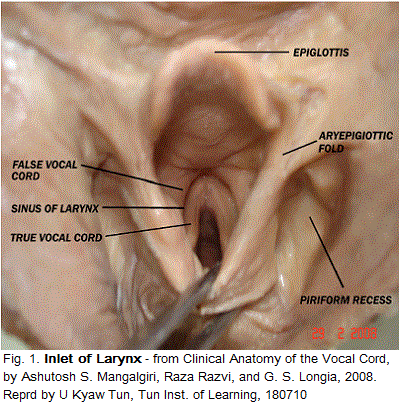

The inlet of the larynx is set obliquely facing backwards (Fig.1). The inlet bounded anteriorly by the upper border of the epiglottis. The aryepiglottic fold containing aryepiglottic muscles and corniculate and cuneiform cartilages. The inlet is related laterally on each side to the piriform recess of the laryngopharynx. [UKT ¶ ]
The cavity of the larynx is divided into the supraglottic, glottic and sub-glottic cavity, by two pairs of horizontal folds, the vestibular and vocal folds as shown in figure 2. Vestibular folds are also termed as false vocal cords and vocal folds are termed as true vocal cords. Each vocal fold consists of central part formed by muscle, intermediate part formed by conus elasticus consisting of layers of collagen and elastic tissue which in turn is covered by epithelium and superficial layer of lamina propria (Reinke’s space) as shown in figure 3 (Cummings et al, 2005).

The thyroid is the big, shielding cartilage protecting the front and sides of the larynx from injury. It forms the 'Adam's apple' in male speakers. The muscles which make up the true vocal folds and the ventricular folds are attached to the front, internal surface of the thyroid, at the point where the lateral plates fuse together.
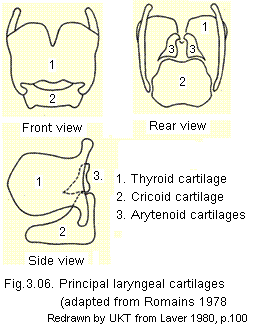 The cricoid [{UKT: so named because of its similarity in shape to a signet
ring}] lies immediately below the thyroid. Together with the thyroid, it forms an
effective external protective structure for the rest of the larynx.
The cricoid [{UKT: so named because of its similarity in shape to a signet
ring}] lies immediately below the thyroid. Together with the thyroid, it forms an
effective external protective structure for the rest of the larynx.
The arytenoid cartilages, can rotate vertically and horizontally to a certain extent, as well as slide from side to side on the cricoid. They are shaped somewhat like small pyramids on a triangular base. The posterior ends of the true vocal folds are attached to the lower, forward angles of the arytenoids, called the vocal processes [{vocal tissues}]. The posterior ends of the ventricular folds are attached to the apex of each arytenoid.
UKT: The term 'process' in Biology means "An outgrowth of tissue; a projecting part: a bony process." -- not "a series of actions" . See AHTD
The thyroid is connected to the hyoid bone above it by the thyrohyoid muscle and ligament. When the larynx rises, pulled up by the action of the thyrohyoid muscle, or of the stylpharyngeus muscle (which runs from the skull nearly vertically downwards at each side of the pharynx to insert in the back edge of the thyroid), the thyroid 'slips up under cover of the hyoid' (Kaplan 1960: 115).
The thyroid is also connected not only to the arytenoid cartilages, as stated immediately above, but also to the cricoid, the the paired cricothyroid muscle. This runs upwards, backwards and laterally from the outer surfaces of the forward part of the cricoid to insert in the lower edge of the thyroid. The effect of its contraction is to pull the front of cricoid ring upwards towards the thyroid, which has the mechanical consequences of rotating the back of the cricoid, with its attached arytenoids, downwards and backwards from its neutral position. This lengthens and tenses the vocal folds, thus contributing to pitch control in phonation, and to the small changes in phonatory quality arising from changes in the fine detail of the cross-section of the folds. This retraction of the cricoid also tends to bring the vocal folds slightly closer to each other.
The laryngeal muscles of interest here fall into two groups:
• firstly, those
which, like the cricothyroid, can change the positions of the cricoid relative
to the thyroid; and
• secondly, those which affect chiefly the positions
of the arytenoids relative to the cricoid.

The muscles which can change the position of the cricoid relative to the thyroid are the cricothyroid muscles, and the paired thyroarytenoid muscles, which make up the true vocal folds and the ventricular folds. The thyroarytenoids, running from a fixed attachment at the fused angle of the thyroid to the mobile arytenoids, as noted above, are described by Heffner as follows:
Each [side] is divided into two parts -- an upper and a lower -- by a ventricle (meaning "a small cavity or chamber"), which undercuts the upper portion throughout most of its length. The lower portion of each thyroarytenoid muscle is attached to the vocal process [{tissue}] of the arytenoid cartilage. The upper portion is attached to the body and the upper tip of the arytenoid. Indeed, some of the upper fibers of the upper portion of the muscle run on upward into the folds which join the arytenoids with the edges of the epiglottis [i.e. the aryepiglottic folds]. When contracted, the thyroarytenoid muscles tend to draw the arytenoids forward, at the same time tilting them towards the thyroid cartilage. ... The upper portions of this pair of muscles, with their covering mucous tissue, are known as the ventricular folds. ... The lower portions ... have a name of their own, the vocalis muscles [and they] constitute the vocal bands. ... In cross-section the vocal bands are triangular, being shaped much like the cushions of a billiard table, and only their median edges are free. (Heffner 1950: 17-18)
The ventricle mentioned is the ventricle of Morgagni, and it should be pointed out that the ventricular folds have a rather different composition of tissue than the true folds: Kaplan describes the ventricular folds as thick rounded folds of mucous membrane developed around the ventricular ligaments. They are soft and somewhat flaccid. Each contains ... a few muscle fibers and numerous mucous glands (Kaplan 1960: 124-5). Saunders (1964: 73) confirms that they contain only a few muscle fibres. Their vibration will therefore tend to be inefficient, with hypertension needed to adduct them sufficiently to phonate.
Longitudinal tension (LT) of the true and ventricular vocal folds can thus be achieved by two different actions. The first action is that of retraction and slight vertical rotation of the the cricoid by means of the cricothyroid muscle, which puts longitudinal tension on the vocal folds by stretching them. The second action is the contraction of the muscles which make up the vocal folds themselves, the thyroarytenoids.
The second category of muscles, those which control the positions of the arytenoid cartilage relative to the cricoid, have the function of opening and closing the glottis. Biologically vital in helping to control the airway to and from the lungs, they are small but powerful muscles, and are capable in combination of setting the glottis in a wide variety of adjustments. Figure 15 is a schematic diagram of these muscles and their action.
Remember that muscles can only contract. Therefore, two sets of muscles are needed: one set to open the glottis, and the other to close it.
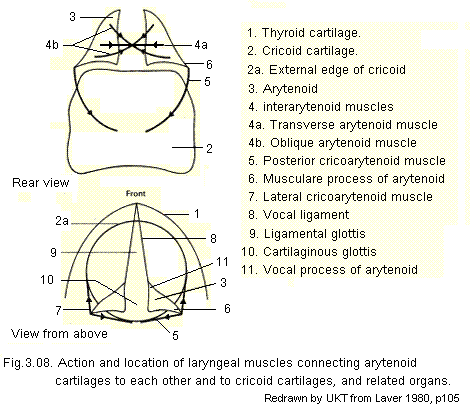
Only one muscle is normally used to open the glottis, the paired posterior cricoarytenoids [#5 fig.15] (Kaplan 1960: 150). These arise from the back, outer surface of the cricoid and run upwards to the side to join the arytenoids on their rearmost angles, called the muscular processes [{tissues}}. Their contraction pulls the muscular processes in an arc towards the back, and the effect is to rotate the arytenoids, pivoting the other ends of the arytenoids, the vocal processes to which the vocal folds are attached, outwards. Haffner (1950: 20) says that this happens 'at every normal inhalation'.
In speech, their action is the major contributor to opening the glottis for voicelessness. Heffner continues: 'The action of these muscles is opposed to and can thus be controlled by the direct pull of the lateral cricoarytenoids and also by the direct pull of the thyroarytenoid muscles. The unopposed pull of the posterior cricoarytenoids widens the opening between the vocal bands to its maximum' (Heffner ibid.).
The muscular action which closes the glottis is more complex. The lateral cricoarytenoids [#7 fig.15] run backwards fro the outer and upper surface of the cricoid on both sides, and like the posterior cricoarytenoids, are attached to the muscular processes of the arytenoids. In contraction, as indicated above, the lateral cricoarytenoids directly opposes the action of their posterior counterparts, and swivel the arytenoid cartilages forward and inward, 'toe-ing' the vocal processes inwards. This action brings the vocal folds together, and closes the glottis along its length from the vocal processes of the arytenoids to the thyroid cartilage.
There are two other muscular actions which help to close the glottis along its full length. The first is that of the arytenoid muscle complex. The arytenoid muscle (sometimes referred to as the interarytenoid muscle) is made up of two sets of fibres: one of these sets is the transverse arytenoid muscle [#4a fig15], which is an (unpaird) thick, rectangular mass covering the entire deep posterior surface of both arytenoids. It may be considered to originate along the muscular process and lateral border of one arytenoid and to cross over to reach the lateral edge of the other arytenoid. It draws the arytenoids medially by a gliding action which adducts the vocal folds. [{The action is "similar" (but not the same) as pulling the strings of the purse (money bag) to close it. This is what the term "adduct" means.}}
It opposes the action of the lateral cricoarytenoids. The other part of the arytenoid muscle complex is the oblique arytenoid muscle [#4b fig15]. It is a paired muscle in the form of the letter X, and it lies behind the transverse muscle, on its outer surface. Each branch of the oblique muscle starts low down on the backmost surface of the arytenoid and rises crossing to the highest angle of the other arytenoid. Its contraction tilts the tops of the arytenoids towards each other, and in conjunction with the transverse part of the arytenoid muscle, helps to adduct the vocal folds.
The second muscular action which can help to close the glottis is the contraction of the muscles forming the vocal folds themselves, the thyroarytenoids. The thyroarytenoids makes a double contribution. The vocalis muscles (the part of the thyroarytenoides which make up the medial body of the folds nearest to the edges of the glottis) contract to exert longitudinal tension (LT) in the vocal folds, which reduces the length of the glottis. Contraction of the outer, lateral parts of the thyroarytenoid muscles helps the lateral cricoarytenoids to bring the vocal processes of the arytenoids together.
To summarize the muscular actions which lead to glottal closure, then, van den Berg writes
A contraction of the (powerful) interarytenoid muscles primarily adducts the apexes of the arytenoids and closes the back part of them so that no wild air can escape ... A contraction of the lateral cricoarytenoid muscles adducts the apexes of the arytenoids and closes the back part of them so that no wild air can escape ... A contraction of the latereal cricoarytenoid muscles adducts the vocal processes of the arytenoids and therefore the body of the vocal folds. This adduction is agumented by a contraction of the lateral parts of the thyroarytenoid muscles (this contraction goes along with an adduction of the vocal folds). These adductional forces provide a medial compression of the vocal folds and reduce the length of the glottis which is effectively free to vibrate. (van den Berg 1968:294)
It is useful to set up a simple map for discussing the different locations in the glottis which are relevant to the characteristics of the different types of phonation. A useful point of reference for this is the vocal ligament, which runs along the glottal edge of each vocal fold at the point where it normally makes contact with the other. We can then follow Catford (1964: 32) in using the term 'glottal', without any further qualification, to mean the whole length of the opening between the true vocal folds, from the front angle of the thyroid cartilage to the back of the arytenoids ; and we can distinguish the ligamental glottis, which is part of the full glottis formed by the vocalis muscles, with the length of the vocal ligaments along each edge, as opposed to the cartilaginous glottis, in the stretch where the arytenoid cartilages are located. The dimensions of these sections are of interest: Morris (1953) says that the 'intermembranous' (ligamental) part of the glottis is normally about 15.5 mm in the male, and 11.5 mm in the female. The length of the cartilaginous glottis is about 7.5 mm in the male and 5.5 in the female. This makes the full glottal length in males about 23 mm, and about 17 mm in females. Kaplan (1960: 128) adds that 'The widest part of the glottis is 6 to 8 mm in the male and this can increase to about 12 mm, according to condition.'
The nature of the glottis tempts one to regard it as a two-dimensional space; and for many phonetic purposes, that is sufficient. But in the case of contributions to the fine detail of phonatory quality, the need to take account of the changing three-dimensional configuration of the space between the vocal folds is very similar to the situation at the other end of the vocal tract, at the lips. The changing vertical thickness of the vocal folds from the outer wall inwards to the vocal ligaments at the edge of the glottal space reflects the interplay of the different tensions that are exerted in and on the folds by the laryngeal musculature, and this third, vertical dimension is one factor among others which differentiates the major settings of the phonatory mechanism.
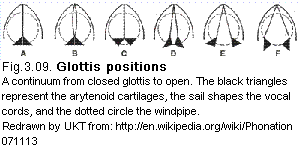
Watching the vocal folds in action during normal breathing would convince you that the movements are not like the action of a trap-door, nor that of camera shutter. It is very complex and to think of the action as if happening in a two-dimensional space (as would be suggested by the diagrams of Ladefoged for glottis positions) would give you an erroneous impression. The situation is very similar to the action of the lips during speaking -- perhaps more complex.

 Animations from:
http://www.ims.uni-stuttgart.de/phonetik/EGG/page5a.htm
• Left: speaking • Right: quiet breathing
You can also go online to the Univ. Stuttgart site.
During normal breathing the glottal area is more open
(about 1 sq-cm) while during phonation the area
is much reduced (0.05 to 0.1 sq-cm.). During speaking (phonation),
the movements are more complex.
 We are now in a position to isolate some parameters of laryngeal control which
are relevant to our discussion of different phonatory settings. From the account
of laryngeal physiology offered above, three parameters of muscular tension
emerge which have to interact with aerodynamic factors of pulmonic airflow and
pressure. They are adductive tension (AT), medial compression (MC)
and longitudinal tension (LT). The second of these, medial compression,
is the factor most in need of definition. The medial compression is a composite adductive
product of the action of number of muscles, including the interarytenoids, the
lateral cricoarytenoids and the lateral parts of the thyroarytenoids. This
conception of medial compression overlaps that of adductive tension, and it will
convenient to try to distinguish these two effects more sharply. One useful
purpose in creating a distinction in this area is to facilitate a
differentiation of phonatory settings, and to offer a tentative
We are now in a position to isolate some parameters of laryngeal control which
are relevant to our discussion of different phonatory settings. From the account
of laryngeal physiology offered above, three parameters of muscular tension
emerge which have to interact with aerodynamic factors of pulmonic airflow and
pressure. They are adductive tension (AT), medial compression (MC)
and longitudinal tension (LT). The second of these, medial compression,
is the factor most in need of definition. The medial compression is a composite adductive
product of the action of number of muscles, including the interarytenoids, the
lateral cricoarytenoids and the lateral parts of the thyroarytenoids. This
conception of medial compression overlaps that of adductive tension, and it will
convenient to try to distinguish these two effects more sharply. One useful
purpose in creating a distinction in this area is to facilitate a
differentiation of phonatory settings, and to offer a tentative
 physiological explanation for some observed incompatibilities
between settings which inhibit their co-occurrence.
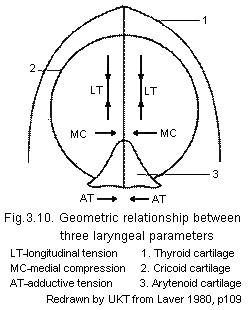
For this specific purpose, adductive tension (AT) will be
defined here as the tension of the interarytenoid muscles, whose consequence
will be to bring the arytenoid cartilages together, closing the cartilaginous
glottis and hence also the ligamental glottis. Medial compression (MC) will be
defined as the compressional pressure on the vocal processes of the
arytenoid cartilages achieved by contraction of the lateral cricoarytenoid
cartilages achieved by contraction of the lateral cricoarytenoid muscles and
reinforced by tension in the lateral parts of the thyroarytenoid muscles.
physiological explanation for some observed incompatibilities
between settings which inhibit their co-occurrence.
For this specific purpose, adductive tension (AT) will be
defined here as the tension of the interarytenoid muscles, whose consequence
will be to bring the arytenoid cartilages together, closing the cartilaginous
glottis and hence also the ligamental glottis. Medial compression (MC) will be
defined as the compressional pressure on the vocal processes of the
arytenoid cartilages achieved by contraction of the lateral cricoarytenoid
cartilages achieved by contraction of the lateral cricoarytenoid muscles and
reinforced by tension in the lateral parts of the thyroarytenoid muscles.
Medial compression will close the ligamental glottis, but whether the cartilaginous glottis also closes will depend on the analytically separate adductive tension achieved by the interarytenoid muscles. A possible acoustic correlate of medial compression is discussed in Chapter 4. Longitudinal tension (LT), straightforwardly, is achieved by contraction of the vocalis and/or the cricothyroid muscles. The geometric relationship of these three parameters is illustrated schematically in Fig.16. Each different phonatory setting will be seen to have different specifications in terms of these three physiological parameters.
The sound signal- carrying air puffs after leaving the glottis travels upwards along the pharynx. It is not a rigid pipe opening into the mouth and nasal cavities, but is a channel controlled by muscles which also have control over the soft palate, cheek, tongue, lips and jaw.


 Click
on figure to enlarge.
Click
on figure to enlarge.
Fig.3.11. Muscles of larynx - lateral view
a: Line drawing indicates the constrictor and suspensory musculature of the pharynx viewed from the side.Fig.3.12. Muscles of larynx - lateral view
b: Sagittal line drawing showing structures in the sagittal plane including the tongue, soft palate, epiglottis, vestibule, false and true cords, arytenoid mass, cricoid cartilage, and trachea.Fig.3.13. Pharynx: opened posterior view
This pix shows what you would see if you could make yourself small enough to ride the little puff of air that has come out of the glottis. Notice the Uvula at the entrance to the mouth cavity. Further up, you could see the entrance to the two nasal chambers.All the 3 figures are from: Bronwyn Jones, Radiographic evaluation of motility of mouth and pharynx, 2006. http://www.nature.com/gimo/contents/pt1/full/gimo25.html 071208.
The pharynx, acting like a pipe, acts like a resonator. However, since it is made up of soft tissues instead of a hard metal surface can also absorb some sound energy and re-emit some again changing the nature of the sound that has come out of the glottis.
UKT: Closing the vocal opening, by drawing the folds together with the respective muscle(s) is known as adduction. The opposite is abduction. See below:
adduct v. tr. adducted adducting adducts Physiology 1. To draw inward toward the median axis of the body or toward an adjacent part or limb. [Back-formation from adductor ] adduction n. adductive adj. -- AHTD
abduct v. tr. abducted abducting abducts 1. To carry off by force; kidnap. 2. Physiology To draw away from the midline of the body or from an adjacent part or limb. [Latin abdūcere abduct- ab- away; See ab- 1 d ūcere to lead; See deuk- in Indo-European Roots.] ab· -- AHTD
The word is commonly used for <kidnapping> -
 {pran-pé:hswè:hkring;}
Go back adduct-note-b
From:
• Wikipedia http://en.wikipedia.org/wiki/Pharyngealization 071113
• John Clark and Colin Yallop, An Introduction to Phonetics and Phonology, 2nd ed., Google Book Search 071113
UKT: Though I am not certain for the present (071113), pharyngalisation and possibly velarization appears to be the formation of {wa.hswè:} and/or {ha.hto:}. With {la.} these processes result in {lwa.}, {lha.}, {lhwa.}. Or, {ya.ping.} and {ha.hto:} to produce {lya.} , {lhya.}. I am waiting comments from my peers.From Wikipedia:
Pharyngealization is a secondary articulation of consonants or vowels by which the pharynx or epiglottis is constricted during the articulation of the sound. Arabic uses phonemic secondary pharyngealization for the " emphatic" coronal consonants. The letter ʿayn represents a pharyngeal fricative or approximant in most dialects. Ubykh, a Northwest Caucasian language formerly spoken in Russia and Turkey, uses pharyngealization in 14 pharyngealized consonants. Chilcotin has pharyngealized consonants that trigger pharyngealization of vowels. Many languages (e.g. Salishan, Sahaptian) in the Plateau culture area of North America also have pharyngealization processes triggered by pharyngeal or pharyngealized consonants that affect vowels. In Danish many of the vowel phonemes have distinct pharyngealized qualities, and in the Tuu languages epiglottalized vowels are phonemic.
Excerpt from machine translation of Wikipedia (in French)
http://fr.wikipedia.org/wiki/Pharyngalisation 070918
"It is found frequently associated with the consonants,
in languages such as Arabic (all the dialects of Arabic
do not use this articulation). One finds in the Arabic handbooks
the term of emphatic consonant. In this language, one opposes
the simple consonants and their emphatic alternative.
Anisi the sounds t, d, s have
an emphatic alternative. In descriptive phonetics,
it is acted in fact of a pharyngalisation.
"Let us specify however that the term emphatic in
the current description of the Semitic languages
always does not indicate same reality. Indeed, in
Hebrew, the emphatic consonants are glottalized consonants (cf
glottalisation).
"From an articulatory point of view, the consonant is
jointly marked with a constriction on the level of the pharynx.
This particular movement of the pharynx is found in
two consonants of Arabic, the fricative pharyngal ones.
"It seems that one can distinguish according to "
langues des articulations plus ou moins
'hautes' ou 'basses'. "
From: J. Clark & C. Yallop
Velarization and pharyngealization
Velarization and pharyngealization involve moving the tongue body and root from
their neutral vocal tract position towards the positions for the vowels [u] and
[ɒ]. Since the tongue body posture is adjusted, these articulations always occur
simultaneously with the basic articulatory gesture. The so-called 'dark l'
referred to above in contrast with (simultaneously palatalized) 'clear l' is
velarized to some extent. In Arabic, the so-called 'emphatic' consonants are
either velarized or pharyngealized. There appear to be no languages which employ
both velarization and pharyngealization. Ladefoged (1971) uses superscript
vowels to distinguish them [e.g. [lu] versus [lɒ]). A more
common practice, followed here, is to place a tilde through the main symbol as a
general marker for either of the two complex articulations, e.g. [ɫ].
(UKT: Because, I am copying this from Google Book Search [lu]
and [lɒ] may be in error.)
Go back pharyngalisation-note-b
From:
• Wikipedia http://en.wikipedia.org/wiki/Phonation download 070928
• EGG and Voice quality: http://www.ims.uni-stuttgart.de/phonetik/EGG/page6.htm#1 download 071008
• Hyperphysics: http://hyperphysics.phy-astr.gsu.edu/hbase/music/voice.html download 071111
We will be taking Phonation up as one of the sections in later chapters.UKT:
• Phonation, due to vocal fold vibrations, is involved in the production of vowels. Therefore, the vowels are always voiced. Exceptions are said to be possible, and if so, are not important. During the production of consonants, the vocal cords may or may not be vibrating, producing voiced and voiceless consonants.
• More on phonation as a separate section in a later chapter. See Phonation -- the first variable of voicing, in The Phonetic Description of Voice quality, by John Laver, Reader in the Department of Linguistics, University of Edinburgh. Cambridge Univ. Press, Cambridge, London, New York, New Rochelle, Melbourne, Sydney. 1980. First published 1980. ISBN 0 521 231 760. The digitized version of the whole book is available in TIL library in scanned version, and also in HTML version for research purposes only. The pdf version of some portions of the book are available online: http://www.ling.mq.edu.au/ling/units/sph302/papers/laver_1980_phonation.pdf 071024.
From: Wikipedia
In phonetics, phonation is the "use of the laryngeal system to generate an audible source of acoustic energy, i.e., sound, which can then be modified by the articulatory actions of the rest of the vocal apparatus."
Phonation has traditionally been seen as one dimension of phonetic voicing, the degree of glottal tension. (A second dimension of voicing is timing, called voice onset time (VOT). When a sound is described as "half voiced", it may not be clear whether it is quality (phonation) or quantity (VOT) that is referred to.)
However, with recent advances in imaging technology,
it has become apparent that in many languages phonation
involves more than just the glottis.

Voicing: A voiced sound is produced
when air expelled from the lungs causes the vocal folds
to vibrate. This produces a fundamental tone
accompanied by several non-harmonic overtones.
The resulting sound is modified by movements in the vocal tract,
by the volume of the airflow and by the degree of constriction
of the vocal cords. (During speech the flow of air is
relatively small because of constrictions of the vocal cords.)
Vowels are usually voiced, as are many consonants.
If the vocal folds are lax and not sufficiently close to vibrate, then the sound (usually a consonant) is voiceless.
The vocal vibration is varied to produce intonation and tone. This is accomplished by varying the pressure of the air column under the glottis as well as the tension in the vocal folds themselves. These actions produce changes in the frequency of vocal-cord vibration, which generates the fundamental pitch of the voice. Tone and intonation are not conveyed well by voiceless sounds, with their lax vocal folds, but the changes in airflow are still audible.
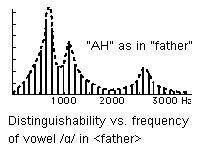
UKT: The graph on the right is from: http://hyperphysics.phy-astr.gsu.edu/hbase/music/voice.html 071113 . It shows the how the vowel in <father> can be distinguished by measuring formants which are related to frequency of the vowel in <father>. The figure on the left shows how "puffs" of air come out of the glottis during production of human voice. We deal with formants in one of the later chapters.
From: EGG and Voice quality
Laver (1994:184) defines phonation as the use of the laryngeal
system to generate an audible source of acoustic energy (the source in the
sense of the source-filter model of speech production) which can then be
modified by the articulatory actions of the rest of the vocal apparatus (the
filter in the source-filter model). The main function of the larynx is to
transform the potential energy of the air compressed below the larynx into the
kinetic energy of egressive airflow. If the transformation occurs sufficiently
fast the air pressure changes generate acoustic waves that expand into the
surrounding air (Orlikoff & Kahane, 1996:127). A more detailed description of
the phonation process will be given in the next section. For the moment it is
sufficient to consider only the basic types of phonation.
• Creaky voice <)) [online from
http://www.ims.uni-stuttgart.de/phonetik/EGG/creak.wav 101030
<)) ]
• Breathy voice <)) [online from
http://www.ims.uni-stuttgart.de/phonetik/EGG/breathy.wav 101030
<)) ]
• Harsh voice <)) [online from
http://www.ims.uni-stuttgart.de/phonetik/EGG/harsh.wav 101030
<)) ]
• Falsetto <)) [online from
http://www.ims.uni-stuttgart.de/phonetik/EGG/falsetto.wav 101030
<)) ]
• Pharyngalized voice <)) [online from
www.ims.uni-stuttgart.de/phonetik/EGG/pharyn.wav 101030
<)) ]
• Nasalized voice <)) [online from
www.ims.uni-stuttgart.de/phonetik/EGG/nasal.wav 101030
<)) ]
Go back phonat-note-b
From: http://en.wikipedia.org/wiki/Quintilian 071124
Marcus Fabius Quintilianus (ca. 35-ca. 100) was a Roman rhetorician from Hispania [{the name given by the Romans to the whole of the Iberian Peninsula}], widely referred to in medieval schools of rhetoric and in Renaissance writing. In English translation, he is usually referred to as Quintilian, although the alternate spellings of Quintillian and Quinctilian are occasionally seen, the latter in older texts.
Life: Quintillian was born ca. 35 in Calagurris (now Calahorra, La Rioja)) in Hispania. His father, a well-educated man, sent him to Rome to study rhetoric early in the reign of Nero. While there, he cultivated a relationship with Domitius Afer, who died in 59. "It had always been the custom … for young men with ambitions in public life to fix upon some older model of their ambition … and regard him as a mentor" (Kennedy, 16). Quintilian evidently adopted Afer as his model and listened to him speak and plead cases in the law courts. ... Of his personal life, little is known. In the Institutio Oratoria, he mentions a wife who died young, as well as two sons who predeceased him.
Works: The only extant work of Quintilian is a twelve-volume textbook on rhetoric entitled Institutio Oratoria. This work deals not only with the theory and practice of rhetoric, but also with the foundational education and development of the orator himself. An earlier text, De Causis Corruptae Eloquentiae ("On the Causes of Corrupted Eloquence") has been lost, but is believed to have been "a preliminary exposition of some of the views later set forth in [Institutio Oratoria]" (Kennedy, 24).
Go back Quintilian-note-b
- UKT 180710: A person trained only in one discipline, such as myself being trained as a chemist at Rangoon University, Burma (Myanmarpré) in 1950-55, has a rather narrow view. Then in 1957-59, I got my training as a chemical engineer at the Inst. of Paper Chemistry, Appleton, Wisconsin, USA. The training I got was primarily on Chemical Engineering, but included many disciplines to work as manager-coordinator in the Paper industry. The minor subjects ranged from Biology (Botany, Genetics, Zoology), Control systems (Pneumatic, Electronics leading to Computers), Economics, Forestry, Mathematics, Mechanical Engineering (Paper and Pulp production, and Steam generation), etc.: every imaginable disciplines that might be useful to Pulp and Paper industry.
When I came across Sapir-Whorf hypothesis, I was at once struck by the original training - Chemical Engineering - in which Whorf was trained.
In linguistics, the Sapir–Whorf hypothesis (SWH) states that there is a systematic relationship between the grammatical categories of the language a person speaks and how that person both understands the world and behaves in it. Although it has come to be known as the Sapir–Whorf hypothesis, it rather was an axiom underlying the work of linguist and anthropologist Edward Sapir and his colleague and student Benjamin Whorf. (UKT: Whorf was a chemical engineer by training.). Whorf wasn't pinned down by his original training, but freeing himself from accepted beliefs, he had kept a sharp mind and had look around, finally coming to a new idea that "we are captives of our own ideas and culture involving our native language".
UKT: This is in accordance with the Buddhist search for Truth and Final Liberation:
{a.swè:a:loän: mha. king:lwat hkying:}. Gautama Buddha, before he became a Buddha (not "god", but an "enlightened commoner" {ma.ha þa-ma.na.þa.}), struggled for six long years to find the "Truth", by following the doctrines of various faiths. Realizing the futility of the tenets of all these doctrines, he set them (such as the idea of a Creator or God) aside, and started to find an unfailing natural law. He discovered that "no sentient being is free from suffering" which became the First Noble Truth of Buddhism. Starting from that universal law, he arrived at three more, and then at the Principle of Anatta (or the futility of finding a permanent unchanging entity commonly known as Atta.). He then realized that he had become a Buddha --
{zi.na.}. Any sane and logical human being can be liberated from "Suffering" if she or he could be free from all "ideas" which could not be proven --
{ra.han~ta} -- not {zi.na.}.
Now let's look at how his idea stands many years later.
See The Sapir-Whorf hypothesis today , by Basel Al-Sheikh Hussein, in Theory and Practice in Language Studies, Vol. 2, No. 3, pp. 642-646, March 2012, in TIL HD-PDF and SD-PDF libraries:
- BAHussein-SapirWhorfHypo<Ô> / Bkp<Ô> (link chk 180710)
"The Sapir-Whorf's Linguistic Relativity Hypothesis provokes intellectual discussion about the strong impact language has on our perception of the world around us. This paper intends to enliven the still open questions raised by this hypothesis. This is done by considering some of Sapir’s, Whorf’s, and other scholar’s works."
Sapir realized that there is a close relationship between language and culture so that the one cannot be understood and appreciated without knowledge of the other. Sapir‟s views on the relationship between language and culture are clearly expressed in the following passage taken from his book “Language”.
“Human beings do not live in the objective world alone, nor alone in the world of social activity as ordinarily understood, but are very much at the mercy of the particular language which has become the medium of expression for their society. It is quite an illusion to imagine that one adjusts to reality essentially without the use of language and that language is merely an incidental means of solving specific problems of communication or reflection. The fact of the matter is that the „real world‟ is to a large extent unconsciously built up on the language habits of the group…We see and hear and otherwise experience very largely as we do because the language habits of our community predispose certain choices of interpretation.” (Sapir, 1929b, P.207)."
Whorf‟s formulation of the linguistic relativity hypothesis is more radical than Sapir‟s but it is the one that is referred to as the Sapir-Whorf hypothesis. This hypothesis is not homogeneous as its name would indicate.
Sapir did not doubt the existence of an objective world. He said that human
beings do not live in the objective world alone, but that the real world is, to
a large extent, unconsciously built up on the language habits of the group.
Whorf stated that the world is presented in a kaleidoscopic flux of impressions
which has to be organized by the linguistic system in our minds. This would seem
to make the objective world into something totally subjective for Whorf.
The application of Whorf's views to the area of grammar makes his claims stronger, since classification systems that belong to sex, number, time, are both more subtle and more pervasive. The effect of such grammatical systems is stronger on language users than vocabulary differences alone. The strongest claim of all is that the grammatical categories available in a particular language not only help the users of that language to perceive the world in a certain way but also at the same time limit such perception. You perceive only what your language allows you, or predispose you, to perceive. Your language controls your world-view. Speakers of different languages will, therefore, have different world-views.
Whorf acquired his views about the relationship between language and the world through his work as a fire prevention engineer, and through his work, as Sapir's student, on American Indian languages, especially on the Hopi language of New Mexico. Whorf found through his work as a fire prevention engineer that English speakers used the words 'full' and 'empty' in describing gasoline drums in relation to their liquid content alone; so, they smoked beside 'empty' gasoline drums, which weren't actually 'empty' but 'full' of gas vapor. Whorf was led by this and other examples to the conclusion that "The cue to a certain line of behavior is often given by the analogies of the linguistic formula in which the situation is spoken of, and by which to some degree it is analyzed, classified, and allotted its place in that world which is to a large extent unconsciously built up on the language habits of the group." (Carroll, 1956, P. 137).
Go back SWH-wiki-b
Contents of this page
End of TIL file.