Update:
2011-12-31 11:19 PM +0630
TIL
ENGLISH PRONOUNCING DICTIONARY
Information panels
infoC.htm
Daniel Jones. Edited by Peter Roach, James Hartman and Jane Setter. Cambridge
University Press, 2003.
Scanned by Maung Kan Tun and edited by U Kyaw Tun, M.S. (I.P.S.T., U.S.A.). Not for
sale. Prepared for students of TIL Computing and Language Center, Yangon, MYANMAR .
index.htm |Top
DJPD16-indx
Information panels C
|
12. Cardinal Vowel |
13. Clear L |
14. Cluster |
15. Coalescence
|
16. Coarticulation |
17. Coda |
18. Compounds |
19. Connected speech phenomena |
20. Consonant |
UKT: This file needs a thorough revision because
of changes in file-names of Bur-Myan aksharas.
Contents of this page
p83. One of the vowels of the standard
classification system used in phonetics.
Description
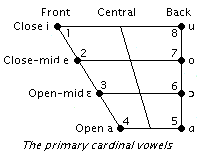 Phoneticians have always needed some way of classifying
vowels which is independent of the vowel system of a
particular language. With most consonants it is quite
easy to observe how their articulation is organized, and
to specify the place and manner of the constriction
formed; vowels, however, are much less easy to observe.
Early in the 20th century, the English
phonetician Daniel Jones worked out a set of "Cardinal Vowels" that students
learning phonetics could be taught to make and which would serve as reference
points that other vowels could be related to.
Phoneticians have always needed some way of classifying
vowels which is independent of the vowel system of a
particular language. With most consonants it is quite
easy to observe how their articulation is organized, and
to specify the place and manner of the constriction
formed; vowels, however, are much less easy to observe.
Early in the 20th century, the English
phonetician Daniel Jones worked out a set of "Cardinal Vowels" that students
learning phonetics could be taught to make and which would serve as reference
points that other vowels could be related to.
The cardinal vowel figure is used to
specify the qualities of the English vowels and diphthongs in the Introduction
to this dictionary.
UKT: Bur-Myan vowels with medial pitch-register corresponding
to Eng-Lat cardinal vowels:

Front:
 {a}
{a}
 {i} - /a/ /i/
Mid-Front:
 {é}
{é}
 {è} - /e/ /ɛ/
Mid-Back:
 {o} - /ɔ/ /o/
Back:
 {u}
{u}
 {au} - /u/ /ɑ/
There is utter confusion in back vowels between Bur-Myan and
Eng-Lat. Though there are well defined back vowels in
Bur-Myan,
{u},
{o},
{au}, there is no uniformity in English back vowels, /u/, /o/,
/ɔ/, /ɑ/ (unrounded), /ɒ/ (rounded),
as sung by various Canadians in continuous speech. My
observation was (more than 10 years) on highly educated
Canadians (employed by AECL in Chalk River, Ontario),
and their equally educated wives, with highly varied
birth and educational backgrounds: birth - Burmese,
English, Indian; education: Myanmar, India
(various parts), England (various parts), Kenya, Germany).
Though I am not a trained phonetician, my keen observation
has led me to believe that, trying to find a reliable
correspondence between Bur-Myan and Eng-Latin was just
a dream. My observation is summarized in the
"Comparison of Myanmar vowels to IPA" shown
in the inset pix. The problem seemed to be in the lip-rounding
and jaw movements. And when the IAST Indian transcription
was taken into account the problem got worse.
There is agreement only in /u/, leaving the transcription
of common Bur-Myan words such as
 {ko} in confusion. Romabama rendering of
{ko} has been disputed by my good friend U Tun Tint of
MLC. According to him it should be kou . I address
my friend as "Ko Tun Tint" when I am writing to
him in English. If I were to go along with him I would
have to address him as "Kou Tun Tint" !
{ko} in confusion. Romabama rendering of
{ko} has been disputed by my good friend U Tun Tint of
MLC. According to him it should be kou . I address
my friend as "Ko Tun Tint" when I am writing to
him in English. If I were to go along with him I would
have to address him as "Kou Tun Tint" !
/kou/ - MED2010-013
The Cardinal Vowel diagram is used both for rounded and unrounded
vowels, and Jones proposed that there should be a primary
set of Cardinal Vowels and a secondary set. The primary
includes the unrounded front vowels [i e ɛ a] , the
back unrounded vowel [ɑ] and the back rounded vowels
[ɔ o u] , while the secondary set comprises the front
rounded vowels [y ɸ œ ɶ] , the back rounded
vowel [ɒ] , and the back unrounded vowels [ʌ
ɤ ɯ] .
UKT:
• Latin small letter phi , U+0278 [ɸ] has been
inserted in place of the italicized phi that was present
in the original text.
• The words "rounded" and "unrounded"
refer to the shape of the lips while singing the vowels. It
is usual to have in Bur-Myan, only unrounded vowels as
front vowels and rounded vowels as back vowels. The same
is true for my personal dialect (a mix-up of RP, GA,
Canadian-English, and Burglish) aka idiolect. As
for other English dialects I am not competent to say.
Phonetic "ear-training" makes much use of the
Cardinal Vowel system, and students can learn to identify
and discriminate a very large number of different vowels
in relation to the Cardinal vowels.

UKT: The material scientist, or the "skeptical chemist" in me always
doubts human observation such as "phonetic ear-training". There is only one
way: to use instruments to study the sound waves. In other words to rely on
measured formants only.
My life-long wish (since my early teens -- I'm now over
76) is to come up with a scheme to write the Burmese speech
from the keyboard of an English typewriter. I learned how
to type (touch method) on my father U Tun Pe's English typewriter
similar to the one shown on the right. My present research
is one of my attempts to come up with such a system -- which
I've named Romabama (from Romanized Burmese). As a beginning I arrived at a one-to-one transliteration of
Bur-Myan (Burmese-Myanmar) to Romabama (Burmese-Latin) based
on Eng-Lat (English-Latin). I am turning it into a workable transcription
by going into Pali and Sanskrit. - UKT110218, 111231
There are two kinds of presentation of the vowels in
Bur-Myan: the basic vowels which is very similar to the
Pal-Myan (Pali-Myanmar), and the more modern one taught in
school.
Table of Pali-Myanmar vowels
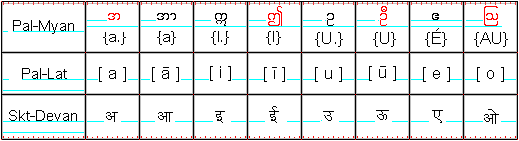
UKT note: There is difference between Pal-Myan and Skt-Dev
which has led me to suggest that Pal-Myan is more related
to Vedic [the term 'Vedic Sanskrit' has been used - but I now prefer the term
'Vedic' because it could very well be an indigenous language related to
other Tibeto-Burman languages used just south of the Himalaya from
Afganistan to Myanmar and slightly beyond to the east] than to the Classical Sanskrit of Panini
पाणिनि
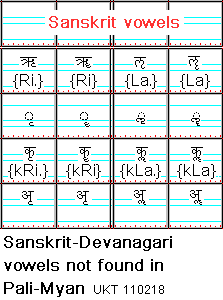
 {pa-Ni.ni.} in rhotic and lateral sounds. The Sanskrit given
in the table below is the Classical Sanskrit - the Sanskrit
in use today.
{pa-Ni.ni.} in rhotic and lateral sounds. The Sanskrit given
in the table below is the Classical Sanskrit - the Sanskrit
in use today.
Table of Burmese-Myanmar vowels

Contents of this page
p101. A type of
LATERAL
sound in which the air escapes past the sides of the tongue,
found normally only before vowels. Usually contrasted with
DARK L.
UKT: A lateral sound is simply a sound involving the akshara
 {la.}. It is an approximant and is known in Bur-Myan an
{a.wag} 'hard to classify' sound. Bur-Myan is extremely
rich in laterals:
{la.},
{la.}. It is an approximant and is known in Bur-Myan an
{a.wag} 'hard to classify' sound. Bur-Myan is extremely
rich in laterals:
{la.},
 {lya.},
 {lwa.},
 {lha.},
 {lhya.},
 {lhwa.}, whereas Eng-Lat cannot even handle Welsh <ll>
sounds. The killed (coda)
{lhwa.}, whereas Eng-Lat cannot even handle Welsh <ll>
sounds. The killed (coda)
 {l} is usually not pronounced in Bur-Myan, e.g.
 {bol} sounds like
/
{bol} sounds like
/ {bo}/.
Examples for English
In the case of an alveolar lateral (e.g. English /l/ the blade
of the tongue (the part further back than the tip) is in contact
with the alveolar ridge, but the rest of the tongue is free to take up different
shapes. One possibility is for the front of the tongue (the part behind the
blade) to be raised in the same shape as that for a close front vowel
[i]. This gives the /l/
[i]-like sound and the result is a "clear l". It is found notably in BBC English
only before vowels, but in some other accents, notably Irish and Welsh ones, it
is found in all positions. However, the variant most often found in all
positions is "DARK L". e.g.
<pill> /pɪl/
[pʰɪɫ]
UKT:
"Some phoneticians speak of the dark and light variants of /l/. What they call
light /l/ might also be termed pre-vocalic
/l/; while dark /l/ is post-vocalic.
In cases of intervocalic /l/, the liquid will tend to group either with the
preceding syllable, in which case it is dark, or with the following syllable,
in which case it is light. But there are many cases where the distinction is
not so clear, and we get elements of both, leading to the nice diamond or
O shape between F2 and F3 which is an easy marker for /l/."
The following is from Structure of Spoken Language, The Approximants,
http://cslu.cse.ogi.edu/tutordemos/SpectrogramReading/
Follow the link to The Approximants
in TIL archives.
Contents of this page
p103. Two or more
CONSONANT
PHONEMES
in sequence, with no vowel sound between them.
Examples for English
English can allow up to three
consonants in a cluster syllable initially in the
ONSET,
and four syllables finally in the
CODA.
For example, the word <stray> /streɪ/ begins with three consonants,
and <sixths> /sɪksθs/ ends with four.
Some types of grammatical information are shown by adding certain consonants at
the ends of words in English, giving rise to consonant clusters, e.g.:
<likes> /laɪks/
<lives> /lɪvz/
<liked> /laɪkt/
<lived> /lɪvd/
<Mark's> /mɑːks/ (US) /mɑːrks/
<John's> /ʤɒnz/ (US) /ʤɑːnz/
<cats> /kæts/
<dogs> /dɒgz/ (US) /dɑːgz/
Contents of this page
p103. A kind of
ASSIMILATION
in which a fusion of neighbouring sounds takes place during rapid or
CONNECTED SPEECH.
Examples for English
The most frequently observed situation in which coalescence occurs in English is when
ALVEOLAR
consonants /t d s z/ are followed by /j/, e.g.:
<won't you> /wəʊnt ju/ --> /ˈwəʊnʧu/
(US) <won't you> /woʊnt-/ --> /woʊnt-/
<would you> /wʊd ju/ --> /ˈwʊʤu/
/ˈwʊʤu/ /mɪs ju/ --> /ˈmɪʃu/
<lose you> /luːz ju/ --> /ˈluːʒu/
In the case of coalescence with /s z/, there will usually be
extra length to the resulting fricative sounds. e.g.:
<miss you> /mɪs ju/ --> /ˈmɪʃʃu/
<lose you> /luːz ju/ --> /ˈluːʒʒu/
A common very much reduced example of coalescence is <do you>
being pronounced as /ʤə/.
UKT: In a way the above is comparable to the formation of medial {ya. ping.}
in Burmese-Myanmar. However, it is to be noted that {ta. da. sa. za.}
corresponding to English /t d s z/ are not "allowed" to form {ya. ping.}
because of their sibilant nature.
<won't you> /wəʊnt ju/ --> /ˈwəʊnʧu/
 {woan.tyu} =
 {woan.kyu}
This explains in part, why
 {kya.}
and
{kya.}
and
 {hkya.}
have been associated with /ʧ/. You should note that though English-Latin <k> is
traditionally equated to Burmese-Myanmar
{hkya.}
have been associated with /ʧ/. You should note that though English-Latin <k> is
traditionally equated to Burmese-Myanmar
 {ka.}, it's pronunciation is closer to that of
 <hka.>.
Contents of this page
p104. The influence of phonetic context on the articulation of speech sounds.
Examples for English
Phonetics studies coarticulation as a way of finding out how the brain controls
the production of speech. When we speak, many muscles are active at the same time
and sometimes the brain tries to make them do things that they are not capable of.
For example, in the word <mum> the vowel phoneme is one that is normally
pronounced with the soft palate raised to prevent the escape of air through the nose,
while the two /m/ phonemes must have the soft palate lowered. The soft palate cannot be
raised very quickly, so the vowel is likely to be pronounced with the soft palate still
lowered, giving a nasalized quality to the vowel, e.g.:
<mum> /mʌm/ [mɐ̃m] (/ɐ̃/= U0250 U0303)
Another example is the lip-rounding of a consonant in the environment of rounded vowels:
in the phrase <you too>, the /t/ occurs between two rounded vowels, and there is not
enough time in normal speech for the lips to move from rounded to unrounded and back again
in a few hundreds of a second; consequently the /t/ is pronounced with lip-rounding, e.g.:
<you too> /juː tuː/
[jʉːtʷʉː]
Co-articulation is a phenomenon closely related to
ASSIMILATION.
The major difference is that assimilation is used as a name for the process whereby one
sound becomes like another neighbouring sound, while coarticulation, though it refers to
a similar process, is concerned with the articulatory explanations for why the assimilation
occurs and considers cases where the changes may occur over a number of segments.
Contents of this page
p105. The end of a syllable, which is said to be made up of an
ONSET,
a peak and a coda. The peak and the coda constitute the
RHYME
(or RIME) of the syllable.
Examples for English
English allows up to four consonants to occur in the coda, so the total number of
possible codas in English is very large -- several hundred in fact, e.g.:
<sick> /sɪk/
<six> /sɪks/
<sixth> /sɪksθ/
<sixths> /sɪksθs/
The central part of a syllable is almost always a vowel, and if the syllable contains nothing after
the vowel it is said to have no coda ('zero coda'), e.g.
<bough> /baʊ/
<buy> /baɪ/
In other languages
Some languages (e.g. Japanese) have no codas in any syllables.
Contents of this page
p111. This panel looks at word
STRESS
stress in compounds. Compounds are words made up of two other
words which can exist independently in English. They are written in a
variety of ways: closed, e.g. <armchair>, <sunflower>;
hyphenated, e.g. <front-runner>, <she-devil>; open,
e.g. <side salad>, <bank manager>. Sometimes it is possible for
the same compounds to be written in different ways, e.g. <shoulder
blade> or <shoulderblade>.
There are some rules for compound word
stress in English but they are not completely reliable. In addition, British and
US English differ. The rules which follow are therefore guidelines, but
exceptions exist.
Examples
Words that combine two nouns usually
have primary stress on the first element, e.g.:
<coffee pot> /ˈkɒf.i.pɒt/
(US) /ˈkɑː.fi.pɑːt/
<suitcase> /ˈsuːt.keɪs/
In US English, it is more frequently the case that compound nouns have first element
stress, and this tendency is appearing among some British English speakers. For example,
<ice cream> can have first or second-element stress in British English, but tends
to be stressed on the first element in US English.
Other types of compound are usually stressed on the second element.
These include words ending in -ed which are used as adjectives,
words with a number as a first element, and words functioning as adverbs or verbs, e.g.:
<kind-hearted> /ˌkaɪndˈhɑː.tɪd/
(US) /-ˈhɑːr.t̬ɪd/
<three-piece> /ˌθriːˈpiːs/
<southeast> /ˌsaʊθˈiːst/
These words are subject to stress-shift when a stressed syllable
follows closely (e.g., /ɑ ˌkindheɑrted ˈmɑn/.
Contents of this page
p115. The process which result in words being pronounced differently
from their dictionary form when they occur in close contact with other words.
Examples for English
In natural speech we rarely leave gaps between words, and we can observed
many processes that result in differences between isolated words and the same
words occurring in connected speech: examples are
ASSIMILATION and
ELISION, e.g.:
(assimilation) <one boy> /wʌn bɔɪ/ /wʌn bɔɪ/
/lɑːst taɪm/ /lɑːs taɪm/
(elision) <last time> (US) /læst taɪm/ (US) /læs taɪm/
The study of connected speech also involves looking at the process of VOWEL
REDUCTION in weak syllables (see also WEAK FORM), at
RHYTHM and prosodic phenomena such as
INTONATION and
STRESS.
Contents of this page
p115. A speech sound which obstructs the flow of air through the vocal
tract or a letter of the alphabet representing such a vowel.
Examples for English
There are many types of consonant, but what all have in common is that they obstruct
the flow of air through the vocal tract. Some do this a lot, some not very much:
those which make the maximum obstruction (i.e.
PLOSIVES, which form a
complete stoppage of the airstream) are the most consonantal, e.g.:
| |
<bat> |
/bæt/ |
|
<keep> |
/kiːp/ |
NASAL consonants result in complete
stoppage of the oral cavity but are less obstructive than plosives since air is
allowed to escape through the nose, e.g.:
|
<man> |
/mæn/ |
|
<name> |
/neɪm/ |
FRICATIVES make a considerable
obstruction to the flow of air, but not a total closure, e.g.:
| |
<sheaf> |
/ʃiːf/ |
|
<south> |
/saʊθ/ |
The class of sounds called
APPROXIMANTS
comprises sounds which make very little obstruction of the flow of air.
The post-alveolar approximant that is the usual pronunciation of /r/
in BBC English involves no contact between the tongue and the palate, e.g.:
| |
<red> |
/red/ |
[ɹed] |
|
<arrive> |
/əˈraɪv/ |
[əˈɹaɪv] |
LATERAL approximants obstructs the
flow of air only in the centre of the mouth, not at the sides, so obstruction is slight, e.g.:
Other sounds classed as approximants make so little obstruction to the flow of air
that they could almost be thought to be vowels if they were in a different context.
These are sometimes referred to as 'semi-vowels', e.g.:
Finally,
AFFRICATES begin as plosives
and are released as fricatives, with no intervening gap, e.g.:
| |
<church> |
/ʧɜːʧ/(us)/ʧɝːʧ/ |
|
<judge> |
/ʤʌʤ/ |
The above explanation is based on phonetic criteria. An alternative approach is to
look at the phonological characteristics of consonants: for example, consonants
are typically found at the beginning (UKT: ONSET) and end (UKT: CODA) of syllables
while vowels are typically found in the middle.
Contents of this page
End of TIL file