
BO-MLC-indx.htm
by U Kyaw Tun (UKT) and staff of TIL (Tun Institute of Learning,
http://www.tuninst.net ). Start: 2007 July
. Prepared for students and
staff of TIL Research Station, Yangon, MYANMAR :
http://www.tuninst.net ,
www.romabama.blogspot.com
Based on:
• Myanmar Orthography (MOrtho)
by MLC (Myanmar Language Commission),
Ministry of Education, 1986, pp 292. Editor U Tun Tint. Note: My attempt
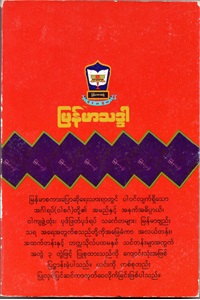
to present Bur-Myan Grammar, in Bur-Myan (the front cover of which is
shown in the pix on the right) in Romabama (before I can translate the Bur-Myan
txt) is a total failure. Unfortunately it is not available in pdf format.
• Myanmar English Dictionary (MEDict)
by MLC, 1993, pp 635. MEDict gives a pronunciation guide in non-IPA script which
I have marked /[...]/ to differentiate from Romabama {...} . The drawback of the
MEDict pronunciation guide is because of its pronunciation is mainly that of
Yangon & Mandalay which is NOT a standard. The syllable-codas are given as
glottals and is a disservice to the phonemic nature of the Myanmar
akshara which is very scientific because it is based on sound phonemic
principles. I have remedied it in Romabama where the syllable-codas are given as
killed aksharas-under- {a.þût}.
•
Myanmar Grammar (BG-MLC) (in Bur-Myan)
by MLC, current as of 2015, is in Bur-Myan. The ink-on-paper book is in the TIL
Library, and my trials to transcribe it in Romabama is a failure. The only
option is to translate it - a task beyond my present (2015) ability.
UKT 080802: This project is being undertaken to test the efficacy of Romabama. If I can transliterate every entry in MOrtho, then I can claim that my Romabama is good enough to write emails, and is suitable for the internet web-pages. The next project would be to transliterate Pali-Myanmar. - UKT 080802
As of today, I have transformed Romabama to a transcription. Moreover, with my added knowledge of Skt-Dev (Sanskrit-Devanagari), I am in the process of going through A Practical Sanskrit Dictionary by A. A. Macdonell -- http://www.tuninst.net/SED-MC/MC-indx.htm 121125
You can see my progress on Macdonell's work in - MC-indx.htm (link chk 151031)Please note that my aim in formulating Romabama is not to replace the long established Burmese-Myanmar writing system of
{ka.kri:}
{hka.hkwé:} with Latin alphabet <a b c d>, but to write emails and for internet publication for researchers outside Myanmar.
With the project, I pay my humble respects to my Burmese-Myanmar ancestors (my great-grandfather Bo Yan Shin and his father Po Tagaung and his uncle Po Mintha) who hailed from Mount Popa area. My humble respects to my Mon-Myanmar ancestors. (my great granduncle U Maung Ngan, and his sister Daw Mè Ma - my great grandmother) who hailed from the old city Dalla. My humble respects to my father U Tun Pe direct descendant of Bo Yan Shin, and my mother Daw Hla May direct descendant of Daw Mè Ma. -- UKT 080802, 121125
index.htm |
Top
BurMyan-indx.htm
Preface - preface.htm (link chk 151031)
Grammaticalization of Nominalizers in Burmese -
Normalizer.htm (link chk
151031)
There was an older file which could be reached from
-
index.htm >
E4M-indx.htm >
GramGloss.htm
> N01.htm >
The Grammaticalization of Nominalizers in
Burmese
PIX accompanying entries in MEDictionary-2006, in folder -
MED-PIX (broken link on 151031)
You will not be able to open it because it is in a folder as of
today (121125). It is only for TIL editors. Eventually it will be presented as a
file(s), from which you will be able to copy-paste.
Note to HTML editor: In these files the AK items still had problems with their bookmarks. You will have to rename them in the present format. -- UKT121125
{ka.}
{hka.}
 {ga.}
{ga.}  {Ga.}
{Ga.}  {nga.}
  {ba.} {Ba.} {ma.}
UKT Notes
• Devanagari
• Romabama
•
Spanish Ñ
Note: The hyper-linkages are being simplified. They are in Romabama and are in alphabetical order : 080325
 {ba.} r5c3 (Devanagari ब)
 {ga.}
{ga.}
 r1c3 (Devanagari ग)
 {gra.}
 {gwa.}

 r1c4 (Devanagari घ)
 r1c2 (Devanagari ख)
Note to HTML editor: there should have been 6 files (and folders): {hka.} r1c2hka.htm,
{hkya.} r1c2hka-med.htm, {hkra.} r1c2hka-med2.htm, {hkwa.} r1c2hka-med3.htm, {hkha.} r1c2hka-med4,
and mixed-medials r1c2hka-med5.htm. However, {hkha.} is not allowed in Burmese-Myanmar, and so there are only 5.


 r1c1 (Devanagari क)
Note: <th> instead of <þ> is used for ease of arranging in alphabetical order
basic {ka.}
 - r1c1ka.htm
{ka. ka ka:} {kaic} {kain kain:} {kait} {kak} {kam kam:} {kän. kän} {kan. kan
kan:} {kaN}
{kap} {kat} {kath} {kau. kau kau:} {kaung kaung:} {kauk} {kauT}
{kè. kèý kè:} {keik} {keing keing:}
{ki. ki} {kic} {king king:}
{ko ko:} {koab} {koam} {koap} {koak} {koän koän:} {koan koan:}
{koat} {koaT} {koý. koý} {ku. ku ku:}
medial {kya.}
 - r1c1ka-med1.htm
{kya. kya kya:} {kyæÑ kyæÑ} {kyain kyain:} {kyaip} {kyait} {kyak} {kyam:} {kyän}
{kyan kyan:}
kyap
kyat
(kyau. kyau kyau:)
(kyaung:)
(kyé kyé:)
(kyèý kyè:)
kyeik
(kyeing:)
(kyi. kyi kyi:)
(kyiñ kyiñ:)
kyic
(kyo. kyo kyo:)
(kyoän. kyoän kyoän:)
kyoap kyoat
(kyu kyu:)
 -
r1c1ka-med2.htm
-
r1c1ka-med2.htm  - r1c1ka-med3.htm

 r1c5 (Devanagari ङ ; IPA /ŋ/)
 (closest pronunciation: /ɲ/ - the palatal nasal)


• Official Myanmar Dictionaries -- the following three:
• Myanmar Orthography (MOrtho)
by (MLC) Myanmar Language Commission (MLC), Ministry of Education, 1986, pp 292
Editor U Tun Tint.
• Myanmar English Dictionary (MEDict)
by Myanmar Language Commission, Ministry of Education, 1993, pp 635
MEDict gives a pronunciation guide in non-PA script which I have marked
/[...]/ to differentiate from Romabama /{...}/
• (MMDict) (Travelling Pocket Myanmar Dictionary)
Burmese-Myanmar to Burmese-Myanmar) by MLC (Myanmar-sar Commission
Directorate, Ministry of Education), 1999, pp 401.
• American Heritage Talking Dictionary (AHTD)
-- CD or online.
• Daniel Jones, English Pronouncing Dictionary, 16 ed (DJPD16),
Cambridge University Press 2003.
From: Wikipedia http://en.wikipedia.org/wiki/Devanagari 080325
After going online, you can click on the active links given by Wikipedia to go to respective pages.
In the MLC tables, the entries are in akshara order, which I for one, has found impossible to memorise.
In recognition of 3 tones (è. èý è:) forming a very distinct coherent group, they are grouped together in the secondary index, resulting in the breaking down of the alphabetical order. The nature of the tonal group has led me to believe that the akshara system is ideal for the writing of tonal languages. This will be one of my future projects: to study Thai and Chinese from the point of view of the akshara system.
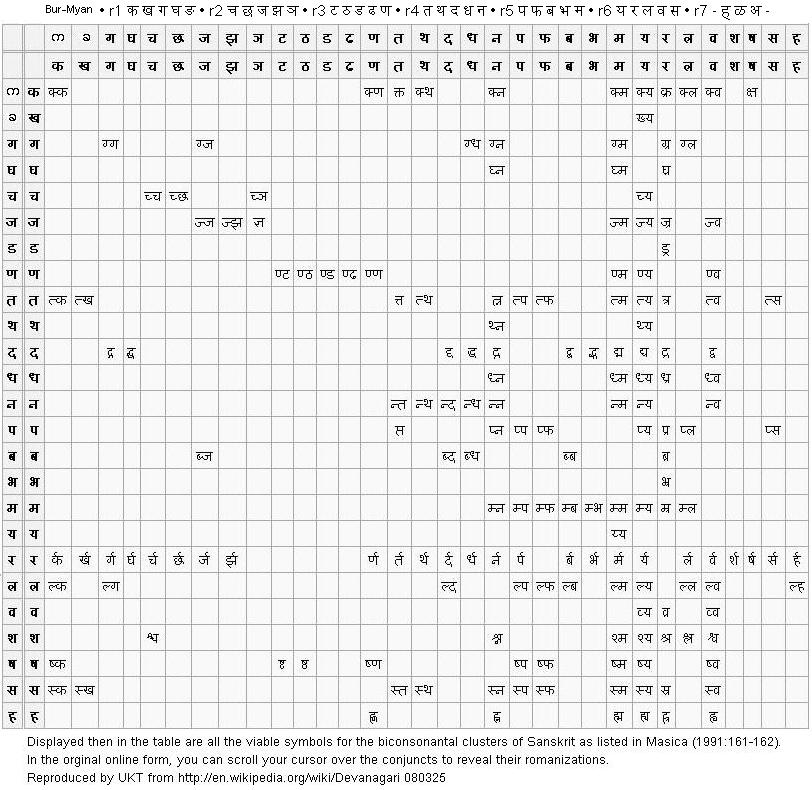
Without the help of a Hindi-Devanagari (or Sanskrit-Devanagari) speaker who is conversant in phonetics, I have to compare Myanmar to Devanagari. I am finding that the conjunct formations are of a great help to me. The following is the conjunct formation of {ra.} र and the other aksharas from Wikipedia 080325
c1 c2 c3 c4 c5 row 1 {ka.} क र + ् + क = र्क र + ् + ख = र्ख row 2 {sa.} च
Go back devan-note-b
Romabama Rule 01 - ASCII characters
Romabama is designed for writing e-mails without using any special fonts. Thus
only ASCII characters are used.
Consonant characters
{ka.}
{hka.} {ga.}
{Ga.} {nga.}
{sa.} {hsa.}
{za.} {Za.}
{Ña.}/{ña.}
{Ta.}
{Hta.} {ða.}
{Ða.} {Na.}
{ta.}
{hta.} {da}
{Da.} {na.}
{pa.} {hpa.}
{ba.}
{Ba.} {ma.}
{ya.}
{ra.}
{la.}
{wa.}
{tha.}
----- {ha.} {La.} {a.} -----
Burmese-Myanmar consonant-akshara characters are always arranged according to phonemic principles in a matrix of 7 rows x 5 columns. Broadly speaking, they are grouped into 3 groups: the classifiables {wag}, the nasals, and the non-classifiables {a.wag}. I have coloured the classiables blue, the nasals red, and the non-classifiables green. The classification follows the classification of the Brahmi script of the Emperor Asoka (273BC-232BC). Compare the classification to that of the International Phonetic Alphabet (IPA) which came into existence centuries later.
One of the most interesting "nasal sound" is represented by the character is r2c5 {Ña.} of Burmese and {ña.} of Pali. In Romabama it is represented by Spanish Ñ.
Vowel characters (usually described as "vowel letters" as opposed to "vowel
signs"):
{a.} {a} {I.}
{I} {U.} {U} {É} {è:}
{AU:} {AU} {än} {a:}
Burmese-Myanmar vowel-akshara characters (the "vowel letters") are arranged in a single line, starting from {a.} /a/ the lower-left corner of the vowel quadrilateral (represented by the English "short a") and moves in a clock-wise manner through {I.} /i/ and {U.} /u/ to {AU:} /ɑ/ at the lower-right corner. Please note that the vowel quadrilateral represents the position of the tongue in pronouncing the vowels. The so-called English "short a" is the most important vowel in the Asoka akshara system and is common in all its descendants including the Burmese-Myanmar.
Incidentally, the "English short a" is not a common vowel in the English pronunciation of the English syllables. I have come to this conclusion in going through DJPD16. English uses the vowel /ɑ/ mostly in syllables which to Burmese-Myanmar ears sound like /a/. Thus, <father> is pronounced as /fɑː.ðəʳ/ (DJPD16 p.199). This same word is pronounced by most English-speaking Myanmar with /a/ instead of /ɑ/.
Romabama Rule 02 - English-Latin alphabet
The 26 letters of the English-Latin alphabet are expanded to 52 letters by
differentiating between the 26 small letter and 26 capital letters. Use of
capital letters is rare in Romabama. However, the use of capital letters for
"killed" c2 is preferable. e.g. for {moaK} (gateway to a pagoda -- MEDict349)
seems to be better than {moahk}. The rational for this is, English <k> is
pronounced nearer to {hka.} than {ka.}. See Rule 03 for the use of capital
letters of the extended Latin alphabet.
Romabama Rule 03 - Extended Latin alphabet
Diacritics and other suitable signs are introduced:
• ä (Alt0228) in än for {thé:thé:ting} (MEDict500)
• à (Alt0224) for denoting {re:hkya. a·thut} ending in a killed non-nasal, as in
{Dàt-hsi} (petrol, gasoline -- MEDict218)
alternate spelling {Daat-hsi}
• æ (Alt0230) in combination with Ñ (Alt0209) to denote {Ña.kri:thut} as in {kyæÑ-hsan}
(cartridge, shell -- MEDict034)
• Æ (Alt0198) in combination with Ñ (Alt0209) to denote {vowel-letter
Ña.kri:thut} as in {ÆÑ.thæÑ} (guest -- MEDict625)
• É (Alt0201) as in {É-ra-wa-ti mris} (Irrawaddy River),
• é (Alt0233) as in {é:hkyam:} (peaceful -- MEDict614)
• È (Alt0200) as in {a.Daip~pÈý} (meaning -- MEDict565)
• è (Alt0232) as in {è:maung:} (lance -- MEDict615).
è (Alt0232) as in {a.pèý-hkän} (outcast -- MEDict572)
• ð (Alt0240) as in {ða.} row3-colunm3 akshara
(Caution: the voiced-pronunciation of English-Latin <th> is also
given as /ð/)
• Ð (Alt0208) as in {Ða.} row3-column akshara
• ï (Alt0239) and ~ to represent {king:si:} as in {ïn~ga.laip} ("English" --
MEDict622)
• ì (Alt0236) for denoting {ré:hkya. a·thut} ending in a killed nasal, as in {mìñ}
- alternate spelling: {maañ}
• í (Alt0237) for denoting {tha.wé-hto: a-thut} as in {hkít} (age, era, period,
time -- MEDict064)
• ñ (Alt0241) as in {ñaaN.} (intellect, wisdom -- MEDict155)
and Ñ (Alt0209) for {Ña.} (night -- MEDict156) both corresponding to <ny>;
• * OA (digraph) for use in place of {U.} for peak vowels in syllables without
consonants in the onset,
as in {OAs~sa} (property -- MEDict625
• ù (Alt0249) for {lù.} in {lù.Baung} (human society -- MEDict431)
• ý (Alt0253) for "killed {ya.}" {ya.thut} as in {wèý} (buy -- MEDict484)
Note: Diacritics in Romabama are chosen in a way so that even if a diacritic is
lost, the effect would be minimal.
* I am writing this note while I am in Canada, where I have to work alone without the assistance of my secretaries who are unable to accompany me to Canada because they are Myanmar citizens and getting Canadian visas for them is next to impossible. At my age (73), my memory is not reliable. Now, I am finding that I have to come up with spellings involving {U.} in words such as <property> /[ou' sa]/ (MEDict625; not listed in MOrtho). I am forced to use "digraphs" which might be mistaken for "diphthongs" (I maintain that Burmese has no diphthongs as commonly found in English). The tentative spelling I would have to use for <property> is {OAs~sa}, where {OA} is a digraph and not a diphthong. -- UKT, Canada, July 2007.
Romabama Rule 04 - Silent e
• e without diacritic (the silent e) will be used occasionally for
sounds of vowels followed by "killed" consonants, e.g.
- {kate} (preferred {kait})
- {kane} (preferred {kain})
• however, an <e> forming part of the peak vowel is not to be confused with the silent e.
- {keik} -- the <e> present here is part of the peak vowel-digraph <ei>. It is a monophthong.
- {keing} (cf. {king}) -- the <e> present here is part of the peak vowel-digraph <ei>.
- {kauk} -- here <au> is the peak vowel-digraph. It is not a diphthong: it is a monophthongal digraph.
Romabama Rule 05 - Killed consonants
- For specialized "killed" consonants
• {kyiñ}
• {kyæÑ}
• {kèý}
We find more problems with r2c5 rimes in the following:
There are theoretically 6 families involving r2c5 syllables. Only some are
realised in practice, however, I have given the tentatively chosen rimes:
1. {ñiñ}
2. /|njin. njin njin:|/ (MEDict 155) -- {ñìñ}
3. /|njin. njin njin:|/ (MEDict 158) -- {ñiñ}
4. {ñæÑ}
5. {ñàÑ}
6. /|nji. nji nji:|/ (MEDict 158) -- {ÑæÑ}
The rational for choosing the above is: though Romabama is meant only to show
the Burmese-Myanmar spelling, it should -- if possible -- show the
pronunciation. And, therefore the peak vowel is chosen arbitrarily, and it and
the following consonant (together the rime) is meant to show the pronunciation.
Go back to Romabama Rule 3 - Extended Latin alphabet
Romabama Rule 06 - {king:si:} vowel-sign
{king:si:} /|kin: si:|/ - n. ortho. miniature symbol of devowelized nga superscripted on the following letter. -- MEDict016
Compare the way in which the two words {hsing-kan:} and {thïn~kan:} are written. The first is written horizontally, but the second is written with the {king:si:} (literally: "centipede-ridden") sign . There are two cues to show that a {king:si:} is involved: use of umlaut over the peak vowel e.g. ï (Alt0239) and ~. The {king:si:} is actually not a conjoined sign and may be written horizontally. It is usually found in words derived from Pali and Sanskrit, e.g. Sanskrit-Myanmar {koän~ku.ma.} (n. saffron -- MEDict024) equivalent to Burmese-Myanmar {koän-ku.män}.
Caution: There is an {a.that} that is not exactly a {king:si:}, yet the consonant under it, is not a conjoined (horizontal conjunct) akshara as in {tha.kri:}. Such an {a.that} is found in {kywan-noap.} and {yauk-kya:}. In {kywan-noap} there is only one {na.ngèý} and in {yauk-kya:} there is only one {ka.kri:}. For the time being, I am treating them as similar to {tha.kri:}, but without a ~ in between. I have simply hyphenated the two {na.} in {kywan-noap.}, and two {ka.} in {yauk-kya:}. I have asked my good friend U Tun Tint for an explanation. He has not responded yet! (UKT 070804)
Romabama Rule 07 - Fossilized killed consonants.
(Based on personal communication with U Tun Tint, formerly of MLC)
There are 4 fossilized characters dating back to the 13 century:
• {nhÉIk} derived from {nheik}
• {rwÉ} derived from {ruèý} pronounced as /{rwé.}/
• {iÉ} derived from {é.} --> {i.}
• {lÉ-kaung:} derived from {læÑ-kaung:}
Go back Romabama-b
Where did the Ñ come from?
by Gerald Erichsen,
http://spanish.about.com/cs/historyofspanish/f/tilde_origins.htm (download
070803)
As you could probably guess, the ñ came originally from the letter n. The ñ does not exist in Latin and is the only Spanish letter of Spanish origins.
Beginning in about the 12th century, Spanish scribes (whose job it was to copy documents by hand) used the tilde placed over letters to indicate that a letter was doubled (so that, for example, nn became ñ and aa became ã). I'm not sure why they used the tilde, except perhaps that it was quick to write, although it may be no coincidence that it is shaped vaguely like an N. The tilde was used not only with the n but with other letters as well.
The popularity of the tilde for other letters eventually waned, and by the 14th century, the ñ was the only place it was used. Its origins can be seen in a word such as año (which means "year"), as it comes from the Latin word annus with a double n. As the phonetic nature of Spanish became solidified, the ñ came to be used for its sound, not just for words with an nn. A number of Spanish words, such as señal and campaña, that are English cognates use the ñ where English uses "gn," such as in "signal" and "campaign," respectively.
The Spanish ñ has been copied by two other languages that are spoken by minorities in Spain. It is used in Euskara, the Basque language that is unrelated to Spanish, to represent approximately the same sound as it has in Spanish. It is also used in Galician, a language similar to Portuguese. (Portuguese uses nh to represent the same sound.)
Additionally, three centuries of Spanish colonial rule in the Phillipines led to the adoption of many Spanish words in the national language, Tagalog (also known as Pilipino or Filipino). The ñ is among the letters that have been added to the traditional 20 letters of the language.
And while the ñ isn't part of the English alphabet, it frequently is used by careful writers when using adopted words such as jalapeño, piña colada or piñata and in the spelling of various personal and place names.
In Portuguese, the tilde is placed over vowels to indicate that the sound is nasalized. That use of the tilde has no apparent direct connection with the use of the tilde in Spanish.
Go back Spanish-Nya-b
End of TIL file