
JudsonGram1-.htm
From Grammar of the Burmese Language, by A. Judson, American Baptist
Mission Press, Rangoon, 1883
Downloaded copies in TIL HD-PDF
and SD-PDF libraries, and in TIL Bk-Cndl Online Library:
- AJudson-GramBur-Lang<Ô>
/ Bkp<Ô>
/ BkCnd<OL> (link
chk 201101)
See also online in Wikisource: https://en.wikisource.org/wiki/Grammar_of_the_Burmese_Language 201212
Set in html and edited
by U Kyaw Tun (UKT) (M.S., I.P.S.T., USA), and staff of Tun Institute of Learning
(TIL).
Not for sale. No copyright. Free for
everyone. Prepared for students and
staff of TIL Research Station, Yangon, MYANMAR :
http://www.tuninst.net ,
www.romabama.blogspot.com
UKT 201203: Note: in older books section numbers in § (alt0167) are more important for giving reference than page numbers. I've to show that the section numbers may go up to 999, by adding a 00 before 1. The last section number is §138. I'm dividing the book into 3 vols:
v1. Akshara and Alphabet - §001 to §045
v2. Parts of Speech - §046 to §127
v3. Appendix - §128 to §138Moreover, I have to follow Judson's English spelling, whenever necessary, even if they are outdated. Remember that in Judson's days, the distinction between the Abugida system of writing (or Abugida-Akshara) and the Alphabet system (or Alphabet-Letter) has not been made and I've to strike-through the word letter and replaced it by the word akshara (which I'll shorten to aks sometimes. Moreover, the modern science of Phonetics of Henry Sweet which began with A Handbook of Phonetics, in 1877 was yet to be born. Note also that the TOC below is mine.
p05.
Introduction
§001 ,
§002 , §003,
Akshara and Alphabet
§004 , §005 ,
§006
Akshara Matrix - that sets
it apart from the Alphabet
§007 ,
§008 , §009 ,
§010 , §011
Vowels : vowels are always
pronounceable
§012 ,
Consonants : with inherent
vowel

 {mwé-hkûn þa.ra.}s are pronounceable
§013 ,
§014 ,
Medials : Compound
consonants
§015 ,
§016, §017 ,
Combination of
Vowels with Consonants
§018
, §019 , §020 ,
§021 ,
§022 ,
Coda : Final consonants
§023 ,
§024 , §025 ,
§026 , §027 ,
§028 , §029 ,
§030 , §031 ,
§032 , §033 ,
§034 , §035 ,
§036 ,
Pitch Registgers
§037 , §038 ,
§039 ,
Abbreviations
§040 ,
§041 , §042 ,
Numerical figures
§043 ,
Punctuation
§044 ,
§045 ,

(p05.)
§001. The Burmese language
[script] is written from left to right, and without
any division of words. [i.e. without white spaces
in between words.]
§002. The pure Burmese [script and speech] is monosyllabic, every word consisting of one syllable only; but the introduction of the Pali language, with the Boodhistic religion [Theravada Buddhism], has occasioned the incorporation many polysyllabic words of Pali origin into the pure Burmese.
§003. The form of the aksharas letters , the order of the vowels
and consonants, and the classification of the aksharas letter ,
prove* [UKT: dissent] Burmese abugida alphabet is but one
modification the ancient Nagari [script] ; as the Pali language itself, as used
by the Burmese [people], is but a modification of Sanscrit [Skt-Devanagari]
*UKT 201101: Rev. Judson has made a mistake here. He did not know that there are two systems of Speech-to-Script systems involved: Abugida-Akshara system where the Akshara is a Syllable and is pronounceable, whereas in the Alphabet-Letter system the Letter is mute.
Also the Rev. must have failed to note that Asokan-Brahmi is the oldest script found in India. See how Bur-Myan could be the ancestor of Asokan through the intermediary of Pyu of Burma, and also how the Kadamba script could have been a descendant of Pyu.
See Wikipedia on Kamdamba - https://en.wikipedia.org/wiki/Kadamba_script 201101
"The Kadamba script is the first writing system devised specifically for writing Kannada [speech] and Telugu [speech]. It is a descendant of the Brahmi script [Asokan-Brahmi], an abugida visually close to the Kalinga alphabet. [ citation needed] The Kadamba script is also known as Pre-Old-Kannada script. This script later became popular in what is today the state of Goa and was used to write Kannada [speech] and Sanskrit [speech - note here that there are two dialects of Sanskrit and here what Wiki must have meant the southern-dialect.]Let's first note the present-day understanding is on Scripts, keeping in mind that no one at present could have heard how the ancient Speeches must have sounded. Remember - actual recording of Speech is a very recent invention. How an ancient Speech, such as that of Gautama Buddha, must have sounded is at best an approximation if not utterly false.
Wikipedia: https://en.wikipedia.org/wiki/N%C4%81gar%C4%AB_script - 201101
"The Nāgarī script is the ancestor of Devanagari, Nandinagari and other variants, and was first used to write Prakrit and Sanskrit. The term is sometimes used as a synonym for Devanagari script. [6] [7] It came in vogue during the first millennium CE. [8] "


(p05 - cont)
§004. The Burmese akshara
alphabet [shortened to aks occasionally] consists of ten vowels
{þa.ra.}, and thirty-two consonants
 {byæÑ:} .
§005. The ten vowels are:
 {a.} ɑ,
 {a} ɑ, -
 {I.} ee,
 {II} ee, -
 {U.},
{U.},
 oo,
oo,
 {U} oo,

-  {É} aa,
[or ey in they, ?]
{É} aa,
[or ey in they, ?]
 {è:} ai, -
 {AU.}
{AU.}
 {AU}
{AU}
 {AU:} au,
- to which may be added the monophthong diphthong
 {o} o.
UKT 201203: What the Rev. has given are Vowel-Letters.
He has given 12+1 vowels without differentiating the matching pairs{þa.wûN} from non-matching pairs
§006. The thirty-two consonants (in rows r and columns c are:

-- ----------- c1, c2 --------------------- c3, c4 -------------------- c5
r1:
 {ka.}ka,
 {hka.}'ka, -
 {ga.}ga,
 {Ga.}ga, -
 {gna.}/
 {ng}nga,
r2:
 {sa.}tsa,
 {hsa.}'tsa, -
 {za.}dza,
 {Za.}dza, -
 {Ña.}/
 {Ñ}nya,
affricate:
 {ca.},
 {cha.} ------
 {ja.}, ? {Ja.} --------
 {ña.}/
 {ñ}
{ñ}
r3:
 {Ta.}ta,
 {HTa.}'ta, ----
 {ða.}da,
 {Ða.}da, ---
 {Na.}/
 {N} na ,
r4:
 {ta.}ta,
 {hta.}'ta, -----
 {da.}da,
 {Da.}da, ----
 {na.}/
 {n} na ,
r5:
 {pa.}pa,
 {hpa.}'pa, ---
 {ba.}ba,
 {Ba.}ba, ----
 {ma.}/
 {m} ma ,
approximant: r6:
 {ya.}ya,
 {ra.}ra, -
 {la.}la, -
 {wa.}wa,
-
{wa.}wa,
-
 {þa.}tha ,
approximant: r7: --------
 {ha.}la, ---
 {La.}la, -------
{a.},
{La.}la, -------
{a.},
 {än}
{än}
- to which may be added the diacritic character
 {än}-sign
UKT 201203: Judson's transcriptions in italics, are given after Romabama. For r1c2,
as·pi·ra·tion - n. ¹. Expulsion of breath in speech. ². Linguistics a. The pronunciation of a consonant with an aspirate. b. A speech sound produced with an aspirate. ³. The act of breathing in; inhalation.
However, there is no inverted comma for r1c5,
{va.}, of Bur-Myan and Pal-Myan
(p06)
§007. According to the foregoing arrangement, the first
twenty-five consonants are distributed into five classes. [UKT ¶]
The aks letters of :
- row#1 the first or
{ka.}-class are velars gutturals (
 {kûN~ða.za}) (Jp06-fn01);
- those of row#2 the
second or
{sa.}-class
are palatals ( {ta-lu.za});
- those of row#3 the third or
{Ta.}-class are retroflex cerebrals ( {moad~Da.za})
- those of the fourth row#4 or
{ta.}-class are dentals
 (dûn~ta.za}; and
- those of the fifth row#5 or
{pa.}-class are labials
 {AUT~HTa.za}
§008. The first [c1] aks letter of each
class is a simple articulation, smooth and soft ;
- the third [c3] is the same, rough and hard;
- the second [c2] is the aspirate of the first [c1];
- the fourth [c4] according to the Nagari system [?], is the aspirate of the
third [c3], but according to the Burmese pronunciation, is the same; and
- the fifth [c5] is the corresponding nasal.
UKT 201205: Rev. Judson did not seem to know that English does not have the tenuis-voiceless or simply tenuis. Moreover what did he mean by the Nagari system? He seems to mean "the Indian-system - probably Sanskrit". With scant knowledge of Phonetics we appreciate what he had done.
§009. The pronunciation of the retroflex cerebrals
and the dentals, though different in the Nagari [Sanskirit ?], is the same in
the Burmese.
§010. Of the seven remaining consonants,
{ya.},
{ra.},
{la.},
{wa.},
{La.} are liquids;
{þa.} is properly a fricative sibilant , but pronounced th ,
and
{ha.} is an aspirate .
UKT 201205:
" Liquid, in phonetics, a consonant sound in which the tongue produces a partial closure in the mouth, resulting in a resonant, vowel-like consonant, such as English l and r. Liquids may be either syllabic or nonsyllabic; i.e., they may sometimes, like vowels, act as the sound carrier in a syllable. " - Google search, Jul 20, 1998
When the Rev. stated
§011. The retroflex cerebrals and the aks letter
{La.} are found in words only of Pali origin.
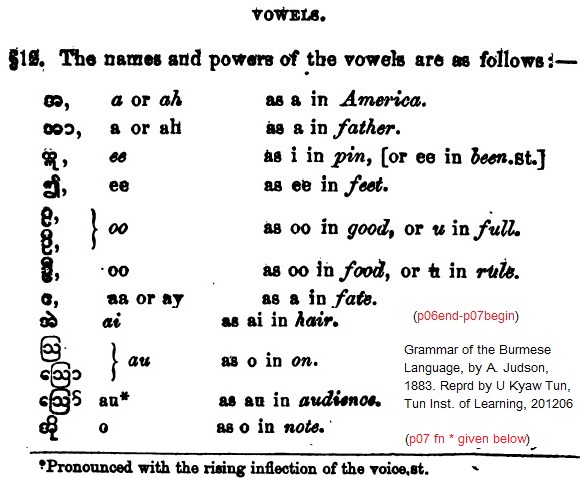
§012. The names and powers of the vowels are as follows:
UKT 201206 : "After the Third Anglo-Burmese War in 1885, Upper Burma was annexed, and the following year, the province of Burma in British India was created, becoming a major province (a lieutenant-governorship) in 1897. [3] " - Wikipedia; https://en.wikipedia.org/wiki/British_rule_in_Burma - 201206
Judson, writing in 1883 - just a couple of years before Burma became just a province of India, and Burmese being just a provincial language among the Indian languages, gave his "hearing" of the Burmese vowels as given on the right. Sixteen years later, in 1899, Lonsdale gave his as below.
Judson's footnotes are in symbols which I've to change to numbers,
e.g., * - Jfn01
(p07)
§013. The names and powers of the consonants are as follows:
UKT 201216: The PDF copy BkCnd<OL> from which I'm writing contains handwritten notes, presumably of Dr. Walter Koels, written on empty spaces of Judson's pages. Dr. Koels was the one who donated the book to Univ. of Michigan Library. These are extremely important for our understanding of the views of the early English grammarians on Bur-Myan grammar. Caveat: I'm not saying Dr. Koels was a contemporary of Rev. Judson. In fact, I could not find anything on Dr. Koels on the Internet.
See what A. Lonsdale has to say 16 years later in
- BG1899-indx.htm > BG1899-1-indx.htm > ch03.htm (link chk 201206)
I've given the numbers of row and column of the cell in the Akshara-matrix occupied by the aks, for ease of identification. It is unfortunate that many authors do not know the phonetic property of the Akshara matrix.
Velars :
{kûN~ða.za}
r1c1:
 {ka.kri:}
r1c2:
 {hka.hkwé}
r1c3:
 {ga.gnèý}
r1c4:
 {Ga.kri:}
r1c5:
{gna.}/
{ng}
UKT 201206: Dr. Koels noted the difference in spelling of onset (initial part of the syllable) as {gna} , and coda (final part of the syllable) as {nga}. His observation lends support to my calling r1c5, as Semi-nasal . He, as well as Judson, seemed to know that the middle part of the syllable is a vowel, which we call nuclear vowel
Palatals :
{ta-lu.za}
r2c1:
 {sa.loän:}
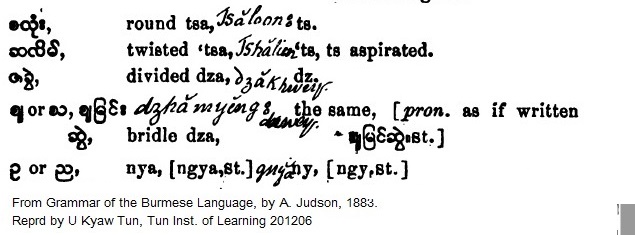
r2c2:
 {hsa.laim}
r2c3:
 {za.hkwè:}
r2c4:
- {Za.myæÑ:hswè:}
r2c5:
{ña.} or
{Ña.}/
{Ñ}
UKT 201206: Judson gives both Nya-minor
Retroflex :
{moad~Da.za}

r3c1:
-
 {Ta.þän-lyín:hkyait}
r3c2:
- {HTa.wûm:Bè:}
r3c3:
- {ða.rín-kauk}
r3c4:
- {Ða.ré-mhoat}
r3c5:
 {Na-major}
{Na.} /
{N}
{Na-major}
{Na.} /
{N}
Dental :
(dûn~ta.za}

r4c1:
 {ta.wûm:pu}
r4c2:
{hta.hsín-htu:}
r4c3:
 {da.htwé:}
r4c4:
 {Da.auk-hkreik}
r4c5:
 {na.gnèý}
{na.}
/
{n}
{na.gnèý}
{na.}
/
{n}
(p07end-p08begin)
Palatal :
{AUT~HTa.za

r5c1:
 {pa.sauk}
r5c2:
 {hpa.U:htoap}
r5c3:
 {ba.htak-hkreik}
r5c4:
 {Ba.koan:}
r5c5:
{ma.} /
{m}
Approximant :

r6c1:
 {ya.pak-lak}
r6c2:
 {ra.kauk}
r6c3:
{la.}
r6c4:
{wa.}
r6c5:
{þa.}
r7c2:
{ha.}
r7c3:
{La.}
r7c4: [Judson leaves this cell empty. However, we have
{a.} as a consonant in this cell. See §14 for Judson's comment on this place.]
§014. The character (
 ) called
  {þé:þé:tín}, small thing placed above, is placed over the akshara
letter with which it is combined, and has the power of a coda
{þé:þé:tín}, small thing placed above, is placed over the akshara
letter with which it is combined, and has the power of a coda final
[in Bur-Myan & Pal-Myan syllables], or coda final
[in Skt-Dev & International Pali syllable], divested of its inherent heavy
accent (see Accents); thus
{än} an ,
 {þän} than .
UKT 201207: Medials are found only in Bur-Myan. In Mon-Myan, there are medials, but also what are known as Hanging-consonants which can only be pronounced after including a schwa. Medials are pronounceable like the regular consonants. What are found in Skt-Dev are conjuncts which are not pronounceable.
§015. [Medials aka ] Compound Consonants are formed by
combining one or more of the medial-formers letters [which we
have already met above in Approximants]
{ya.},
{ra.},
{wa.},
and
{ha.}, under symbolic forms with simple consonants, according to the following
table, in which
{ma.} is selected as the principle [which we usually call Dummy character],
because that is the only aks letter which admits all the
adjuncts: -
§016.

UKT 201207: Table on the right is from Judson. I've given below the medials formed from basic consonant
{mya.},
{mya},
{mya:}. The order of entries below do not follow the traditional order.
with 0-medial former:
{ma.}
with 1-medial former:
 {mha.} ,
 {mra.} ,
{mya.} ,
{mra.} ,
{mya.} ,
 {mwa.},
with 2-medial former:
 {mhya.} ,
 {mwra.] ,
 {mwya.},
---------------------------
 {mhra.} ,
 {mwra.} ,
with 3-medial former:
 {mhwra.}
(p08end-p09begin)
§017. The letter
{ha.}, in the quality of an "aspirate", may be combined with:
- the nasals, as
 {gnha},
 {Ñha.},
 {Nha.},
 {nha.},
{mha.},
{nha.},
{mha.},
- the liquids
{la.} and
{wa.},
as
 {hla.},
 {wha.}.
But when combined with
{ya.}, or
{ra.}, the compound has the power of sh ,
as ... shan . [UKT ¶].
UKT 201208: The last sentence is the one I cannot accept. With
{yhûn}, but with
{rhûn} with the onset /r/ - never /s/. It means that I must invent a new aks for /sh/ from a non-existent phoneme. For the non-existent phoneme I choose Skt-Dev Dental ष ṣ [ʂ] /s/ :
{Sa.}/
{S} (which is not the same as Palatal
{c}). Because the Dental
. Now, Romabama has
{Sha.}/
{Sh} - the same as Skt-Dev Dental श ś [ɕ] /ʃ/ .
 {lhya.} 'lya also is frequently pronounced sha , and
 {þhya.} has the same power.
 {gnra.} is equivalent to
{Ña.} nya , and
{gnra.} is equivalent to
{Ña.} nya , and
 {yya.} to
{ya.}, ya.
{yya.} to
{ya.}, ya.

§018. The vowel
{a.} is supposed to be inherent in every consonant that is not furnished with
the symbol of another vowel, or marked as coda final [with a
Flag
 {tän-hkûn}
 .].
.].
§019. The other vowels are combined with consonants, simple or compound, under symbolic forms, according to the following table: -
§020. [Table given on the right. "Junction" with dummy
{ka.} given below. Vowel-lengths given in eye-blnks.]
-
{ka.} (1blnk),
 {ka} (2blnk);
 {ki.} (1blnk),
 {ki} (2blnk);
 {ku.} (1blnk),
 {ku} (2blnk};
-  {ké} (2blnk},
 {kè:} (emphatic 2blnk);
 {kau.} (1blnk},
 {kau} (2blnk);
 {ko}
{ko}
§021. The second symbol of the vowel
{a} (
 ) [Mauk'cha
 {mauk-hkya.}] is used whenever the use of the first [Weik'cha
 {weik-hkya.}
(
{weik-hkya.}
(
 )] would make the consonant look like
 convert the consonant into
another aks letter , -- also with
{hka.} and
{gna.}, as
 , not
, not
 . The latter part of the symbols of
{AU:} and
{AU}, is similarly modified in the same circumstances, as
. The latter part of the symbols of
{AU:} and
{AU}, is similarly modified in the same circumstances, as
 {hkau} , not
 .
.
§022. The symbol of any vowel may be combined with the vowel
{a.}, in which case the compound has the power of the vowel which the symbol
represents; thus
-  {i.} is equivalent to
{I.}
{i.} is equivalent to
{I.}
-  {u.} to
{U.}, &c.
{u.} to
{U.}, &c.
(p09end-p10begin)
§023. When a consonant is
deprived of its its inherent vowel
{mwé-hkûn þa.ra.}
{a.}, and not furnished with the symbol of another,
it becomes final [coda] in the syllable. [UKT ¶]
UKT 201214: Don't forget the canonical structure CVÇ of the syllable where Ç the coda is different from C the onset. In the Alphabet-Letter system with the canonical structure CVC, there is no difference between coda and onset. In both systems, the nuclear vowel
" Rhyme is much broader, in that many words can have the same sounds and not necessarily be part of the same word family or spelt using the same letters. So, in a nutshell. Rhyme relates to phonemic awareness (what we HEAR) and rime relates to phonics (the letters that are used to make the sound)". -- Google Search, May 19, 2019
The absence of the inherent vowel
{a.} is denoted by a [Flag
{tän-hkûn}] mark ()
called [ {a.þût} - Virama in Sanskrit] that , [th as in thin , st.] signifying killed
, placed above the consonant thus,
{a.þût} - Virama in Sanskrit] that , [th as in thin , st.] signifying killed
, placed above the consonant thus,
 {k}, or by another consonant subjoined, thus
 {k~hka.} [=
 ]; in which case the subjoined consonant becomes the onset
 initial
of the next syllable, thus
 {kût~hta.} [first syllable shown in red made up of
 {kût}, and second syllable made up of only one aks
{hta.}] .
{kût}, and second syllable made up of only one aks
{hta.}] .
UKT 201209: Virama or Viram for short,
{þ~þa.} - which we will meet presently.
§024. One consonant however is sometimes placed under another
as a mere abbreviation, and does not therefore deprive the preceding consonant
of its inherent vowel
{mwé-hkûn þa.ra.}; thus
 [illegitimate abbreviation] to
 {þa.ma:}, and is to be read, not thma , but tha-ma .
§025. [Cell r2c5] has two forms [Nya-minor]
{ña.} (single), and [Nya-major]
{Ña.} (double). In elementary works, therefore, the double form may
be well distinguished by subjoining a double tail, thus

§026. [Retroflex]
{Ta.} with
{HTa.} subjoined is sometimes [erroneously] written as
. But frequently and more properly as
 {T~Hta.}. [It is a horizontal conjunct
 and is mute.] A double
{þa.} [is called Tha-major, and ] is written as
{þ~þa.}. [It is also a horizontal conjunct
and is mute.] A double
{þa.} [is called Tha-major, and ] is written as
{þ~þa.}. [It is also a horizontal conjunct
 and is mute.]
§027. Final consonants [Coda of syllable] generally assume a
new and peculiar power, and also modify the preceding vowel [the nuclear vowel
 {nyu-ka.li.ya þa.ra.}
of the syllable]. These permutations, as they occur in words of pure Burmese
origin, are exhibited in the following table [which I've modified]:
{nyu-ka.li.ya þa.ra.}
of the syllable]. These permutations, as they occur in words of pure Burmese
origin, are exhibited in the following table [which I've modified]:
(p10end-p11begin)
§028. 
UKT 201215: Judson's table of Coda is given on the right. Column headings are in Vowel-Letters and Vowel-signs. The vow-duration for
: from which we get
{ít} and
{hkít}.
-------
{a.}
c1 / c5
-----------
{I.}
/
{U.}
---------
{AU:}
/
{o}
----------
 -------------------------
  -----
-----
 ----------------
 ------

r1: --
 {ak}/
-----------------------------------------------
{ak}/
-----------------------------------------------
 {auk} /
 {eik}
{eik}
-----------------
 {ín} ---------------------------------------
 {aún} /
 {eín}
{eín}
r2: --
 {ic}/
{ic}/
 {æÑ}
{æÑ}
r4: --
 {ût}/
{ût}/
 {ûn} --------
 {ait} /
 {oat}
{oat}
r5: --
 {ûp}/
{ûp}/
 {ûm}
-------
{ûm}
-------
 {aip} /
 {oap}
{oap}
§029. The coda final syllables , as here
exhibited, are combined with any consonant simple or compound, as
 {kak} ket
,
{kak} ket
,  {kyín} kyeen , &c.
without any change in their pronunciation, except in two cases, viz:
{wa.}
{kyín} kyeen , &c.
without any change in their pronunciation, except in two cases, viz:
{wa.}
- before
 {t} or
 {p}
wŏt * (Jp11-fn01) not wat
, and
{p}
wŏt * (Jp11-fn01) not wat
, and
- before
{n},
{m}, or
{än}, wŏn or woon not wan ;
and consonants compounded with
{wa.}
, as
 {kwa.} ,
 {swa.} , &c.
- before
{t} or
{p}, are commonly pronounced kooat † (Jp11-fn02)
, and
- before
{n},
{m}, or
{än} , kooan † , tsooan † , &c. (These coda
final consonants are not pronounced as distinctly as in
English.st.)
UKT 201209: The last line within ( ... ) is due to Judson's failure to realize that English syllable structure CVC (Consonant-Vowel-Consonant), and that of Bur-Myan, CVÇ where Ç is a killed-consonant, are different. In English which use the Alphabet-Letter system, the coda is distinctly pronounced, whereas the coda is a killed-consonant, the coda is not pronounced. However in BEPS which use Romabama the coda may or may not be pronounced.
§030. There are also many words of Pali origin, in which consonants, final in a syllable [ i.e. coda], are subject to permutations somewhat similar to the above, and others of a peculiar character. A key to the whole is furnished in the following table:

§031. [Judson's table on p11 is given on the right]
§032. In the preceding table, coda final consonants are marked [with a
Flag
{tän-hkûn}]
, for the sake of simplifying the tabular view; but though there are some
instances of that kind, as
-
 {U.poaþ}, oo-pōk ,
-
 {ma.htér}, ma-'tee ,
in almost all cases derived from the Pali, coda final consonants are made so
by having other consonants subjoined, as
-
 {AIn~dRé}, eing-dray, or by modification (see §23),
ein-dray,
{AIn~dRé}, eing-dray, or by modification (see §23),
ein-dray,
-
 {OAc~sa}, ōk-tsa , or by modification ōt-tsa,
-
 {mét~ta}, meet-ta ‡ (Jp11-fn03)
-
 {AUt~tûp~pa.} oot-tap-pa .
(p11end-p12begin)
§033. As an appendix to both the proceeding tables, note: -
1st. Retroflex cerebrals, when final (coda)
[ {T},
{T},
 {HT},
{HT},
 {ð},
{ð},
 {Ð},
{N}],
{Ð},
{N}],
are the same as dentals
[ {t},
 {ht},
{ht},
 {d},
{d},
 {D},
{n}] ;
{D},
{n}] ;
thus,
 {ûT~HTa.ma.} is pronounced at-ta-ma, as if written
 {ût~hta.ma.} .
2nd. The third [killed] akshara letter [c3] of each row
class is the same as the first [c1]; thus
 {praþ~þûd}, pronounced pyat-that , as if written
 {praþ~þût}
3rd. The second [c2] and fourth [c4] akshara letters of
each row class never occur as coda finals,
except in some words derived from the Pali, - when they are mute; as
 {moG:}, from
 {mé-Ga.}, the sky, pronounced mo .
4th. [Approximant Coda]
 {y},
{y},
 {r},
{r},  {w},
{w},
 {h}, and
 {L}, after
{o}, are mute, e.g.
{L}, after
{o}, are mute, e.g.
 {koý} ko ,
 {mrín:mor} Myeen-mo ,
 {bol} bo ,
 {htoO} 'to ,
 {groh} gyo ,
 {þi-hoL} Thee-ho .
UKT 201210: The name of one ethnic group
{pa.oO.} (bookmark: pa1oOO1) is still unsettled in Romabama.
5th. [The nuclear vowel]
 {aa} before a coda
 final consonant
gives the syllable the same power as
{a.},
thus
 {aar}
is pronounced, an , as if written
{aar}
is pronounced, an , as if written
 {ar}, e.g.
 {maar-nût} man-nat.
UKT 201210: "
§034. The sound of a
final consonant is frequently modified by
the initial consonant of the following syllable
or word, as
-
 {ak~hka.ra} ek-ka-ra , [ek-kha-ra, st.]
not et-ka-ra ,
{ak~hka.ra} ek-ka-ra , [ek-kha-ra, st.]
not et-ka-ra ,
-
 {þín~Bau} them-bau, not then-bau .
But these permutations, being dictates of nature,
will be naturally acquired without rule.
UKT 201210: Rev. Judson did not differentiate syllable

{sa·ka:þän-su.} from word
{waad}, because of which I've to come up with definitions for BEPS.
The first word
{ra}. The syllable
The second word
{þín},
{Bau} . Note that the Burmese speakers always pronounced them with heavy ending sounds. We must also note that r1c5 akshara
§035. There is another permutation of perpetual occurrence which may be thus stated: [UKT ¶]
- when two syllables are in juxtaposition, so as to form one word, the first
syllable ending in a vowel (except
{a.}) [expressed.st.] or a nasal,
- and the onset initial letter of the second syllable being [c1
or c2] the first or second letter of either of the five classes of
consonants, it frequently takes the sound of the [c3] third
aks letter of the same row class;
UKT 201210: paraphrasing the above - which I presume is a rule formed by Judson or Judson's rule of Conjuncts :
In a disyllabic word the coda of the first syllable and the onset of the second form a conjunct, either vertical or horizontal, e.g.
-{nak~hkût} formed from
{nak} and
{hkût}
-{koaT~HTa.} (from
{koaT~Hta.nu-na} 'leprosy'}, the first syllable is
{koaT} and the second
that is,
-
{ka.} and
{hka.} are pronounced as
{ga.};
-
{sa.}
and
{hsa.}, as
{za.}
-
{Ta.} and
{HTa.}, as
{ða.} [Judson contradicts himself by writing
{Ða.}]
-
{ta.} and
{hta.}, as
{da.}
-
{pa.} and
{hpa.}, as
{ba.}
thus
{sa.ka:} "a word", is pronounced, not tsa-kah , but tsa-gah , as
if written
 {sa.ga:} ,
and
 {ín tûn} "considerably", is pronounced, not en-tan , but en-dasn , as if
written
{ín tûn} "considerably", is pronounced, not en-tan , but en-dasn , as if
written
 {ín-dan} ,
§036. But there are so many exceptions to this general rule,
that regard to the coalescence of sounds as exhibited in common practice is
recommended as the only true guide.
(p12end-p13begin)
§037. There are two
accents, the short, light accent called
Dot-below  {auk-mric}
 , and the short, heavy accent Double-dot
or Visarga
, and the short, heavy accent Double-dot
or Visarga

 {wic~sa.pauk}

UKT 201215: Burmese, Mon, Pali, and Sanskrit use of certain terms such as Visarga
§038. The
short, light accent Dot-below
, called
 {a·mric}, the
 {a·sak} stop, (formerly a small subscriptive
,)
or
{auk-mric} the under stop, is placed under
the word
{waad}
{a·sak} stop, (formerly a small subscriptive
,)
or
{auk-mric} the under stop, is placed under
the word
{waad} letter, thus
 {kûn.}. [UKT ¶]
It is used with the vowels
{É},
 {è:},
{AÚ},
{o} [all 4
{è:},
{AÚ},
{o} [all 4

 {a.wag}], and the nasal
coda
{a.wag}], and the nasal
coda consonants [
{ng},
{Ñ},
{N},
{n},
{m}] .
UKT 201213: Whenever, a foreigner uses the word vowel, make sure what he means: vowel letters, or vowel signs. Here Judson means vowel-signs even though his examples are vowel letters, the following are with vowel signs. They are pronounced with the shortest vowel duration. e.g.
{é.},
{è.},
{aú.},
{o.}
{ké.},
{kè.},
{ko.}
§039.
The short heavy accent
Double-dot
, called
[Visarga {wic~sa.pauk}]  {wic~sa.nhic-loän:pauk}, the two round woot-tsahs, or
 [BEPS ver.
 {shé.pauk}], the dots before (after), is placed after the
latter, thus
{shé.pauk}], the dots before (after), is placed after the
latter, thus
 {kûn:}. [UKT ¶]
It is used with the vowels
{aa},
{É},
{è:},
{AÚ},
{o} [5 vowels], and the nasal coda consonants. This accent is considered as
inherent in the vowel
{è:} (unless superseded by the light accent), and in the coda final consonant
{m}, when combined with the vowel
. In the latter case it is frequently omitted as superfluous; and in the
former case, almost uniformly, in modern usage.

UKT 201213: Most of the abbreviations contradict Akshara rules. Though they are useful when only one language - Bur-Myan - is involved, by play havoc in BEPS, 4 speeches in 3 scripts belonging to 3 language groups - the Tib-Bur, IE, and Aus-Asi. Most of them are illegal in BEPS
§040. [Judson's table is given on the right.]
§041.
{ya.} is sometimes represented by its symbol [Ya'pín sign
 ], after
{k}, as
], after
{k}, as
 {yauk~kya:} for

 ,
,
 for
for
 , &c.
, &c.
§042.
{ng} or
 {ng:} is frequently removed from its natural situation in the line, and
placed over the following aks
{ng:} is frequently removed from its natural situation in the line, and
placed over the following aks letter,
as
 {þïn~kûn:} for
  {þín-kûn:}.
(In this position it is called
{þín-kûn:}.
(In this position it is called
 {kín:si:}.St. [ lit. ridden by a centipede]). In the case of
{ng:}, the accent is omitted, without affecting the pronunciation; as
{þïn~Bau:} for
{kín:si:}.St. [ lit. ridden by a centipede]). In the case of
{ng:}, the accent is omitted, without affecting the pronunciation; as
{þïn~Bau:} for
 {þín:Bau:}.
(p13end-p14begin)
§043.
-----
 ----------
 --------
 ----------
 --------
 ------------
 --------------
 -------------
 ---------

-
 {tic},
 {nhic},
 {þoän:},
 {lé:},
 {gna:},
 {hkrauk},
 {hku.nic},
 {Shic},
 {ko:}
{ko:}
---- 1 -------- 2
--------- 3 ------------ 4
------- 5 ------------ 6
-------------- 7 ------------- 8
--------- 9
UKT 201213: I've included
{þoän-Ña.}
ten:{tic-hsèý}
hundred:
thousand:{tic-htaún ;
§044. The mark [called Danda । in Skt-Dev, and
 {poad-hprût}]
 called
 {peik}*
or
{a·peik}, a stop , [UKT ¶]
{peik}*
or
{a·peik}, a stop , [UKT ¶]
*UKT 201216: There are two words which can be mistaken - one for the other -
{poad} and
{peid}
is used to separate sentences, and the clauses or a sentence. The double mark
[
 {poad-ma.}]

 {peik-kri:} a great stop , is used to divide paragraphs.
§045. The mark
{peik-ka.lé} a little stop , begins to be used in printed books, as an
equivalent to the English comma, (a great desideratum in Burmese writing)
leaving the
to supply the place of semicolon and period.
(p14-to continue)
in
JudsonGram2.htm
for Parts os Speech.
Jp06-fn01 - The Sanscrit authorities, it is true,
give the second akshara of the class, r3c2, as the adjunct to the [Semi]-nasal
{Na.}; but the Pali authorities give the third, r3c3, which is here adopted. -
go back Jp06-fn01b
Jp11-fn01 - O , as oo in foot.st. -
go back Jp11-fn01b
Jp11-fn02 - Ooa , as oo in foot ,
or soon.st. - go back Jp11-fn02b
Jp11-fn03 - Pron , myit-ta.st - go back
Jp11-fn03b
End of TIL file


